

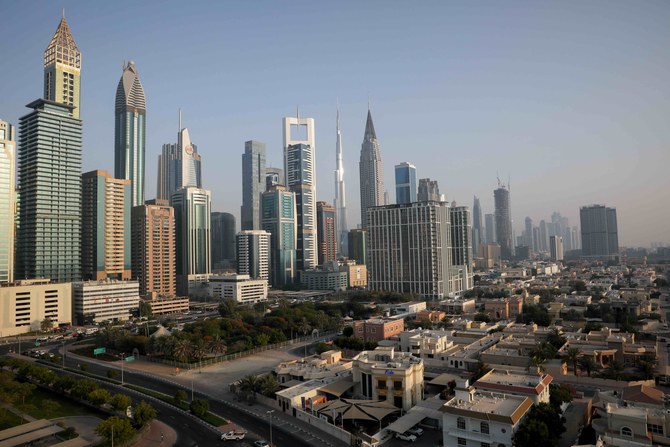
UAE’s economy set to grow by 5.2% in 2025: central bank 

The quarterly economic review for the fourth quarter of 2023 by CBUAE provides a breakdown of the expected shift, forecasting a 4.7 percent rise in non-oil GDP for both 2024 and 2025.  
Short Url
Updated 01 April 2024
Follow

UAE’s economy set to grow by 5.2% in 2025: central bank 

RIYADH: The UAE’s economy received a positive outlook, with the nation’s central bank predicting a substantial 5.2 percent growth in the gross domestic product by 2025.  

According to the Central Bank of the UAE, the country’s GDP is expected to rise by 4.2 percent in 2024 before accelerating to 5.2 percent the following year. 

This growth projection is a follow-up to the bank’s estimate of a 3.1 percent expansion in 2023. 

The quarterly economic review for the fourth quarter of 2023 by CBUAE provides a breakdown of the expected shift, forecasting a 4.7 percent rise in non-oil GDP for both 2024 and 2025.  

Similarly, oil GDP growth is projected at 2.9 percent for 2024, with a significant jump to 6.2 percent predicted for 2025. 

Financially, the UAE showed a robust fiscal balance in the first nine months of 2023, posting a surplus of 61 billion dirhams ($16.6 billion), equivalent to 4.4 percent of GDP.  

This financial health is supported by total revenues of approximately 370 billion dirhams against expenditures of around 309 billion dirhams. 

The report further highlighted that the introduction of a federal corporate tax is expected to bolster government finances further, enhancing revenue diversification beyond the oil sector.  

Moreover, the CBUAE study indicates sustained strength in the non-oil private sector, evidenced by a Purchasing Managers’ Index of 56.6 in January, reflecting continued business confidence and economic dynamism driven by steady demand and sales.  

These factors are expected to underpin ongoing production expansion and investment in new projects, reinforcing the UAE’s economic resilience and diversification efforts. 

The apex bank’s predictions for the UAE’s economic growth do not align with the more conservative figures projected by the World Bank.  

The World Bank’s Global Economic Prospects report set the UAE’s real GDP growth at 3.4 percent for 2023, with a gradual rise to 3.7 percent in 2024 and 3.8 percent in 2025.  

In a more extensive regional outlook, specific projections for other Gulf countries include a 4.1 percent growth for Saudi Arabia in 2024 and similar modest growth forecasts for Kuwait, Bahrain and Qatar as well as Oman. 


Saudi retail spending holds steady near $4bn during early Ramadan, while postal services rise

Updated 8 sec ago
Follow

Saudi retail spending holds steady near $4bn during early Ramadan, while postal services rise

RIYADH: Saudi Arabia’s point-of-sale spending remained close to $4 billion in the week ending Feb. 21, even as overall transaction volumes declined during the early days of Ramadan, central bank data showed. 

According to the latest data from the Saudi Central Bank, also known as SAMA, total POS transactions settled at SR13.9 billion ($3.71 billion), representing a 9.3 percent week-on-week decline, while the number of transactions fell 12.5 percent to 220.57 million. 

Spending on freight transport, postal and courier services rose 24.4 percent week on week to SR80.68 million, marking one of the strongest sectoral gains as demand for deliveries increased during the holy month. 

In an interview with Arab News, Saudi economist Talat Hafiz attributed the broader slowdown in spending to seasonal consumption patterns linked to Ramadan. 

“During the first week of Ramadan, consumer behavior typically shifts, as individuals focus more on purchasing goods related to the holy month while reducing discretionary spending,” he said. 

SAMA’s report showed that spending on food and beverages increased by 2.1 percent to SR2.62 billion, accounting for the largest share of total POS transactions.

Meanwhile, spending at restaurants and cafes fell by 28.3 percent to SR1.24 billion. 

Hafiz said this purchasing pattern is expected to continue as Eid Al-Fitr approaches. 

“Spending behavior is likely to shift again, with increased expenditure on travel-related services, apparel, clothing, and accessories in preparation for Eid. During the Eid holiday itself, we can expect a noticeable rebound in spending on recreation, entertainment, restaurants, and cafes,” he added. 

Expenditure on public utilities saw an increase of 2.3 percent to SR63.06 million, while spending on apparel and clothing outlays followed with a 4.8 percent decrease to reach SR1.32 billion. 

Spending at pharmacies and medical supply outlets decreased by 7.9 percent to SR206.1 million, while spending on medical services fell by 10.6 percent to SR482.53 million. Expenditure on personal care declined by 23.6 percent to SR93.34 million. 

The Kingdom’s key urban centers mirrored the negative changes. Riyadh, which accounted for the largest share of total POS spending, saw a 10.8 percent drop to SR4.75 billion. The number of transactions in the capital reached 69.8 million, down 13.3 percent week on week. 

In Jeddah, transaction values decreased 11.1 percent to SR1.88 billion, while Dammam reported a 9.1 percent fall to SR678.29 million. 

POS data, tracked weekly by SAMA, provides an indicator of consumer spending trends and the ongoing growth of digital payments in Saudi Arabia. 

The data also highlights the expanding reach of POS infrastructure, extending beyond major retail hubs to smaller cities and service sectors, supporting broader digital inclusion initiatives.