

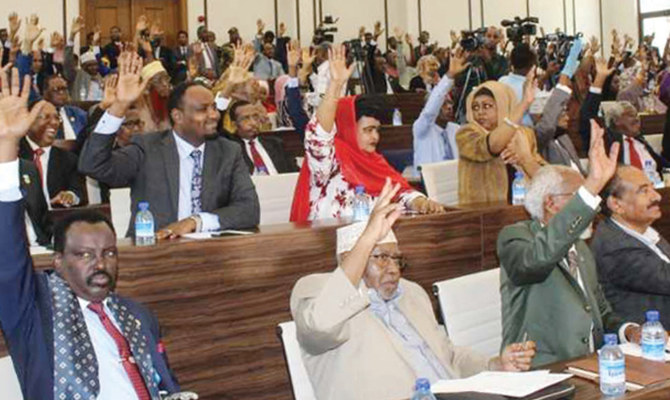

MOGADISHU: Somalia’s parliament has unanimously approved proposals to overhaul the country’s electoral system to reintroduce universal suffrage, a plan that has been criticized by some leading politicians.
Last March, President Hassan Sheikh Mohamud pledged to end the complex clan-based indirect voting system in place for more than half a century in the troubled Horn of Africa nation.
The central government and four federal states later announced an agreement that a one-person, one-vote system would be introduced in local elections set for June 2024, but the proposals still had to be approved by parliament.
On Saturday, lawmakers approved four of the 15 constitutional chapters that are due to be amended as part of the overhaul.
“The legislators from both houses unanimously endorsed the amended chapters of the constitution,” said Sheikh Adan Mohamed Nur, president of the lower chamber of parliament.
The remaining 11 chapters are to be voted on later, Mahad Wasuge, head of the Somali Public Agenda think tank, said.
“Once the 11 remaining chapters are amended by the parliament, the constitution will be voted for by the public,” he said.
When the central government announced the election overhaul plan last year, a former president and four former prime ministers were among the prominent politicians objecting because, among other reasons, not all of the country’s federal member states had participated in the talks.
Ahead of Saturday’s vote, former president Mohamed Abdullahi Farmaajo echoed the criticism.
“This Constitution, which is being implemented by an illegal process and that will not be accepted by society, will never be recognized as a legal Constitution,” he said in a statement on Friday.
It does not “represent the current political situation in the country and the pillars that were at the heart of Somali political reconciliation and power sharing,” he said.
Omar Mahmood, senior analyst for eastern Africa at the International Crisis Group, said the amendments were “likely to heighten political tensions” and “divide Somalia’s politics further as opposition groups rally” against them.
Meanwhile, the semi-autonomous Somali state of Puntland said on Sunday it would no longer recognize federal institutions after parliament backed the plan.
It was the latest move in a long-running and sometimes tense saga, with Puntland repeatedly issuing similar declarations in recent years to express its disagreement with the central government in Mogadishu.
Arid Puntland, in Somalia’s northeast, claimed autonomy in 1998, bolstered by natural resources including oil and its Bosaso port.
“The Puntland administration revoked its recognition and confidence in the federal government institutions until an outright constitutional process that is mutually accepted is obtained,” a Puntland statement said.
As a result, “Puntland will have its own comprehensive government authority until a federal government system is in place, with a mutually accepted Somali constitution that is subject to a public referendum.”
Authorities in the region opposed the adoption by parliament of the plan to reintroduce universal suffrage.
The Puntland authorities accused the president of violating the constitution and losing his legitimacy.



