

Jordan says Gaza ‘famine’ can be tackled quickly if Israel opens crossings

1 / 2
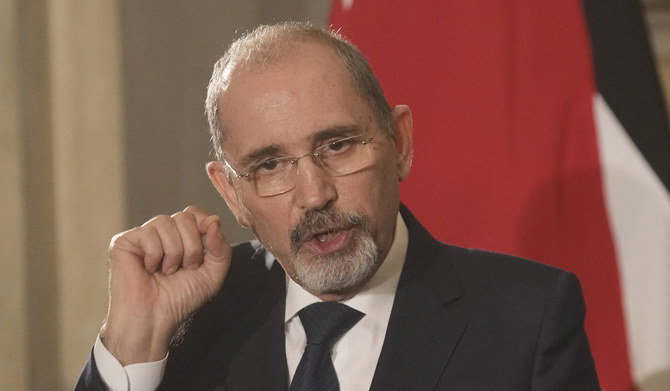
Jordanian Foreign Minister Ayman Safadi speaks during a joint press conference with his counterparts, Egyptian Foreign Minister Sameh Shoukry, and French Foreign Minister Stephane Sejourne, at Tahrir palace in Cairo, Egypt, Saturday, March 30, 2024. (AP)
2 / 2
Palestinians inspect the site of an Israeli strike, amid the ongoing conflict between Israel and the Palestinian group Hamas, in Rafah, in the southern Gaza Strip. (REUTERS file photo)
Short Url
Updated 31 March 2024
Follow

Jordan says Gaza ‘famine’ can be tackled quickly if Israel opens crossings

  • Israel has said that after the war, it will maintain open-ended security control over Gaza and partner with Palestinians who are not affiliated with the Palestinian Authority or Hamas
  • Israel has killed over 32,705 Palestinians in Gaza, two-thirds of them women and children, according to the Gaza Health Ministry

CAIRO: Jordanian Foreign Minister Ayman Safadi said on Saturday that “famine” in Gaza can be dealt with in a short time if Israel opened the land crossings for aid to enter.
Safadi made the comments at a press conference with his Egyptian and French counterparts in Cairo.
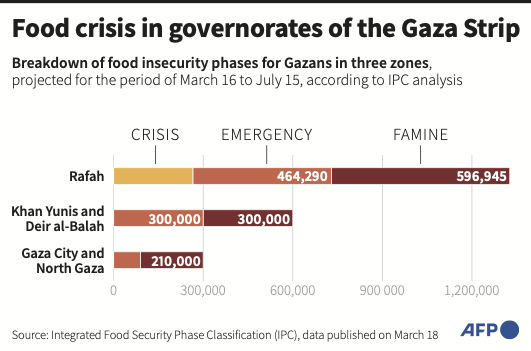
The UN and partners have warned that famine could occur in devastated, largely isolated northern Gaza as early as this month
A three-ship convoy left a port in Cyprus on Saturday with 400 tonnes of food and other supplies for Gaza as concerns about hunger in the territory soar.
World Central Kitchen said the vessels and a barge were carrying ready-to-eat items like rice, pasta, flour, legumes, canned vegetables, and proteins, enough to prepare more than 1 million meals. Also on board were dates, traditionally eaten to break the daily fast during the holy month of Ramadan.
It was not clear when the ships would reach Gaza.

BACKGROUND

An Open Arms ship inaugurated the direct sea route to the Palestinian territory earlier this month, carrying 200 tonnes of food, water, and other aid.

An Open Arms ship inaugurated the direct sea route to the Palestinian territory earlier this month, carrying 200 tonnes of food, water, and other aid.
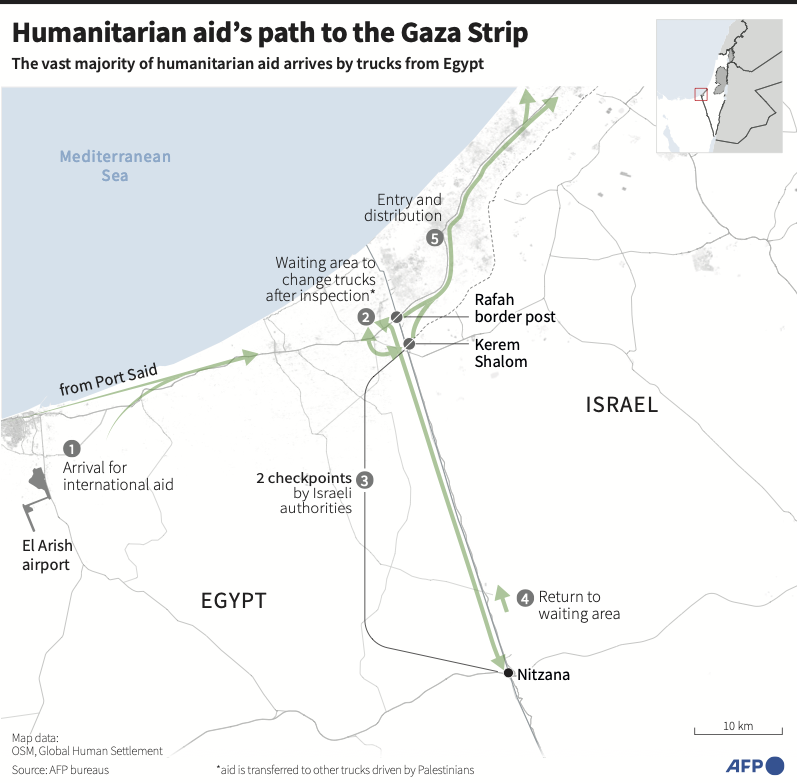
Humanitarian officials say deliveries by sea and air are not enough and that Israel must allow far more aid by road. The top UN court has ordered Israel to open more land crossings and take other measures to address the humanitarian crisis.
The US has welcomed the formation of a new Palestinian autonomous government, signaling that it would accept the revised Cabinet lineup as a step toward political reform.
The administration of President Joe Biden has called for “revitalizing” the West Bank-based Palestinian Authority in the hope that it can also administer the Gaza Strip once the Israel-Hamas war ends.
It is headed by Palestinian President Mahmoud Abbas, who tapped US-educated economist Mohammed Mustafa as prime minister earlier this month.
But both Israel and Hamas — which drove Abbas’ security forces from Gaza in a 2007 takeover — reject the idea of it administering Gaza, and Hamas rejects the formation of the new Palestinian government as illegitimate.
The authority also has little popular support or legitimacy among Palestinians because of its security cooperation with Israel in the West Bank.
The war began after Hamas-led militants stormed across southern Israel on Oct. 7, killing 1,200 people, mostly civilians, and taking about 250 others hostage.
More than 400 Palestinians have been killed by Israeli forces or settlers in the West Bank or east Jerusalem since Oct. 7, according to local health authorities.
Dr. Fawaz Hamad, director of Al-Razi Hospital in Jenin, told local station Awda TV that Israeli forces killed a 13-year-old boy in nearby Qabatiya early Saturday. Israel’s military said the incident was under review.
A major challenge for anyone administering Gaza will be reconstruction. Nearly six months of war has destroyed critical infrastructure, including hospitals, schools, and homes, as well as roads, sewage systems, and the electrical grid.
Airstrikes and Israel’s ground offensive have left 32,705 Palestinians dead, local health authorities said on Saturday, with 82 bodies taken to hospitals in the past 24 hours. Gaza’s Health Ministry doesn’t distinguish between civilians and combatants in its toll but has said the majority of those killed have been women and children.
Israel says over one-third of the dead are militants.
However, it has not provided evidence to support that, and it blames Hamas for civilian casualties because the group operates in residential areas.
The fighting has displaced over 80 percent of Gaza’s population and pushed hundreds of thousands to the brink of famine, the UN and international aid agencies say. Israel’s military said it continued to strike dozens of targets in Gaza, days after the UN Security Council issued its first demand for a ceasefire.
Aid also fell on Gaza. During an airdrop on Friday, the US military said it had released over 100,000 pounds of aid that day and almost a million pounds overall, part of a multi-country effort.
Israel has said that after the war, it will maintain open-ended security control over Gaza and partner with Palestinians who are not affiliated with the Palestinian Authority or Hamas. Who in Gaza would be willing to take on such a role is unclear.
Hamas has warned Palestinians in Gaza against cooperating with Israel to administer the territory, saying anyone who does will be treated as a collaborator, which is understood as a death threat.
Hamas calls instead for all Palestinian factions to form a power-sharing government ahead of national elections, which have not taken place in 18 years.


Dark times under Syria’s Assad hit Arab screens for Ramadan

Updated 8 sec ago
Follow

Dark times under Syria’s Assad hit Arab screens for Ramadan

Dark times under Syria’s Assad hit Arab screens for Ramadan

BEIRUT: A Syrian prison warden screams at a group of chained, crouching inmates in a harrowing scene from one of several Ramadan television series this year that tackle the era of former ruler Bashar Assad.
Talking about Syria’s prisons and the torture, enforced disappearances and executions that took place there was taboo during half a century of the Assad family’s iron-fisted rule, but the topics are now fertile ground for creative productions, though not without controversy.
An abandoned soap factory north of the Lebanese capital Beirut has been transformed into a replica of the basements and corridors of Syria’s Saydnaya prison, a facility synonymous with horror under Assad, for the series “Going Out to the Well.”
Crews were filming the last episodes this week as the Muslim holy month kicked off — primetime viewing in the Arab world, with channels and outlets furiously competing for eager audiences’ attention.
Director Mohammed Lutfi told AFP that “for Syrians, Saydnaya prison is a dark place, full of stories and tales.”
The series focuses on the 2008 prison riots in Saydnaya, “when inmates revolted against the soldiers and took control of the prison, and there were negotiations between them and Syrian intelligence services,” he said.
The military prison, one of Syria’s largest and which also held political prisoners, remains an open wound for thousands of families still looking for traces of their loved ones.

Tragedy into drama

The Association of Detainees and Missing Persons of Saydnaya Prison estimates that some 30,000 people were thrown into the facility after the 2011 uprising against Assad began, but only 6,000 came out after he was toppled.
Amnesty International has described the prison outside Damascus, which was notorious for torture and enforced disappearances, as a “human slaughterhouse.”
In the opening scene of the series, the main character is seen in a tense exchange with his family before jumping into a deep well.
The symbolic scene in part captures the struggles of the detainees’ relatives. Many spent years going from one Assad-era security facility to another in search of their missing family members.
Syrian writer Samer Radwan said on Facebook that he finished writing the series several months before Assad’s fall.
Director Lutfi had previously told AFP that challenges including actors’ fears of the Assad authorities’ reaction had prevented filming until after his ouster.
Since then, productions have jumped on the chance to finally tackle issues related to his family’s brutal rule.
Another series titled “Caesar, no time, no place” presents testimonies and experiences based on true stories from inside Syria’s prisons during the civil war, which erupted in 2011.
But in a statement this week, the Caesar Families Association strongly rejected “transforming our tragedy into dramatic material to be shown on screen.”
“Justice is sought in court, not in film studios,” said the association, whose name refers to thousands of images smuggled out of Syria more than a decade ago showing bodies of people tortured and starved to death in the country’s prisons.

Refugees
Another series, “Governorate 15,” sees two Saydnaya inmates, one Lebanese and one Syrian, leave the facility after Assad’s fall and return to their families.
Producer Marwan Haddad said that the series tackles the period of “the Syrian presence in Lebanon” through the Lebanese character.
The show also addresses the Syria refugee crisis through the story of the Syrian character’s family, who fled to the struggling neighboring country to escape the civil war.
“For years we said we didn’t want Lebanon to be (Syria’s) 15th province” and each person fought it in their own way, said Lebanese screenwriter Carine Rizkallah.
Under Assad’s father Hafez, Syria’s army entered Lebanon in 1976 during the country’s civil war and only left in 2005 after dominating all aspects of Lebanese life for almost three decades.
It was also accused of numerous political assassinations.
Lebanese director Samir Habchy said that the actors represent their “own community’s problems” in the “Lebanese-Syrian series.”
The show could prove controversial because it includes real people who “are still alive and will see themselves” in the episodes, he added.