Jordan says Gaza ‘famine’ can be tackled quickly if Israel opens crossings

1 / 2
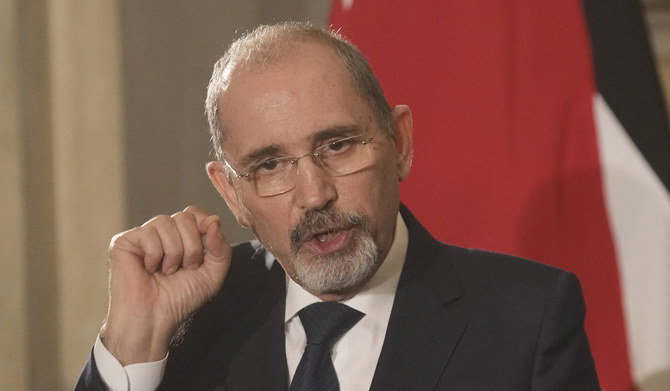
Jordanian Foreign Minister Ayman Safadi speaks during a joint press conference with his counterparts, Egyptian Foreign Minister Sameh Shoukry, and French Foreign Minister Stephane Sejourne, at Tahrir palace in Cairo, Egypt, Saturday, March 30, 2024. (AP)
2 / 2
Palestinians inspect the site of an Israeli strike, amid the ongoing conflict between Israel and the Palestinian group Hamas, in Rafah, in the southern Gaza Strip. (REUTERS file photo)
Short Url
Updated 31 March 2024
Follow

Jordan says Gaza ‘famine’ can be tackled quickly if Israel opens crossings

  • Israel has said that after the war, it will maintain open-ended security control over Gaza and partner with Palestinians who are not affiliated with the Palestinian Authority or Hamas
  • Israel has killed over 32,705 Palestinians in Gaza, two-thirds of them women and children, according to the Gaza Health Ministry

CAIRO: Jordanian Foreign Minister Ayman Safadi said on Saturday that “famine” in Gaza can be dealt with in a short time if Israel opened the land crossings for aid to enter.
Safadi made the comments at a press conference with his Egyptian and French counterparts in Cairo.
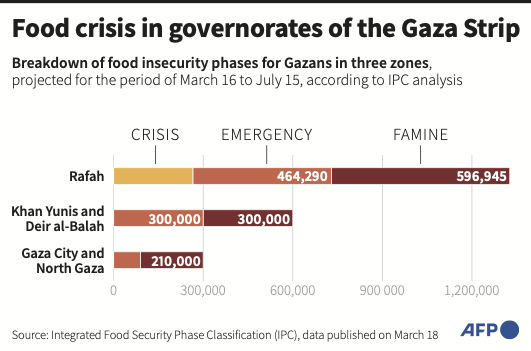
The UN and partners have warned that famine could occur in devastated, largely isolated northern Gaza as early as this month
A three-ship convoy left a port in Cyprus on Saturday with 400 tonnes of food and other supplies for Gaza as concerns about hunger in the territory soar.
World Central Kitchen said the vessels and a barge were carrying ready-to-eat items like rice, pasta, flour, legumes, canned vegetables, and proteins, enough to prepare more than 1 million meals. Also on board were dates, traditionally eaten to break the daily fast during the holy month of Ramadan.
It was not clear when the ships would reach Gaza.

BACKGROUND

An Open Arms ship inaugurated the direct sea route to the Palestinian territory earlier this month, carrying 200 tonnes of food, water, and other aid.

An Open Arms ship inaugurated the direct sea route to the Palestinian territory earlier this month, carrying 200 tonnes of food, water, and other aid.
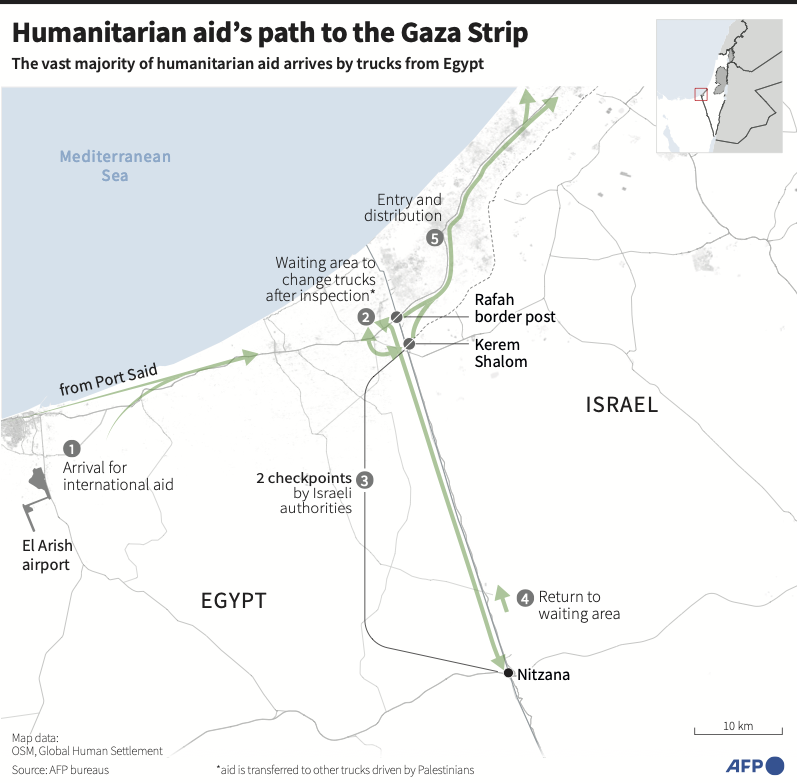
Humanitarian officials say deliveries by sea and air are not enough and that Israel must allow far more aid by road. The top UN court has ordered Israel to open more land crossings and take other measures to address the humanitarian crisis.
The US has welcomed the formation of a new Palestinian autonomous government, signaling that it would accept the revised Cabinet lineup as a step toward political reform.
The administration of President Joe Biden has called for “revitalizing” the West Bank-based Palestinian Authority in the hope that it can also administer the Gaza Strip once the Israel-Hamas war ends.
It is headed by Palestinian President Mahmoud Abbas, who tapped US-educated economist Mohammed Mustafa as prime minister earlier this month.
But both Israel and Hamas — which drove Abbas’ security forces from Gaza in a 2007 takeover — reject the idea of it administering Gaza, and Hamas rejects the formation of the new Palestinian government as illegitimate.
The authority also has little popular support or legitimacy among Palestinians because of its security cooperation with Israel in the West Bank.
The war began after Hamas-led militants stormed across southern Israel on Oct. 7, killing 1,200 people, mostly civilians, and taking about 250 others hostage.
More than 400 Palestinians have been killed by Israeli forces or settlers in the West Bank or east Jerusalem since Oct. 7, according to local health authorities.
Dr. Fawaz Hamad, director of Al-Razi Hospital in Jenin, told local station Awda TV that Israeli forces killed a 13-year-old boy in nearby Qabatiya early Saturday. Israel’s military said the incident was under review.
A major challenge for anyone administering Gaza will be reconstruction. Nearly six months of war has destroyed critical infrastructure, including hospitals, schools, and homes, as well as roads, sewage systems, and the electrical grid.
Airstrikes and Israel’s ground offensive have left 32,705 Palestinians dead, local health authorities said on Saturday, with 82 bodies taken to hospitals in the past 24 hours. Gaza’s Health Ministry doesn’t distinguish between civilians and combatants in its toll but has said the majority of those killed have been women and children.
Israel says over one-third of the dead are militants.
However, it has not provided evidence to support that, and it blames Hamas for civilian casualties because the group operates in residential areas.
The fighting has displaced over 80 percent of Gaza’s population and pushed hundreds of thousands to the brink of famine, the UN and international aid agencies say. Israel’s military said it continued to strike dozens of targets in Gaza, days after the UN Security Council issued its first demand for a ceasefire.
Aid also fell on Gaza. During an airdrop on Friday, the US military said it had released over 100,000 pounds of aid that day and almost a million pounds overall, part of a multi-country effort.
Israel has said that after the war, it will maintain open-ended security control over Gaza and partner with Palestinians who are not affiliated with the Palestinian Authority or Hamas. Who in Gaza would be willing to take on such a role is unclear.
Hamas has warned Palestinians in Gaza against cooperating with Israel to administer the territory, saying anyone who does will be treated as a collaborator, which is understood as a death threat.
Hamas calls instead for all Palestinian factions to form a power-sharing government ahead of national elections, which have not taken place in 18 years.


A language course is reviving Moroccan Jewish culture and bridging Middle East divide

Updated 7 sec ago
Follow

A language course is reviving Moroccan Jewish culture and bridging Middle East divide

  • “In my family there were (many) different languages — Moroccan Arabic, French, Hebrew at the synagogue, and my dad also speaks Amazigh, Berber,” said Elfassi.
  • His passions for music and language took Elfassi on a journey to Bordeaux, France, and Be’er Sheva, Israel, writing a dissertation on Jewish identity among Moroccan Jews

RABAT: Growing up in Fez, Morocco, Yona Elfassi was always aware of the history of the city, which has been a center of culture, learning and spirituality since the ninth century.
Home to great minds such as the 12th-century philosopher and jurist Ibn Rushd and his contemporary, the physician and codifier of Jewish law Maimonides, the city was shaped by Jewish, Arab, Amazigh, Spanish and French cultures.
These influences left a deep imprint on Elfassi, 37.
“In my family there were (many) different languages — Moroccan Arabic, French, Hebrew at the synagogue, and my dad also speaks Amazigh, Berber,” said Elfassi.
Music, too, was a constant presence — from Andalusian to Flamenco, to Moroccan classic, to Moroccan chaabi popular, to Berber music,” he said. “We weren’t a family of professional musicians, but we were a family that lived with music.”
As a Jewish resident of Morocco, Elfassi belongs to a tiny demographic, as 99 percent of Jews of Moroccan heritage today live elsewhere. After major emigrations in the 20th century, only around 2,500 Jews remain in a country where they once made up 5 percent of the population. Today an estimated 50,000 live in France, 25,000 in Canada and 25,000 in the United States; and some 1 million Moroccan Jews make up one of Israel’s largest ethnic groups.
His passions for music and language took Elfassi on a journey to Bordeaux, France, and Be’er Sheva, Israel, writing a dissertation on Jewish identity among Moroccan Jews. (He has two doctorates, one in sociology and political science from Sciences Po Bordeaux and one in anthropology and history from Ben-Gurion University of the Negev.)
His research into Morocco’s history eventually grew into a vocation to teach Darija, the Moroccan Arabic dialect, to allow diaspora Moroccan Jews to connect with their ancestors through language, culture and stories.
“As a sociologist, I was fueled by the conviction that academic research ought to forge connections and deepen understanding” beyond the academy, Elfassi said. “These stories and human histories are at the core of why I decided to teach, and my identity has inspired me to work with Jews of Moroccan background to reconcile with their ancestral language.”
As the COVID-19 pandemic ended, he launched Limud Darija, an educational movement and multimedia language platform. The hybrid courses mix Zoom classes with in-person gatherings, which take place in Israel. Elfassi also holds music workshops, drawing from Sephardic piyyutim— Jewish liturgical poems with Judeo-Arabic pronunciation and melodies — and the music of 20th-century Moroccan pop icons such as Hajja El Hamdaouia, Sliman Elmaghribi, Zohra El Fassiya and Abdelhadi Belkhayat.
Limud Darija’s impact has grown rapidly. “Today our community includes over 500 active members with the mission of connecting people across generations, helping participants reclaim lost voices and fostering resilience and a sense of belonging through cultural practices,” Elfassi said.
Through his Instagram feed and TikTok presence, many Moroccan Muslims have found Elfassi’s work and are inspired to see Moroccan Jews preserving the language of their shared home. Muslims, Elfassi said, in turn have expressed interest in learning Hebrew. “I opened an active WhatsApp group where we’re teaching Hebrew to Muslim speakers of Darija,” he said.
“Through this shared connection, divisions begin to fade,” Elfassi said. “The Israelis the Muslim Moroccans meet are seen as Moroccans like themselves, as family. They are talking a common language, talking about what unites them, people are begun to be seen as individuals.” The Muslims and Jews, he said, get the chance “to bond over music and heritage and language, not political or war-related topics, and they do not further the false ‘pro-Palestine’ vs ‘pro-Israel’ dichotomy, and instead humanize everyone as individuals, as human beings.”
Limud Darija students describe how the program has connected them more deeply with people in their own lives as well. “My parents talked between them in Moroccan language, but by the time I was an adult, I forgot,” said Yehudit Levy, a retired schoolteacher in Ganei Tikvah, Israel, who has studied with Elfassi for three years. “Since I started to learn with Yona, everything comes up — songs, music, food, poetry, all the traditional things come up. I smell Morocco when I am in the class.”
Noam Sibony, a Limud Darija alumnus, is a neuroscience researcher and musician living in Toronto. The 28-year-old spent nine months volunteering in Lod, an Israeli city whose population is Arab and Jewish, at a community center, working with local children and youth. Limud Darija, he said, showed him how learning the language of another culture can help build relationships that transcend regional politics and conflicts.
Habiba Boumlik, a professor of French, literature and women’s and gender studies at LaGuardia University in Queens, New York, and co-founder of the New York Forum of Amazigh Film, an annual film festival celebrating the Indigenous Berber people of North Africa, sees parallels between Elfassi’s work and her efforts to preserve the Tamazight language.
“I give credit to people who invest in learning language, and it is great with the new technology and variety of sources on the Internet. Even if people aren’t fluent, they can do so much with the language, and they will go to Morocco and connect more deeply,” Boumlik said.
Darija is closely related to the Judeo-Arabic dialect, Boumlik explained, and so has the potential to contribute to the Moroccan vernacular, just as Judeo-Arabic slang and idioms have shaped Modern Hebrew.
“The exchange among the Moroccans and Israelis will only enrich Darija as they also enrich their families and themselves,” Boumlik said. “And it is so important that they can connect with Moroccans on the Internet and have a dialogue. It is not just the culture and language of their grandparents — it is the living language and culture of the new generation.”
Bringing people together on this level, Elfassi said, is peacebuilding on a human scale, prioritizing personal stories, shared culture and mutual respect. “For me, peace will start with people, not with the decision-makers,” he said. “Peace is just two people talking to each other, having respect for each other and having a conversation where they can disagree, but where they always show respect for the humanity of the other.”