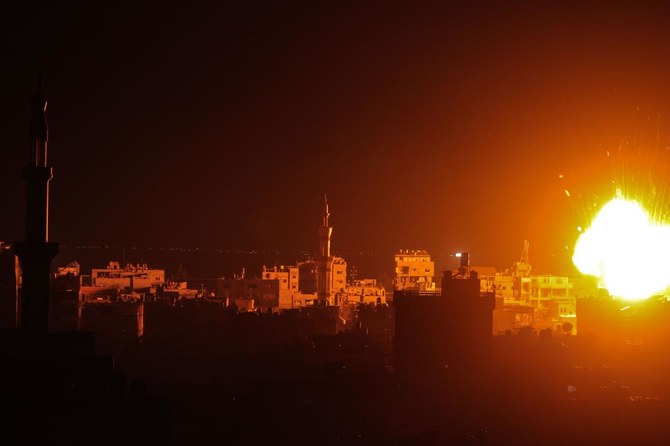
GAZA STRIP, Palestinian Territories: Heavy clashes and explosions shook Gaza, witnesses said on Saturday, as the Red Crescent reported several people killed during the latest chaotic aid distribution in the territory’s north, where famine looms.
Israel’s Prime Minister Benjamin Netanyahu approved a new round of talks on a Gaza truce between Israel and Hamas militants, after a binding UN Security Council resolution last Monday demanded an “immediate ceasefire.”
A subsequent ruling by the world’s top court ordered Israel to ensure aid reaches civilians, whose desperation was again laid bare Saturday.
The Palestine Red Crescent said five people were killed and dozens injured by gunfire and a stampede during an aid delivery in Gaza’s north.
Eyewitnesses told AFP that Gazans overseeing the aid delivery shot in the air, but Israeli troops in the area also opened fire and some moving trucks hit people trying to get the food.
The Israeli military told AFP it “has no record of the incident described.”
Fighting has not eased — including around the territory’s largest hospital — and the latest toll from the health ministry in the Hamas-run Gaza Strip said at least 82 more people were killed in the previous 24 hours.
The Hamas press office reported more than 50 Israeli air strikes over the past day, with “civilian houses” targeted across the coastal territory, as well as tank fire in the Gaza City area and southern Gaza.
Israel’s military on Saturday said it had struck dozens of targets, including militants and their compounds in central and northern Gaza.
The war began with Hamas’s October 7 attack that resulted in about 1,160 deaths in Israel, mostly civilians, according to an AFP tally of Israeli official figures.
Israel’s retaliatory campaign against Hamas has killed at least 32,705 people, mostly women and children, according to the health ministry.
Netanyahu’s office said new talks on a Gaza ceasefire and hostage release will take place in Doha and Cairo “in the coming days... with guidelines for moving forward in the negotiations.”
Talks had appeared deadlocked despite a push by the United States — which provides billions of dollars in military aid to Israel — and fellow mediators Egypt and Qatar to secure a truce for the Muslim fasting month of Ramadan, now more than halfway through.
In its ruling, the International Court of Justice (ICJ) in The Hague said it had accepted South Africa’s argument that the further deterioration of the humanitarian situation in Gaza required Israel to do more, with famine now “setting in.”
Saturday’s aid delivery chaos is the latest incident of its kind in north Gaza, where a UN-backed report has projected famine by May unless urgent intervention occurs.
The report released on March 19 warned that half of Gazans are feeling “catastrophic” hunger.
The Israeli defense ministry body responsible for Palestinian civil affairs, COGAT, said the assessment contained inaccuracies and questionable sources.
Israel’s allies, and the UN, have blamed Israel for limitations on the aid flow but COGAT accused United Nations agencies of being unable to handle the quantity of assistance arriving daily.
With limited ground access, several nations have begun aid airdrops, and a ship was expected to depart Saturday from Cyprus with the second cargo of food assistance.
ICJ rulings are binding but it has little means of enforcement.
On Saturday Israel’s military said it was continuing operations around Gaza’s largest hospital Al-Shifa for a 13th day.
Most of the Palestinian territory’s hospitals are not functioning and its health system is “barely surviving,” the United Nations humanitarian agency, OCHA, said.
Israel’s military accuses Hamas and the Islamic Jihad militant group of hiding inside medical facilities, using patients, staff and displaced people for cover — charges the militants have denied.
Troops first raided Al-Shifa in November, but the army says Palestinian fighters have since returned. The army said it “continued to eliminate” militants and locate weapons in the area, adding to a toll of around 200 it earlier reported killed in the Al-Shifa operation.
On Saturday Hamas said that in addition to the ongoing Al-Shifa operation, Israeli troops continued “aggression” against Nasser Hospital and “besiege” Al-Amal Hospital in the same city.
The army said troops continue to operate in the Al-Amal area of Khan Yunis.
Gaza’s Christian minority are marking Easter weekend, but in Jerusalem fewer pilgrims were visible.
“There is a deep sadness you can feel in the air,” John Timmons, of Australia, said on Good Friday, when Christians in the walled Old City follow the path they believe Christ took to his crucifixion.
Fears of a wider regional conflagration intensified on Friday as Israel struck targets of Lebanon’s Hamas-allied Hezbollah movement in Syria and Lebanon.
Both Hamas and Hezbollah are backed by Iran, Israel’s arch enemy.
The Israeli military said it killed the deputy commander of Hezbollah’s rocket unit in south Lebanon in an air strike.
In a new toll issued Saturday, a war monitor said the Israeli strikes in Syria on Friday killed seven Hezbollah members, seven Syrian pro-Iran fighters and 38 Syrian soldiers, the highest Syrian army toll in Israeli strikes since the Gaza war began.
“We have turned from the ones who are repelling Hezbollah to the ones who are chasing them. We reach all the places that Hezbollah is present,” Israeli Defense Minister Yoav Gallant said on a visit to Northern Command, vowing to “speed up the pace.”
The United Nations said four of its military observers were wounded Saturday when a shell exploded near them in southern Lebanon.
In their October attack, Palestinian militants also seized about 250 hostages. Israel believes about 130 remain in Gaza, including 34 who are presumed dead.
Netanyahu is under domestic pressure, facing regular demonstrations, over his failure to bring home all of the captives.


![]()

Heavy clashes, more deadly aid chaos in war-ravaged Gaza
Short Url
https://arab.news/pxytu
Heavy clashes, more deadly aid chaos in war-ravaged Gaza
- The Palestine Red Crescent said five people were killed and dozens injured by gunfire and a stampede during an aid delivery in Gaza’s north
- The Israeli military told AFP it “has no record of the incident described“


Latest updates


© 2026 SAUDI RESEARCH & PUBLISHING COMPANY, All Rights Reserved And subject to Terms of Use Agreement.