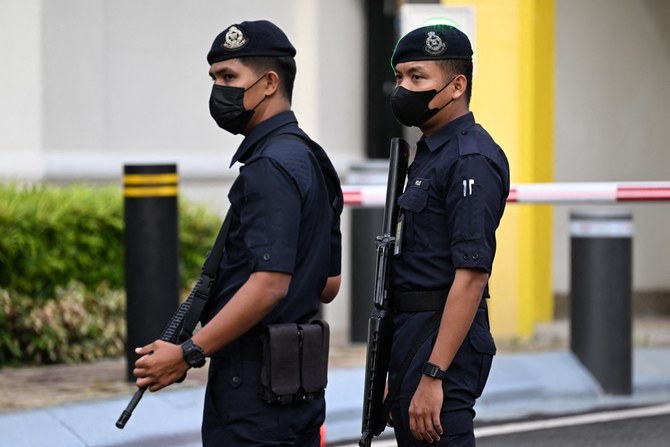
KUALA LUMPUR: Malaysian authorities were on high alert on Saturday after the arrest of an Israeli national who was apprehended with several handguns and rounds of ammunition at a hotel in Kuala Lumpur.
Malaysia has long shown support for Palestinian statehood and its leaders have been fiercely critical of Israel since the beginning of its deadly invasion of Gaza in October.
Kuala Lumpur does not have diplomatic relations with Tel Aviv and does not allow Israeli nationals to enter its territory. Israeli or Israel-bound ships are also barred from docking in Malaysian ports.
The 36-year-old suspect was detained earlier this week, and found with six pistols and 200 bullets, police said on Friday, expressing concern to local media over the haul.
“Why does the suspect need that many pistols and bullets?” National Police Chief Razarudin Husain told reporters.
“He claimed to have come to Malaysia to kill another Israeli citizen over a personal dispute, but is it true?”
Police revealed that the man had entered the country on March 12 from the UAE and had stayed in several hotels since.
He reportedly handed over what authorities believed to be a fake French passport before producing an Israeli one after further questioning.
Since then, authorities said that they were cautious about the security of several public figures, including the king — Sultan Ibrahim Sultan Iskandar — and Prime Minister Anwar Ibrahim.
Earlier on Saturday, local media reported that police arrested three Malaysians on suspicion of supplying the weapons and acting as a driver to the Israeli suspect. They also seized another handgun during the arrest.
The arrest of the Israeli prompted Mohd. Azmi Abdul Hamid, the leader of the Malaysian Consultative Council of Islamic Organization — a local humanitarian group — to urge Malaysia to beef-up its security.
State news agency Bernama quoted Azmi as saying Malaysia’s firm stance against Israel and boycott of Israeli products had attracted Tel Aviv’s attention, as the country “stands out among the countries that strongly condemn Israel and spearheads international campaigns in support of Palestine.”

Malaysia on high alert after arrest of armed Israeli national
https://arab.news/wp7uc
Malaysia on high alert after arrest of armed Israeli national
- Malaysia does not allow Israeli nationals to enter its territory
- 36-year-old Israeli was traveling on reportedly fake French passport
Iran war unsettles India’s packaged water makers as bottles, caps get pricey
- Higher polymer prices hurt bottled water industry
- Industry worth $5 billion has big multinational players like Pepsi, Coca-Cola
NEW DELHI: The Iran war is rattling India’s $5 billion packaged water market just ahead of the sweltering summer season.
One of the world’s fastest growing bottled water markets is seeing some manufacturers hike prices for distributors, as supply disruptions linked to the war fuel higher costs in everything from plastic bottles to caps, labels and cardboard boxes.
Though retail prices are yet to feel the heat and bigger companies are absorbing the pain, about 2,000 smaller bottled water makers have increased rates for their resellers by around 1 rupee per bottle, a 5 percent hike, which will rise by a further 10 percent in coming days, according to the Federation of All India Packaged Drinking Water Manufacturers’ Association.
Consumers usually pay less than 20 rupees, or around 20 US cents, for a one-liter bottle.
“There is chaos and within the next 4-5 days, this will start impacting customer prices,” said Apurva Doshi, the federation’s secretary general.
Rising oil prices have increased the cost of polymer, which is made from crude oil and is a key material for the industry’s plastic bottles. The cost of material used in making plastic bottles has risen by 50 percent to 170 rupees per kilogram, while the price of the caps has more than doubled to 0.45 rupees apiece. Even corrugated boxes, labels and adhesive tape are costing much more, industry letters showed.
Clean water is a privilege in the country of 1.4 billion people where researchers say 70 percent of the groundwater is contaminated, leaving people reliant on bottled water. Companies including Bisleri, Coca-Cola’s Kinley, Pepsi’s Aquafina, billionaire Mukesh Ambani’s Reliance and Tata all compete for a share of the $5 billion market. The companies did not respond to Reuters request for comment.
PREMIUM WATER FACES HEAT TOO
Within the broad bottled water market, natural mineral water is a $400 million business in India and a new, fast-growing wellness product for India’s wealthy.
The premium water segment accounted for 8 percent of the bottled water market last year in India, compared to just 1 percent in 2021, Euromonitor says.
Aava, which sells mineral water sourced from the foothills of the Aravalli mountains, has increased prices of its water bottles by 18 percent for resellers, Shiroy Mehta, CEO of the company, told Reuters.
“Most manufacturers are absorbing 40-50 percent of the cost to ensure that they don’t lose clients. It’s a poor situation for the beverage industry ahead of the summer season,” he said.
The mass market, however, is dominated by companies that produce “drinking water” to be sold in 1-liter bottles to customers. Clear Premium Water, a brand of India’s Energy Beverages, said in a notice to its distributors there had been an “unprecedented and continuous surge” in prices of key raw materials used in packaging and production.
“It is no longer possible for us to absorb the escalating costs while maintaining existing product prices,” the notice said.