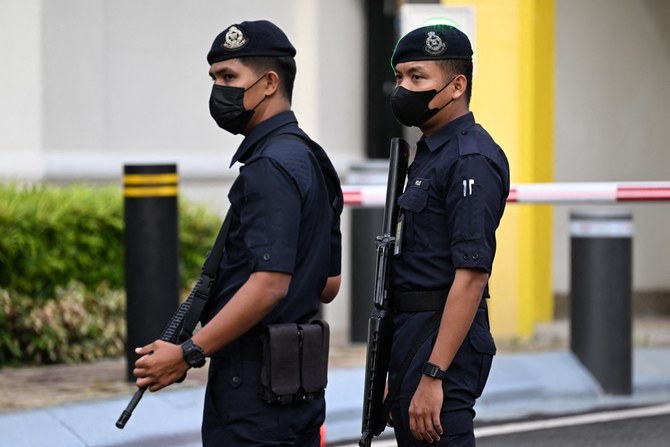
KUALA LUMPUR: Malaysian authorities were on high alert on Saturday after the arrest of an Israeli national who was apprehended with several handguns and rounds of ammunition at a hotel in Kuala Lumpur.
Malaysia has long shown support for Palestinian statehood and its leaders have been fiercely critical of Israel since the beginning of its deadly invasion of Gaza in October.
Kuala Lumpur does not have diplomatic relations with Tel Aviv and does not allow Israeli nationals to enter its territory. Israeli or Israel-bound ships are also barred from docking in Malaysian ports.
The 36-year-old suspect was detained earlier this week, and found with six pistols and 200 bullets, police said on Friday, expressing concern to local media over the haul.
“Why does the suspect need that many pistols and bullets?” National Police Chief Razarudin Husain told reporters.
“He claimed to have come to Malaysia to kill another Israeli citizen over a personal dispute, but is it true?”
Police revealed that the man had entered the country on March 12 from the UAE and had stayed in several hotels since.
He reportedly handed over what authorities believed to be a fake French passport before producing an Israeli one after further questioning.
Since then, authorities said that they were cautious about the security of several public figures, including the king — Sultan Ibrahim Sultan Iskandar — and Prime Minister Anwar Ibrahim.
Earlier on Saturday, local media reported that police arrested three Malaysians on suspicion of supplying the weapons and acting as a driver to the Israeli suspect. They also seized another handgun during the arrest.
The arrest of the Israeli prompted Mohd. Azmi Abdul Hamid, the leader of the Malaysian Consultative Council of Islamic Organization — a local humanitarian group — to urge Malaysia to beef-up its security.
State news agency Bernama quoted Azmi as saying Malaysia’s firm stance against Israel and boycott of Israeli products had attracted Tel Aviv’s attention, as the country “stands out among the countries that strongly condemn Israel and spearheads international campaigns in support of Palestine.”

Malaysia on high alert after arrest of armed Israeli national
https://arab.news/wp7uc
Malaysia on high alert after arrest of armed Israeli national
- Malaysia does not allow Israeli nationals to enter its territory
- 36-year-old Israeli was traveling on reportedly fake French passport
In Bangladesh’s mangrove forest, villagers brave tigers to collect rare honey
- Honey is gathered from wild bee colonies deep in the Sundarbans
- Producers made a debut at the biggest food fair in Jeddah this month
—
—
Dhaka
When the harvest begins, Mizanur Rahman gathers a few hundred men and sets out into the mangrove forest along the Bay of Bengal, where for months they climb trees to collect by hand a wild natural honey whose unique properties are only starting to attract global attention.
The honey is collected from wild bee colonies deep within the Sundarbans, the world’s largest mangrove reserve spanning parts of India and southwestern Bangladesh.
“Honey collection from this forest is mostly done in the Bangladesh part,” Rahman said. “All plants, trees, and the overall environment of this forest are natural. There is no human touch.”
Sundarban honey comes from an ecosystem where trees grow and bloom naturally, without the use of fertilizers or pesticides. Its collectors, known as mawalis, begin work in March for about three and a half months.
Rahman estimates there are about 4,000 mawalis in the local community. To enter the forest, they require special passes from the forest department.
“It’s a very risky job for the people who enter the forest,” he told Arab News. “It’s the only honey in the world where collectors risk their lives in the den of the mighty Bengal tiger to gather it. Sometimes, they also face the danger of poisonous snake bites.”
During the season, his team reaches up to 1,200 members who together manage to collect about 400 tons of honey.
“One hundred small boats start sailing together, each carrying eight to 10 people,” Rahman said. “Despite the dangers, it is a matter of pride to be part of these challenging tasks.”
Collected from a humid environment, Sundarban honey is thinner than other types. Its greenish-amber shade comes from the nectar of mangrove flowers, and the taste is less sweet than most commercial honeys, with a subtle citrus-like tanginess. The scent is mild.
Being raw and unprocessed, the honey retains more enzymes, antioxidants, and pollen.
“Some people can feel acidity similar to orange juice,” Rahman said. “It has a unique taste. If someone tastes this honey once, she or he will definitely love to taste it again and again.”
Well known locally in Bangladesh and parts of eastern India, where it has been harvested and consumed for generations, Sundarban honey is only starting to gain attention in organic and specialty food markets.
Earlier this month, it debuted at AgroFood Jeddah, Saudi Arabia’s leading international exhibition for the agriculture, food, and agritech industries.
The organic honey from the Sundarbans received an encouraging reception, according to Mohammed Saleh Uddin Bhuyan, chief category officer at Ghorer Bazar, one of the companies participating in the expo.
“We have been receiving good responses from the local buyers,” he said. “Saudi Arabia is a very promising market for us.”
Bangladeshi authorities recognize the honey’s export potential but also the fact that production still needs to be standardized to enter global markets.
Mahmudul Hasan, director of Bangladesh’s Export Promotion Bureau, told Arab News that there are plans to promote the organic practices behind the honey during future food fairs in the Gulf region.
“There is huge export potential for our mangrove honey in the Gulf countries, as Arab consumers are fond of honey. They just need to be assured of the quality in the production process,” he said.
“Our mangrove honey is undoubtedly an organic product. It has unique value, but the world is not very aware of it yet.”


