VIRTY-SUR-SEINE, France: “The police arrived at 7am and said to us ‘get in the bus’,” Ali, a refugee from war-torn Sudan, remembers of the morning that police raided the squat he was living in last April in northern Paris along with 500 other migrants.
Despite having a job and refugee status, he was ordered on to the vehicle.
“We didn’t have any choice,” he explained.
Along with others scooped up at the disaffected office building, he was told he was being sent by bus to Toulouse — a nearly 700-kilometer (435-mile) trip of seven or eight hours to the southwest.
“They (the police) went from room to room to tell us to get out, then they took our identity documents and said ‘get in the bus’,” he added in an interview with AFP. “It was impossible to get out of it. They were saying we had to hurry up.”
Ali, who has a job as a cleaner at Disneyland Paris earning 1,400 euros ($1,500) a month, had been caught up in the French government’s policy of sending migrants from the capital to regional towns.
It was announced by French President Emmanuel Macron in September 2022 during a speech in which he criticized the idea of concentrating refugees and migrants in low-income and troubled neighborhoods of Paris as “absurd.”
Rather than adding strain to the stretched social services of these areas, he argued that asylum seekers and refugees could help reverse declining populations and labor shortages in other areas of the country.
Some charities welcomed the idea in principle, but worried about the implementation.
It caused immediate fury among anti-immigration politicians, and many charities now suspect Macron and his ministers of wanting to clean up Paris ahead of the Olympic Games this July and August — which the government denies.
Ali’s experience demonstrates the difficulties of relocating people.
He didn’t know Toulouse and, once he arrived there, he was taken to an asylum seekers’ center where he was told he couldn’t stay for longer than four days.
Because he had already obtained refugee status, he was also informed that he shouldn’t be there “along with 17 other refugees” who had been transported from Paris, he remembers.
“I explained that I didn’t know where to go and that I didn’t know anyone. They told me ‘it’s not our problem’,” he explained from his new home, an office building in Vitry-sur-Seine in southeast Paris occupied by 400 migrants.
Soon after arriving in the southwest, he bought a return ticket to Paris and managed to save his job at Disneyland.
Abdallah Kader, a 51-year-old from Chad in northern Africa, was another person evacuated from the Ali’s squat on the Ile-Saint-Denis, an area of Paris that will host the Olympic village during the Games.
Also with refugee status, he was sent to Bordeaux in southwest France, but decided to return to the capital soon after.
“I know people here. We help each other. I find work,” he said in Vitry-sur-Seine where he sleeps in a small former office with another refugee.
Abdallah was once employed as a security guard at one of the many building sites around Paris linked to the Olympic Games which kick off on July 26.
Several charities are convinced that the migrant transfers are linked to a desire among French authorities to banish rough-sleeping, tents and squats from the capital before the eyes of the world fall on its famed cobbled streets.
In February, an umbrella group of 80 French NGOs denounced what it called the “social cleansing” of Paris ahead of the Olympics with efforts to remove migrants, the homeless and sex workers.
“Clearly ahead of the Olympics, there are transfers, a social clean up to prepare the city for the arrival of tourists,” Jhila Prentis, a volunteer at United Migrants, a charity that works in Vitry-sur-Seine.
The group wants the state to run more checks before sending people to provincial France “so that it meets their needs and that they agree to leave,” she added, explaining that often “they have a life here.”
France logged 167,000 requests for asylum last year and Macron is under constant pressure from right-wing political opponents and public opinion to reduce immigration.
Housing Minister Guillaume Kasbarian told parliament on Tuesday that 200,000 homeless people slept each night in shelters provided by the French state, with 100,000 of these places in the capital region.
“Given the saturation in the Paris region, not everyone can find a place,” he added. “That’s why, without any link to the Olympic Games, the government put in place a dispersal policy from March 2023,” he explained.


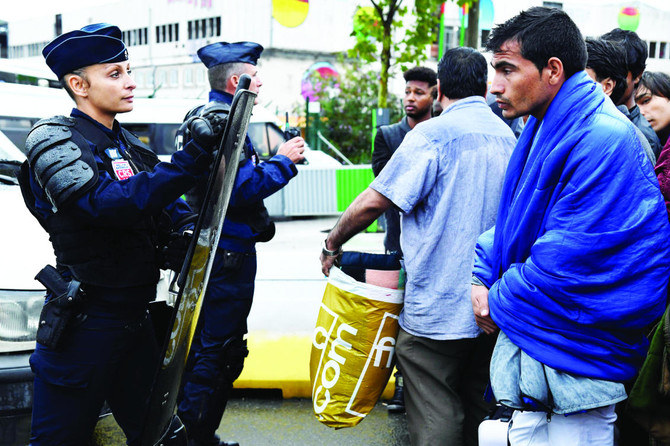
Refugees caught up in Paris clean-up drive
https://arab.news/wh85y
Refugees caught up in Paris clean-up drive

- Ali, who has a job as a cleaner at Disneyland Paris earning $1,500 a month, had been caught up in the French government’s policy of sending migrants from Paris to regional towns
- Some charities welcomed the idea in principle, but worried about the implementation


Trump invites Colombia’s Petro to White House after earlier threat of military action
- Relations between Trump and Petro have been frosty since the Republican returned to the White House in January 2025
WASHINGTON/BOGOTA: Days after threatening Colombia with military action, US President Donald Trump on Wednesday said arrangements were being made for the country’s President Gustavo Petro to visit the White House, following a call between the two leaders. Trump and Petro said they discussed relations between the two countries in their first call since the US president on Sunday said that a US military operation focused on Colombia’s government “sounds good” to him. That threat followed Trump ordering the US capture of the president of neighboring Venezuela, who was flown to the US to face drug and weapons charges.
“It was a great honor to speak with the President of Colombia, Gustavo Petro, who called to explain the situation of drugs and other disagreements that we have had. I appreciated his call and tone, and look forward to meeting him in the near future,” Trump wrote on social media.
Trump added “arrangements are being made” for a meeting in Washington between himself and Petro, Colombia’s first leftist president, but gave no specific date for a meeting.
“We have spoken by phone for the first time since he became president,” Petro told supporters gathered at a rally in Bogota meant to celebrate Colombia’s sovereignty, adding he had requested a restart of dialogue between the two countries.
A source in Petro’s office told Reuters the call was “cordial” and “respectful.”
Relations between Trump and Petro have been frosty since the Republican returned to the White House in January 2025.
Trump has repeatedly accused the administration of Petro, without evidence, of enabling a steady flow of cocaine into the US, imposing sanctions on the Colombian leader in October.
On Sunday Trump referred to Petro as “a sick man, who likes making cocaine and selling it to the United States.”
The US in September had revoked Petro’s visa after he joined a pro-Palestinian demonstration in New York following a meeting of the United Nations General Assembly and called on US soldiers to “disobey the orders of Trump.”
Petro, who has been a vocal opponent of Israel’s war in Gaza, had accused Trump of being “complicit in genocide” in Gaza and called for “criminal proceedings” over US missile attacks on suspected drug-running boats in Caribbean waters.
The Trump administration has carried out more than 30 strikes against suspected drug boats since September, in a campaign that has killed at least 110 people.