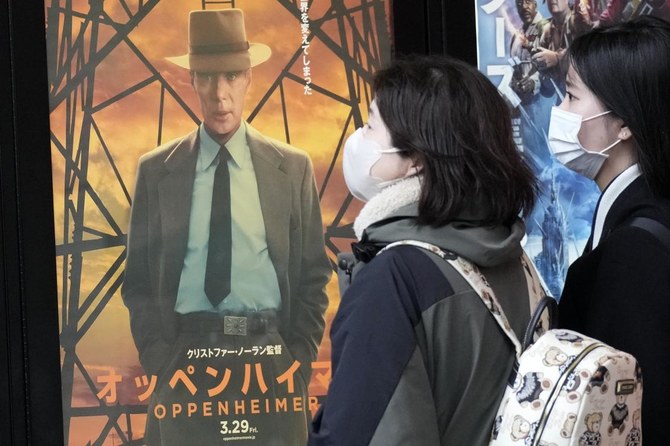
TOKYO: “Oppenheimer” finally premiered Friday in the nation where two cities were obliterated 79 years ago by the nuclear weapons invented by the American scientist who was the subject of the Oscar-winning film. Japanese filmgoers’ reactions understandably were mixed and highly emotional.
Toshiyuki Mimaki, who survived the bombing of Hiroshima when he was 3, said he has been fascinated by the story of J. Robert Oppenheimer, often called “the father of the atomic bomb” for leading the Manhattan Project.
“What were the Japanese thinking, carrying out the attack on Pearl Harbor, starting a war they could never hope to win,” he said, sadness in his voice, in a telephone interview with The Associated Press.
He is now chairperson of a group of bomb victims called the Japan Confederation of A- and H-Bomb Sufferers Organization and he saw “Oppenheimer” at a preview event. “During the whole movie, I was waiting and waiting for the Hiroshima bombing scene to come on, but it never did,” Mimaki said.
“Oppenheimer” does not directly depict what happened on the ground when the bombs were dropped on Hiroshima and Nagasaki, turning some 100,000 people instantly into ashes, and killed thousands more in the days that followed, mostly civilians.
The film instead focuses on Oppenheimer as a person and his internal conflicts.
The film’s release in Japan, more than eight months after it opened in the US, had been watched with trepidation because of the sensitivity of the subject matter.
Former Hiroshima Mayor Takashi Hiraoka, who spoke at a preview event for the film in the southwestern city, was more critical of what was omitted.
“From Hiroshima’s standpoint, the horror of nuclear weapons was not sufficiently depicted,” he was quoted as saying by Japanese media. “The film was made in a way to validate the conclusion that the atomic bomb was used to save the lives of Americans.”
Some moviegoers offered praise. One man emerging from a Tokyo theater Friday said the movie was great, stressing that the topic was of great interest to Japanese, although emotionally volatile as well. Another said he got choked up over the film’s scenes depicting Oppenheimer’s inner turmoil. Neither man would give his name to an Associated Press journalist.
In a sign of the historical controversy, a backlash flared last year over the “Barbenheimer” marketing phenomenon that merged pink-and-fun “Barbie” with seriously intense “Oppenheimer.” Warner Bros. Japan, which distributed “Barbie” in the country, apologized after some memes depicted the Mattel doll with atomic blast imagery.
Kazuhiro Maeshima, professor at Sophia University, who specializes in US politics, called the film an expression of “an American conscience.”
Those who expect an anti-war movie may be disappointed. But the telling of Oppenheimer’s story in a Hollywood blockbuster would have been unthinkable several decades ago, when justification of nuclear weapons dominated American sentiments, Maeshima said.
“The work shows an America that has changed dramatically,” he said in a telephone interview.
Others suggested the world might be ready for a Japanese response to that story.
Takashi Yamazaki, director of “Godzilla Minus One,” which won the Oscar for visual effects and is a powerful statement on nuclear catastrophe in its own way, suggested he might be the man for that job.
“I feel there needs to an answer from Japan to ‘Oppenheimer.’ Someday, I would like to make that movie,” he said in an online dialogue with “Oppenheimer” director Christopher Nolan.
Nolan heartily agreed.
Hiroyuki Shinju, a lawyer, noted Japan and Germany also carried out wartime atrocities, even as the nuclear threat grows around the world. Historians say Japan was also working on nuclear weapons during World War II and would have almost certainly used them against other nations, Shinju said.
“This movie can serve as the starting point for addressing the legitimacy of the use of nuclear weapons on Hiroshima and Nagasaki, as well as humanity’s, and Japan’s, reflections on nuclear weapons and war,” he wrote in his commentary on “Oppenheimer” published by the Tokyo Bar Association.


![]()

‘Oppenheimer’ finally premieres in Japan to mixed reactions and high emotions
Short Url
https://arab.news/8334f
‘Oppenheimer’ finally premieres in Japan to mixed reactions and high emotions
- “Oppenheimer” has finally opened in the nation where two cities were obliterated by the nuclear weapons invented by the American scientist at the center of the film
- The film’s release in Japan had been watched with trepidation


Latest updates


© 2026 SAUDI RESEARCH & PUBLISHING COMPANY, All Rights Reserved And subject to Terms of Use Agreement.