

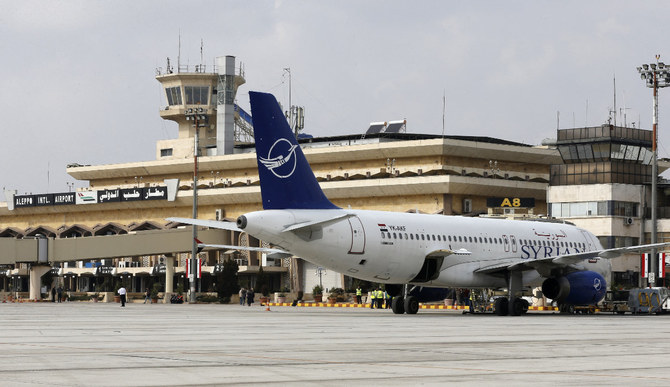

BEIRUT: A war monitor said Israeli air strikes Friday on Syria’s Aleppo province killed at least 42 including 36 Syrian soldiers, the deadliest toll for the army since the Israel-Hamas war began.
Israel has launched hundreds of air strikes in Syria since civil war there broke out in 2011, targeting army positions as well as Iran-backed forces including Hezbollah, an ally of Damascus and Palestinian militant group Hamas.
The strikes have increased since Israel’s war with Hamas began on October 7, and Friday’s was the second such attack in 24 hours.
“Israeli strikes” targeted “a rockets depot belonging to Lebanon’s Hezbollah” close to Aleppo airport, said the UK-based Syrian Observatory for Human Rights, which has a network of sources inside Syria.
It reported “42 killed, including six from Lebanon’s Hezbollah group” and “36 soldiers,” the highest Syrian army toll in Israeli strikes since the Israel-Hamas war began.
State news agency SANA, quoting a military source, reported that “at approximately 1:45 am, the Israeli enemy launched an air attack from the direction of Athriya, southeast of Aleppo,” adding that “civilians and military personnel” were killed and wounded.
Contacted by AFP from Jerusalem, the Israeli military said it would “not comment on reports in the foreign media.”
The Observatory also reported strikes targeting “defense factories” controlled by pro-Iran groups elsewhere in Aleppo province.
The attack came just hours after a reported Israeli strike in the Damascus countryside.
Syrian state media said “two civilians” were killed in an “Israeli air attack that targeted a residential building” on Thursday, also reporting material damage.
The Observatory said the Sayyida Zeinab area, a stronghold of pro-Iran armed groups including Hezbollah south of the capital, was targeted.
Israeli raids in Syria also seek to cut off Hezbollah supply routes to neighboring Lebanon.
The Israel-Hamas war began with the Gaza-based Palestinian militants’ unprecedented attacks that resulted in about 1,160 deaths in Israel, mostly civilians, according to an AFP tally based on Israeli official figures.
Israel’s retaliatory campaign has killed at least 32,623 people in Gaza, mostly women and children, according to the Hamas-run health ministry there.
Israel has exchanged near-daily cross-border fire with Hamas ally Hezbollah in Lebanon since the Gaza war began, sparking fears of a major regional conflagration.
In Lebanon, cross-border fire since October has killed at least 346 people, mostly Hezbollah fighters, but also including at least 68 civilians, according to an AFP tally.
The fighting has displaced tens of thousands of people in southern Lebanon and in northern Israel, where the military says 10 soldiers and eight civilians have been killed.
Hezbollah has fought alongside ally Damascus in Syria’s civil war since at least 2013, and continues to operate in the country.
The Syrian government’s brutal suppression of a 2011 uprising triggered a conflict that has killed more than half a million people and drawn in foreign armies and jihadists.
On Tuesday, strikes on eastern Syria’s Deir Ezzor province killed 19 people, mostly pro-Iran fighters including two advisers from Iran’s Revolutionary Guards, the Observatory said.
The World Health Organization reported one of its workers was killed in the strikes, which the Observatory blamed on Israel, after initially not saying who carried them out.
A US defense official said the United States “did not conduct any airstrikes” at the time.
Israel rarely comments on individual strikes in Syria, but has repeatedly said it will not allow Iran to expand its presence in Syria.

keywords


