

Philippine president warns of countermeasures in response to Chinese aggression at sea

1 / 3
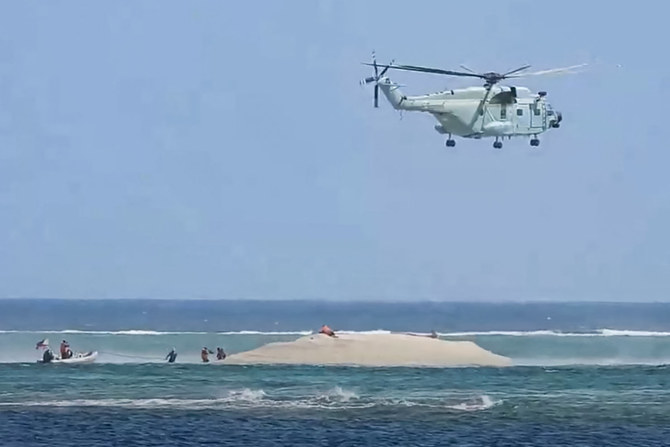
A Chinese coast guard helicopter hovers as Philippine scientists inspect a cay near the Philippine-held Thitu Island in the disputed South China Sea on March 23, 2024. (PCG/BFAR handout photo via AFP)
2 / 3
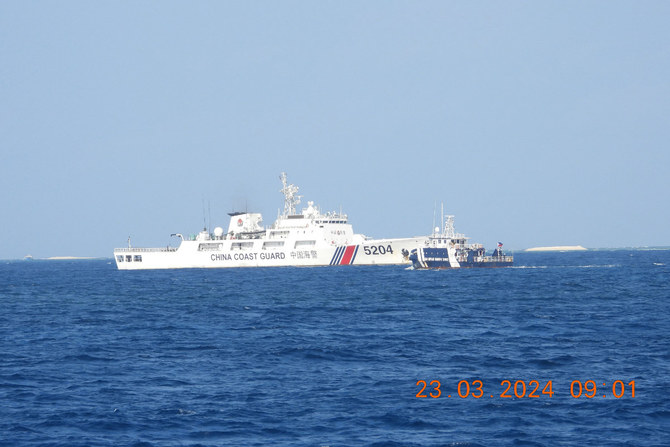
A Chinese Coast Guard ship (L) is shown blocking a Philippine Bureau of Fisheries and Aquatic Resources ship (R) on March 23, 2024 on the their way to inspect a cay near the Philippine-held Thitu Island in the disputed South China Sea. (PCG/BFAR handout photo via AFP)
3 / 3
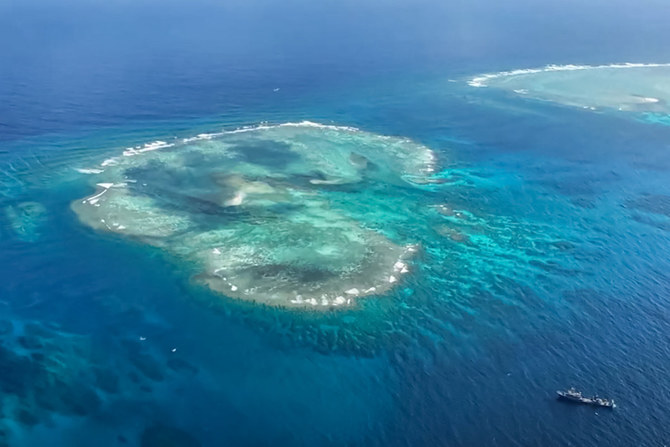
An aerial view of a cay near the Philippine-held Thitu Island in the disputed South China Sea, which the Chinese coast guard had been trying to prevent Philippine supply vessels from entering. (PCG/BFAR handout photo via AFP)
Short Url
Updated 29 March 2024
Follow

Philippine president warns of countermeasures in response to Chinese aggression at sea

  • Marcos said the Philippines "seek no conflict with any nation,” but would not be “cowed into silence”
  • His remark follows repeated aggressive action by Chinese coast guard ships in disputed South China Sea waters

MANILA: The Philippine president said Thursday that his government would take action against what he called dangerous attacks by the Chinese coast guard and suspected militia ships in the disputed South China Sea, saying “Filipinos do not yield.”

Ferdinand Marcos Jr. did not provide details of the actions his government would take in the succeeding weeks but said these would be “proportionate, deliberate and reasonable in the face of the open, unabating, and illegal, coercive, aggressive and dangerous attacks by agents of the China coast guard and Chinese maritime militia.”

“We seek no conflict with any nation, more so nations that purport and claim to be our friends but we will not be cowed into silence, submission, or subservience,” Marcos wrote on X, formerly Twitter.

Marcos’s warning is the latest sign of the escalating disputes between China and the Philippines in the contested waters that have caused minor collisions between the coast guard and other vessels of the rival claimant nations, sparked a war of words and strained relations.
China and the Philippines, along with Vietnam, Malaysia, Taiwan and Brunei, have overlapping claims in the resource-rich and busy waterway, where a bulk of the world’s commerce and oil transits.
Chinese officials in Manila or Beijing did not immediately respond to Marcos’s public warning, which he issued during Holy Week — one of the most sacred religious periods in the largely Roman Catholic nation.
China’s defense ministry accused the Philippines of escalating the South China Sea disputes by undertaking provocative moves and spreading “misinformation to mislead the international community.”
“It is straying further down a dangerous path,” Senior Col. Wu Qian, the Chinese defense ministry’s top spokesperson, said in a statement issued Thursday by the Chinese Embassy in Manila.
Both China and the Philippines said they were acting to protect their sovereignty. Wu said China remained “committed to properly managing maritime differences,” while Marcos said he had been in touch with international allies who had offered to help the Philippines.
Marcos said he issued his statement after meeting top Philippine defense and national security officials, who submitted their recommendations. These include the use of faster military vessels instead of chartered civilian boats when the Philippine navy delivers a new batch of personnel and supplies to the disputed Second Thomas Shoal, two Philippine security officials said.
The shoal, the site of frequent hostilities since last year, has been occupied by a small Philippine naval contingent but surrounded by the Chinese coast guard and other vessels in a decades-long territorial standoff.
It’s unclear if Marcos approved that recommendation. The two Philippine officials separately spoke to The Associated Press on condition of anonymity because of a lack of authority to discuss the issue publicly.
In the latest hostilities on Saturday, the Chinese coast guard used water cannons that injured several Philippine navy crewmen and heavily damaged their wooden supply boat near the Second Thomas Shoal. The cannon blast was so strong it threw a crewman off the floor but he hit a wall instead of plunging into the sea, Philippine military officials said.
The Philippine government summoned a Chinese embassy diplomat in Manila to convey its “strongest protest” against China. Beijing accused the Philippine vessels of intruding into Chinese territorial waters, warning Manila not to “play with fire” and saying China would continue to take actions to defend its sovereignty.
The United States condemned the actions by the Chinese coast guard. In a telephone call with Philippine defense chief Gilberto Teodoro Jr. Wednesday, US Defense Secretary Lloyd Austin reiterated a warning that it is obligated to come to the aid of the Philippines under a 1951 Mutual Defense Treaty if Philippine forces, aircraft and ships come under armed attack, including anywhere in the South China Sea, Pentagon Press Secretary Pat Ryder said.
Beijing has warned Washington to stay away from what it says is a purely Asian dispute, but the US has said it would press on with Navy patrols as it has done for more than 70 years in accordance with international law to help safeguard freedom of navigation and overflight in the South China Sea.


Ugandan opposition turns national flag into protest symbol

Updated 4 sec ago
Follow

Ugandan opposition turns national flag into protest symbol

KAMPALA: Hundreds screamed with excitement as Uganda’s opposition leader passed by a recent rally, with the crowd waving a sea of national flags — a dangerously politicized symbol in the run-up to this week’s election.
Analysts say it is almost a foregone conclusion that President Yoweri Museveni, 81, will win a seventh term in Thursday’s vote, given his near-total control over the state apparatus in the east African country.
But his opponent, 43-year-old Robert Kyagulanyi, better known as Bobi Wine, has framed the election as a protest vote and cannily turned the national flag into a symbol of resistance.
Police last month warned against using the flag “casually and inappropriately.”
Wine’s supporters have faced frequent intimidation by the security forces during the campaign, according to the United Nations Human Rights Office and other observers.
But the flag is “the only weapon we have,” said woodworker Conrad Olwenyi, 31, at a Wine rally this week.
“We cannot fight the security, because they have a gun. We only have the flag,” he said. But “if they shoot you when you have the flag, they are shooting the country.”

- ‘Reclaiming patriotism’ -

Uganda’s flag — created when the country achieved independence from Britain in 1962 — has stripes of black to represent Africa, yellow for its sunshine, and red to represent African brotherhood, with a grey crowned crane overlaid.
In the 2021 elections, Wine’s National Unity Platform (NUP) adopted red berets as a symbol, but the government ruled that was illegal since they were part of the military uniform, and used that ruling to justify raids on the party’s offices.
The flag is a clever alternative and a way of “reclaiming patriotism,” said Uganda expert Kristof Titeca.
“It’s kind of taken the government by surprise, and so that’s why they started this clampdown,” he told AFP.
Like many countries in east Africa, there are laws governing how the national flag may be used, though these were rarely enforced in Uganda in the past.
“It shows the panic,” prominent cartoonist Jimmy Spire Ssentongo told AFP.
“I don’t think they are threatened by misuse of the flag. They are threatened by the visibility of the support toward NUP,” said Ssentongo, adding that as Museveni ages and nears 40 years in power, “the space for freedom of expression also shrinks.”
“Everyone has a right to use the national flag, but it depends on in what context they’re using it for. I believe the opposition is politicizing it,” said Israel Kyarisiima, a national youth co-ordinator for Museveni’s National Resistance Movement party.
Security services have repeatedly been accused by Wine’s supporters of targeting those carrying the flag at rallies, with the leader urging followers in his Christmas address to “come to the defense of anyone assaulted for carrying the flag.”
And the threats from police have not stopped Wine’s supporters brandishing the flag at rallies.
“Now we’ve got something that can really show our unity as Ugandans, and they are trying to make it criminal,” said one attendee this week, Ruth Excellent Mirembe, 25, waving a flag.
Trying to stop its use is “oppression in the highest form,” she told AFP. “This represents us as Ugandans.”