

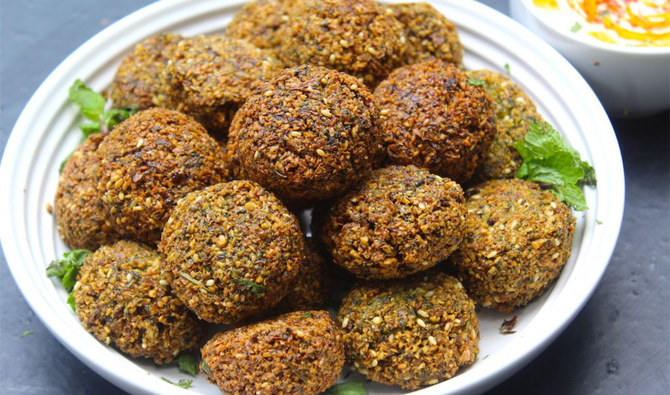
Ramadan Recipes: Falafel

Falafel is a dish that vegans and vegetarians can enjoy as it is dairy-free. (Supplied)
Short Url
Updated 29 March 2024
Follow

Ramadan Recipes: Falafel

Falafel is a popular dish in the Middle East that can be a side dish or the main course. It is also treated as fast food, made of a mixture of chickpeas, fresh and dried herbs, and spices.

While countries like Lebanon, Yemen, Palestine, and others claim falafel belongs to them, the dish is known to be of Egyptian origin.

Falafel was invented around 140 years ago, with French journalist Paul Balta and Syrian historian Farouk Mardam Bey showing that falafel first appeared in Egyptian literature after the British occupation in 1882.

Both men suggest that British officers, who had acquired a taste for Indian fried vegetable croquettes, asked for a similar dish using local ingredients, and Egyptians came up with falafel.

Falafel is a dish that vegans and vegetarians can enjoy as it is dairy-free and consists of legumes, herbs, and spices.

To make the dish you need two cups of dried chickpeas, one tsp of baking soda, one tsp of baking powder, one cup of parsley,  half a cup of coriander, half a cup of mint, one tbsp of ground cumin, one tbsp of ground coriander, one tsp cayenne pepper (optional), two tbsp toasted sesame seeds, one onion, six garlic cloves, salt and pepper, flatbread, tahini, tomato, cucumber, parsley, pickle, and chili sauce.

Soak the dried chickpeas in water overnight, adding baking soda, mixing and leaving it at room temperature for 8 -12 hours. The next day, chop the onion, garlic, and herbs, add them to a food processor with the chickpeas, baking powder, sesame seeds, and the spices, and half blend until the mixture resembles coarse sand.

Shape the falafel into balls and fry them until they turn dark brown.

For the tahini salad, mix tahini with diced tomatoes and cucumbers, then add salt and lemon juice.

Place falafel inside the bread, add tahini salad on top, add pickles or chili sauce if desired, roll the bread, and serve.


Chef serves up a taste of Spain at Ithra Cultural Days in Saudi Arabia 

Updated 20 January 2026
Follow

Chef serves up a taste of Spain at Ithra Cultural Days in Saudi Arabia 

DHAHRAN: Among the attractions of the Ithra Cultural Days: Spain at the King Abdulaziz Center for World Culture (Ithra), visitors can try a tantalizing selection of Spanish foods — none more renowned than its famous paella. 

Arab News spoke with chef Jose Zafra at the event, which runs until Jan. 31, who flew in from Spain to offer a taste of his homeland to the people of Saudi Arabia. 

A “master rice cook, paella researcher and promoter,” according to his business card, his logo is even designed around the recognizable cooking pan and the phrase “Pasion por la paella,” or “Passion for paella.”

“That's why the pan is round because people get around and eat all together — to share culture and passion and life,” Zafra told Arab News as foodies lined up behind him, eager to try a plateful.

Arab News spoke with chef Jose Zafra at the event, which runs until Jan. 31. (Supplied)

“It’s not just a food. It’s a link, a connection. Paella is the symbol of unity and sharing. And people now are going to try it — authentic Spanish paella in Saudi Arabia.”

The word “paella” comes from the Latin “patella,” meaning pan.

In Spanish, it refers both to the rice dish itself and the pan in which it is cooked.

Paella was introduced to Spain during Moorish rule. It originated in Valencia, on the country’s eastern coast, as a rural peasant dish that was cooked by farm workers over open fires using local ingredients. Over time, the dish’s popularity spread and other versions evolved, for example featuring seafood and meat.

It is different to Saudi Arabia’s kabsa, a communal dish which similarly uses rice and meat. Kabsa is cooked in a deep pot to ensure the rice stays soft and aromatic from the meaty broth, whereas paella uses a wide, shallow pan to fully absorb flavors evenly, often creating a prized crispy layer at the bottom. 

Visitors to Ithra’s Culture Days can enjoy the flavors of Spain made with a sprinkling of local love — true to the origins of the dish.

Find the scoops of Spanish joy near the food truck area and try chicken paella, seafood paella —or both! You will see the signs offering a plate, at SR35 ($9) for chicken and SR40 for seafood, or let your nose lead you there.

Zafra concluded: “The chicken is from here, the seafood is from here — and the passion, well, that is from Spain.”