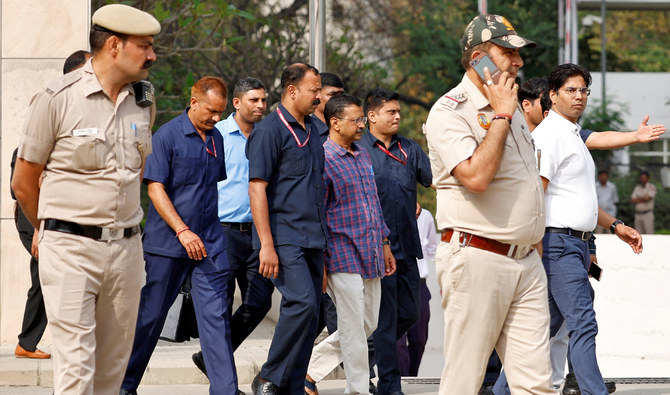
Delhi Chief Minister Kejriwal’s custody extended until April 1 in graft case

Police officers escort Chief Minister of Delhi and Aam Aadmi Party (AAP) Arvind Kejriwal as he leaves the court after a hearing in New Delhi, India on March 28, 2024. (REUTERS)
Short Url
Updated 28 March 2024
Follow

Delhi Chief Minister Kejriwal’s custody extended until April 1 in graft case

  • Delhi CM Kejriwal was arrested in connection with corruption allegations related to city’s liquor policy
  • Kejriwal’s Aam Aadmi Party says case is fabricated, politically motivated against him by Indian government 

NEW DELHI: An Indian court extended the custody of opposition leader and Delhi Chief Minister Arvind Kejriwal until April 1 on Thursday in a graft case related to the national capital territory’s liquor policy, local media said.

India’s financial crime-fighting agency arrested Kejriwal last week in connection with corruption allegations related to the city’s liquor policy and he was remanded to its custody until Thursday, weeks before India begins voting in general elections on April 19.

Kejriwal’s Aam Aadmi Party (AAP) says the case is fabricated and politically motivated. Prime Minister Narendra Modi’s government and his Bharatiya Janata Party deny political interference and say law enforcement agencies are doing their job.

All the main leaders of AAP were already imprisoned in the case before Kejriwal was arrested.

Terming his arrest a “political conspiracy,” Kejriwal, 55, told reporters outside court on Thursday that “the public will respond to this.” 

Speaking in court later, he said the Enforcement Directorate (ED), which has arrested him, aims to crush AAP.

ED lawyers told the court that they needed Kejriwal in custody for another seven days as he was “deliberately not cooperating” and needed to be interrogated further.

Kejriwal’s arrest has sparked protests in the national capital and the nearby northern state of Punjab, which is also governed by AAP, over the last few days.

Dozens of AAP supporters were detained on Tuesday as they attempted to march to Modi’s residence to demand his release. 

Some AAP workers protesting and distributing leaflets to commuters outside a busy metro station in central Delhi were also detained on Thursday.

“This is the time when we campaign (for elections), our leaders are being put in prison, arrested ... they (federal government) are stopping us from campaigning, (but) nobody can stop us from winning,” a protester told news agency ANI.

A joint rally of the ‘INDIA’ alliance, consisting of more than two dozen political parties including AAP, is planned in the capital on Sunday to protest against the arrest.

The issue has also drawn international attention with the US and Germany calling for a “fair” and “impartial” trial in the case, causing New Delhi to tell Washington and Berlin that India’s legal processes are based on an independent judiciary and that they should stay away from its internal affairs.


Tensions flare in Minnesota as protesters and federal agents repeatedly square off

Updated 13 sec ago
Follow

Tensions flare in Minnesota as protesters and federal agents repeatedly square off

  • The Trump administration has repeatedly defended the immigration agent who shot Good, saying he acted in self-defense
  • With the Department of Homeland Security pledging to send more than 2,000 immigration officers into Minnesota, the state, joined by Minneapolis and St. Paul, sued President Donald Trump’s administration Monday to halt or limit the surge

MINNEAPOLIS: Federal officers dropped tear gas and sprayed eye irritant at activists Tuesday during another day of confrontations in Minneapolis while students miles away walked out of a suburban school to protest the Trump administration’s bold immigration sweeps.
The government’s immigration crackdown is next headed to a federal court where Minnesota and two mayors are asking a judge to immediately suspend the operation. No hearing has been set on the request.
Gas clouds filled a Minneapolis street near where Renee Good was fatally shot in the head by an immigration agent last week. A man scrubbed his eyes with snow and screamed for help while agents in an unmarked Jeep sprayed an orange irritant and drove away.
It’s common for people to boo, taunt and blow orange whistles when they spot heavily armed agents passing through in unmarked vehicles or walking the streets, all part of a grassroots effort to warn the neighborhood and remind the government that they’re watching.
“Who doesn’t have a whistle?” a man with a bag of them yelled.
Brita Anderson, who lives nearby and came to support neighborhood friends, said she was “incensed” to see agents in tactical gear and gas masks, and wondered about their purpose.
“It felt like the only reason they’d come here is to harass people,” Anderson said.
Separately, a judge heard arguments and said she would rule by Thursday or Friday on a request to restrict the use of force, such as chemical irritants, on people who are observing and recording agents’ activities. Government attorneys argued that officers are acting within their authority and must protect themselves.
In Brooklyn Park, Minnesota, students protesting the immigration enforcement operation walked out of school, as students in other communities have done this week.
With the Department of Homeland Security pledging to send more than 2,000 immigration officers into Minnesota, the state, joined by Minneapolis and St. Paul, sued President Donald Trump’s administration Monday to halt or limit the surge.
The lawsuit says the Department of Homeland Security is violating the First Amendment and other constitutional protections by focusing on a progressive state that favors Democrats and welcomes immigrants.
“This is, in essence, a federal invasion of the Twin Cities in Minnesota, and it must stop,” state Attorney General Keith Ellison said.
Minneapolis Mayor Jacob Frey said: “What we are seeing is thousands — plural — thousands of federal agents coming into our city. And, yeah, they’re having a tremendous impact on day-to-day life.”
Dozens of protests or vigils have taken place across the US to honor Good since the 37-year-old mother of three was killed.
Homeland Security says it has made more than 2,000 arrests in the state since early December and is vowing to not back down. Spokesperson Tricia McLaughlin, responding to the lawsuit, accused Minnesota officials of ignoring public safety.
“President Trump’s job is to protect the American people and enforce the law — no matter who your mayor, governor, or state attorney general is,” McLaughlin said.
The Trump administration has repeatedly defended the immigration agent who shot Good, saying he acted in self-defense. But that explanation has been widely panned by Frey, Minnesota Gov. Tim Walz and others based on videos of the confrontation.
Two Democratic lawmakers from Massachusetts announced Tuesday they are sponsoring a bill to make it easier for people to sue and overcome immunity protections for federal officers who are accused of violating civil rights. The bill stands little chance of passage in the Republican-controlled Congress.
In Wisconsin, Lt. Gov. Sara Rodriguez is proposing that the state ban civil immigration enforcement around courthouses, hospitals, health clinics, schools, churches and other places. She is hoping to succeed Gov. Tony Evers, a fellow Democrat, who is not running for a third term.
“We can take a look at that, but I think banning things absolutely will ramp up the actions of our folks in Washington, D.C.,” Evers said, referring to the Trump administration. “They don’t tend to approach those things appropriately.”