


NORCROSS, Georgia/WASHINGTON: US Treasury Secretary Janet Yellen said on Wednesday she intends to warn China about the negative effects of Beijing’s subsidies for its clean energy industries, including solar panels and electric vehicles, during a visit to the country.
“I intend to talk to the Chinese when I visit about overcapacity in some of these industries, and make sure that they understand the undesirable impact that this is having — flooding the market with cheap goods — on the United States but also in many of our closest allies,” Yellen told MSNBC in a live interview.
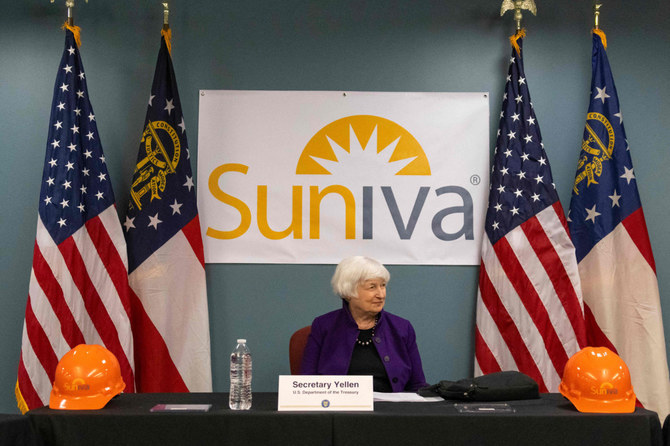
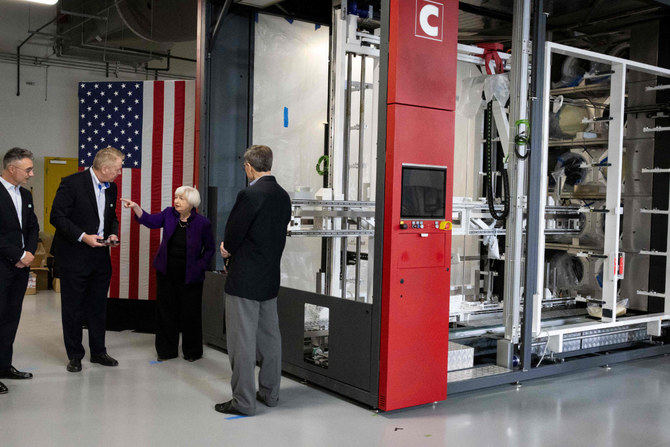
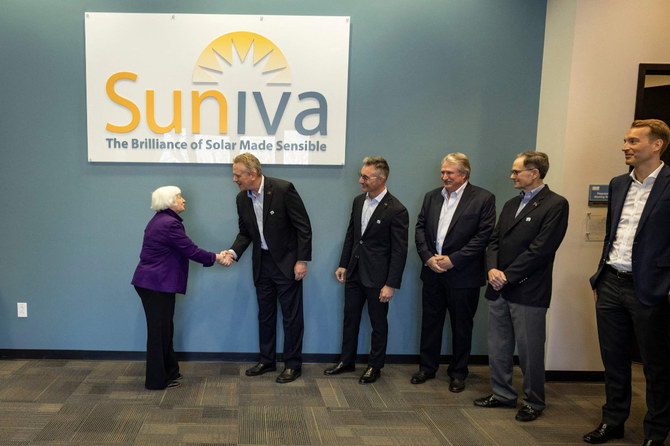
Yellen traveled to the state of Georgia to visit a Suniva solar cell manufacturing plant that closed in 2017 due to competition from cheaper, subsidized solar panels from China.
The plant is now reopening because of anticipated demand fueled by tax credits for US-made clean energy technology in the 2022 Inflation Reduction Act worth hundreds of billions of dollars.
Earlier on Wednesday, Suniva and Canada’s Heliene announced a three-year, $400 million deal to join forces to cooperate on the production of fully US-made complete solar panels that can be installed into solar power projects. A steady supply of US-produced panels will enable solar project developers to claim a 10 percent bonus credit on top of the 30 percent tax credit on the cost of renewable energy facilities.
Yellen said in remarks at the factory that she will raise concerns China is now overproducing solar panels, EVs and lithium-ion batteries in the same way that it built too much capacity to make steel and aluminum, distorting global markets and hurting jobs in other industrial and developing economies.
Politico has reported that Yellen will travel to China in April. The Treasury Department has declined to confirm her travel plans.
“I will convey my belief that excess capacity poses risks not only to American workers and firms and to the global economy, but also productivity and growth in the Chinese economy, as China itself acknowledged in its National People’s Congress this month,” Yellen said. “And I will press my Chinese counterparts to take necessary steps to address this issue.”
China’s excess capacity is an increasing source of concern to Biden administration officials as its exports surge in the face of weak demand at home, while Chinese policymakers are pledging more support for strategically important sectors.
At the same time, the US is pouring hundreds of billions of dollars of tax incentives into clean energy to attract investments that can build viable EV and alternative power sectors that do not depend on China for crucial components such as batteries.
Yellen highlighted the Suniva plant as an example of how the Biden administration’s economic agenda is “lowering energy costs for American consumes and powering growth in strategic industries.”
Yellen told reporters the US has been advocating a rebalancing of China’s economy toward more consumer spending, but added that she was not prepared to discuss potential retaliation from the US and its allies against China’s policies.
“We see, of course, the same concerns in Europe, for example, but I don’t want to get into retaliation,” Yellen said. “We want to see what we can do that’s constructive.”




