

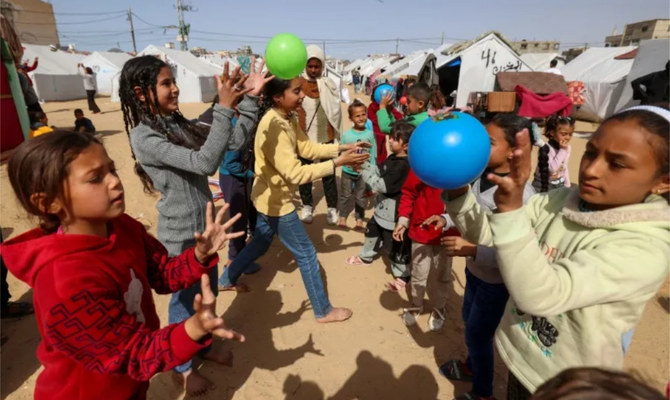
Clowns try to put smiles back on faces of Gaza children

Gaza’s children have few opportunities to play and forget the horrors of war, however briefly, amid the daily battle to find food. (AFP)
Short Url
Updated 27 March 2024
Follow

Clowns try to put smiles back on faces of Gaza children

  • Clowns and acrobats performed for them in the courtyard of a school where their displaced families have been sheltering from the bombing

NUSEIRAT: The children of Gaza have little to eat, have had to flee their homes and have survived nearly six months of terrifying Israeli bombardment.

But for a few precious minutes children in the Nuseirat refugee camp in the center of the Gaza Strip laughed and yelped with joy.

Clowns and acrobats performed for them in the courtyard of a school where their displaced families have been sheltering from the bombing.

The unrelenting war has taken a terrible toll on Gaza’s children.

Most of the 32,490 people killed in the besieged territory since the Oct. 7 Hamas attack on Israel have been women and children, according to the Health Ministry toll.

But for once they could forget all that horror as performers in rabbit costumes led them in a conga, pushing one injured boy in a wheelchair.

Then it was the turn of clown Omar Al-Saidi to tickle their funny bones with zany antics at the expense of another jester.

Wassim Lobed, whose support group organized the show and who acted as compere, said: “Traumas are beginning to appear in children so we are trying to provide psychological relief. “We hope to God that this war will end for the sake of our children in Gaza.”

So deep is the mental suffering of Gaza’s young that some hope to die quickly to escape the “nightmare,” a spokesman for the UN child welfare agency said on Tuesday.

“The unspeakable is regularly said in Gaza” now, said UNICEF spokesman James Elder, who is in the territory.

After meeting young people on Monday, he said several teenagers said they were “so desperate for this nightmare to end that they hoped to be killed.”

But Saidi, whose clown name is Uncle Zaatar, said he hoped the show had lifted some of that “burden” from the children’s shoulders.

As the children clapped and cheered at the end, he said he hoped the “smile will remain on their faces forever.”


The art of war: fears for masterpieces on loan to Louvre Abu Dhabi

Updated 13 March 2026
Follow

The art of war: fears for masterpieces on loan to Louvre Abu Dhabi

  • UAE paid more than €1 billion to borrow priceless works, but experts in France want them back

PARIS: The Middle East war has raised fears for the safety of priceless masterpieces on loan from France to the Louvre Abu Dhabi, the museum’s only foreign branch.
The Abu Dhabi museum, which opened in 2017, has so far escaped damage from nearly 1,800 Iranian drone and missile strikes launched since the conflict erupted on Feb. 28.
However, concerns are mounting in France. “The works must be removed,” said Didier Selles, who helped broker the original agreement between France and the UAE.
French journal La Tribune de l’Art echoed that alarm. “The Louvre’s works in Abu Dhabi must be secured!” it said.
France’s culture ministry said French authorities were “in close and regular contact with the authorities of the UAE to ensure the protection of the works loaned by France.”
Under the agreement with the UAE, France agreed to provide expertise, lend works of art and organize exhibitions, in return for €1 billion, including €400 million for licensing the use of the Louvre name. The deal was extended in 2021 to 2047 for an additional €165 million.
Works on loan include paintings by Rembrandt and Chardin, Classical statues of Isis, Roman sarcophagi and Islamic masterpieces: such as the Pyxis of Al-Mughira.

A Louvre Abu Dhabi source said the museum was designed to protect collections from both security threats and natural disasters.