

Pakistan moves closer to PIA privatization with inaugural holding company meeting

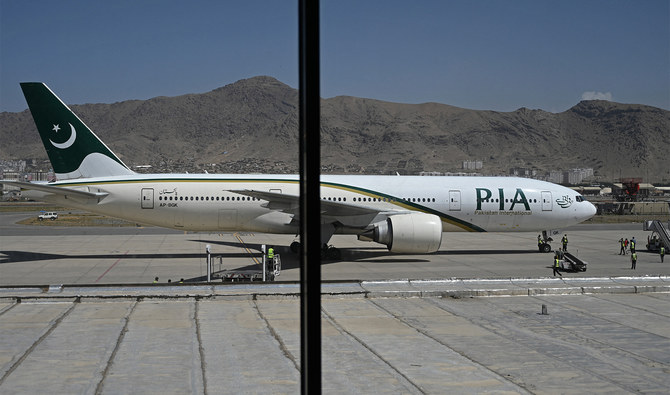
Members of ground staff stand on the tarmac beside a Pakistan International Airlines (PIA) aircraft at the airport in Kabul, Afghanistan on September 13, 2021. (AFP/File)
Short Url
Updated 27 March 2024
Follow

Pakistan moves closer to PIA privatization with inaugural holding company meeting

  • PIA Holding Company was formed to expedite the airline’s privatization by managing its liabilities and assisting with its transfer
  • The company’s board deliberated on strategic facets of the business to lay down groundwork for its efficient functioning

KARACHI: The government took yet another step toward the privatization of Pakistan International Airlines (PIA), as the newly established PIA Holding Company convened its first board meeting in Islamabad on Wednesday, initiating its operations.

The entity was formed following the approval of PIA’s restructuring plan last July by its board of directors, with an aim to expedite the national carrier’s privatization by managing the airline’s liabilities and assisting in its transfer to potential investors.

PIA’s privatization also aligns with the government’s commitment to structural economic reforms under the International Monetary Fund’s financial assistance programs.

“The board in its first meeting held on March 27, 2024, endorsed the Scheme of Arrangement delineating the pathway for the privatization of Pakistan International Airlines,” said an official statement circulated after the holding company’s inaugural board meeting. “This comprehensive scheme, already receiving the stamp of approval from both the Federal Cabinet and the [Pakistan International Airlines Corporation Limited] PIACL Board, sets the stage for the next chapter of the national carrier.”

“Additionally,” it continued, “the board meticulously deliberated on various strategic facets of the business, thereby laying down the groundwork for the efficient functioning of the holding company.”

Only a day earlier, the federal cabinet approved the board of PIA Holding Company, with former central bank governor, Tariq Bajwa, appointed as its chairman.

PIA has faced multiple financial challenges over the years, seeking financial bailouts from successive government.

With a struggling national economy, Pakistan has started working toward its privatization.

The decision is also expected to improve the service provided by the airlines to its customers.


Pakistan engages Saudi Arabia, China in bid to ease surging Middle East tensions 

Updated 10 March 2026
Follow

Pakistan engages Saudi Arabia, China in bid to ease surging Middle East tensions 

  • Pakistan’s foreign minister stresses need for de-escalation in conversations with Chinese, Saudi counterparts
  • Tensions in the Middle East continue to remain high as conflict between US, Israel and Iran intensifies

ISLAMABAD: Pakistan’s Deputy Prime Minister Ishaq Dar spoke to the foreign ministers of Saudi Arabia and China on Tuesday, stressing the importance of diplomatic engagement to de-escalate tensions in the Middle East as the Iran war intensifies. 

Pakistan has constantly engaged regional countries in efforts to broker a ceasefire in the Middle East, after the US and Isreal launched coordinated strikes against Iran on Feb. 28. 

Iran launched fresh attacks on Gulf countries on Tuesday morning, where it has targeted US military bases in recent weeks. In addition to firing missiles and drones at Israel and American bases in the region, Iran has also been targeting energy infrastructure which, combined with its stranglehold on the Strait of Hormuz, has sent oil prices soaring worldwide. 

Dar spoke to Saudi Foreign Minister Prince Faisal bin Farhan to discuss developments in the Middle East and ongoing deliberations at the UN Security Council, Pakistan’s foreign office said in a statement. 

“DPM/FM shared Pakistan’s perspective, underscoring the importance of continued coordination and diplomatic engagement to support de-escalation and promote peace and stability across the region and beyond,” the statement said. 

Dar, who also serves as Pakistan’s foreign minister, spoke to Chinese foreign minister Wang Yi over the telephone separately. The two discussed the evolving regional situation and broader global developments.

Dar underscored the need to ease tensions in the Middle East and the wider region during the conversation, the foreign office said. 

Yi appreciated Pakistan’s constructive efforts aimed at promoting de-escalation and stability in the region, it added. 

“The two leaders stressed the importance of de-escalation and emphasized the need to pursue dialogue and diplomacy in accordance with the principles of the UN Charter,” the foreign office’s statement said. 

The conflict in the Middle East has hit Pakistan hard as well, forcing Islamabad to hike petrol and diesel prices by Rs55 per liter last Friday. 

Pakistan’s government has also announced a set of austerity measures, which include closing schools and cutting down on government expenditures, as it evaluates petrol stocks and looks for alternative supply routes.