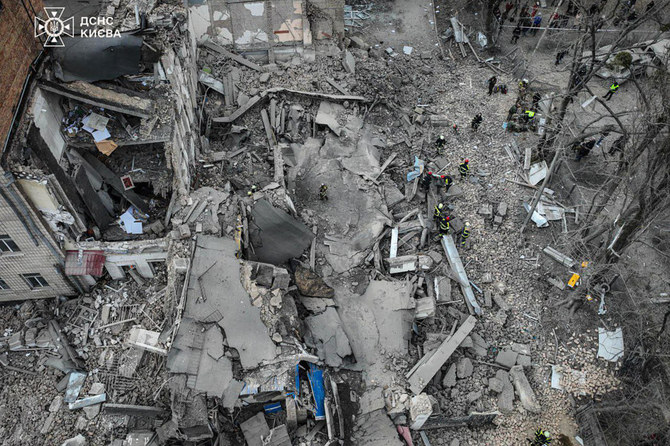
KYIV: Russian attacks on eastern and southern Ukraine killed two people and wounded 10 others, officials said Wednesday, as Kyiv called for Patriot air defense systems to battle a surge in missile strikes.
Moscow has escalated its aerial attacks on Ukraine in the past few weeks, targeting key infrastructure including power stations in retaliation for fatal bombardment of Russia’s border regions.
A 55-year-old man was killed by artillery fire in Ukraine’s southeastern city of Nikopol, Dnipropetrovsk region head Sergiy Lysak said.
The governor of Ukraine’s southern Kherson region, which is partially occupied by Russia, said one woman had been killed in a drone attack on the village of Mykhailivka.
Ukrainian forces retook swathes of the Black Sea territory in late 2022 but Russia has been shelling recaptured towns and villages since.
“A 61-year-old local resident was fatally wounded in her own home,” the official, Oleksandr Prokudin, wrote on social media.
The governor of the neighboring Mykolaiv region said later that a Russian ballistic missile had struck the coastal territory, leaving six wounded, with one in a critical condition.
Separately, the governor of the eastern Kharkiv region, Oleg Sinegubov, said three men and one woman all over the age of 50 were injured in separate strikes on towns and villages in the region.
The mayor of the region’s capital, also called Kharkiv, said that a strike on a residential neighborhood had left “dead and wounded,” but did not give details about casualties.
The Ukrainian air force said Russia had launched 13 Iranian-designed attack drones at Ukraine overnight and that 10 were downed over the Kharkiv region, the neighboring Sumy region and near the capital Kyiv.
During an online briefing Wednesday, Ukraine’s Foreign Minister Dmytro Kuleba called for urgent deliveries of air defense systems to ward off an increase in ballistic missile strikes.
“The peculiarity of the current Russian attacks is the intensive use of ballistic missiles that can reach targets at extremely high speeds, leaving little time for people to take cover and causing significant destruction,” Kuleba said.
“Patriot and other similar systems are defensive by definition. They are designed to protect lives, not take them,” he said.
Ukraine has been forced onto the defensive in the past few months as it struggles with ammunition shortages and a hold up to a $60 billion aid package from Washington.
It has also been forced to concede ground to Russia on the eastern front in recent months, warning earlier this week of “difficult” battles around the eastern city of Chasiv Yar.
Russia meanwhile announced that its air defense systems had shot down 18 rockets near the border city of Belgorod, which has recently seen an uptick in fatal Ukrainian attacks.
The governor of Russia’s Belgorod region, Vyacheslav Gladkov, said one person was wounded during the barrage.


Two dead, 10 wounded in Russian attacks on Ukraine
https://arab.news/49etb
Two dead, 10 wounded in Russian attacks on Ukraine

- Moscow has escalated its aerial attacks on Ukraine in the past few weeks, targeting key infrastructure including power stations
- A 55-year-old man was killed by artillery fire in Ukraine’s southeastern city of Nikopol


Venezuela to debate historic amnesty bill for political prisoners
- Venezuela could pass a landmark bill on Thursday granting amnesty to political prisoners, marking an early milestone in the transition from the rule of toppled leader Nicolas Maduro
CARACAS:Venezuela could pass a landmark bill on Thursday granting amnesty to political prisoners, marking an early milestone in the transition from the rule of toppled leader Nicolas Maduro.
The legislation, which covers charges used to lock up dissidents under Maduro and his predecessor Hugo Chavez, aims to turn the page on nearly three decades of state repression.
It was spearheaded by interim president Delcy Rodriguez, who replaced Maduro after he was captured by US forces in Caracas last month and flown to New York to face trial.
Rodriguez took Maduro’s place with the consent of US President Donald Trump, provided she does Washington’s bidding on access to Venezuelan oil and expanding democratic freedoms.
She has already started releasing political prisoners ahead of the pending amnesty. More than 400 people have been released so far, according to rights group Foro Penal, but many more are still behind bars.
Rodriguez also ordered the closure of the notorious Helicoide prison in Caracas, which has been denounced as a torture center by the opposition and activists.
Lawmakers voted last week in favor of the amnesty bill in the first of two debates.
The second debate on Thursday coincides with Youth Day in Venezuela, which is traditionally marked by protests.
Students from the Central University of Venezuela, one of the country’s largest schools and home to criticism of Chavismo, called for a rally on campus.
Venezuela’s ruling party also announced a march in the capital Caracas.
’We deserve peace’
Venezuela’s attorney general said Wednesday that the amnesty — which is meant to clear the rap sheets of hundreds of people jailed for challenging the Maduro regime — must apply to both opposition and government figures.
He urged the United States to release Maduro and his wife, both in detention in New York.
“We deserve peace, and everything should be debated through dialogue,” Attorney General Tarek William Saab told AFP in an interview.
Delcy Rodriguez’s brother Jorge Rodriguez, who presides over the National Assembly, said last week that the law’s approval would trigger the release of all political prisoners.
“Once this law is approved, they will all be released the very same day,” he told prisoners’ families outside the notorious Zona 7 detention center in Caracas.
’We are all afraid’
Venezuelan opposition leader Juan Pablo Guanipa was one of the detainees granted early release.
But he was re-arrested less than 12 hours later and put under house arrest.
Authorities accused him of violating his parole after calling for elections during a visit to Helicoide prison, where he joined a demonstration with the families of political prisoners.
Guanipa is a close ally of Nobel Peace Prize laureate and opposition leader Maria Corina Machado, who was in hiding for over a year before she fled the country to travel to Oslo to receive the award.
“We are all afraid, but we have to keep fighting so we can speak and live in peace,” Guanipa’s son told reporters outside his home in Maracaibo.