

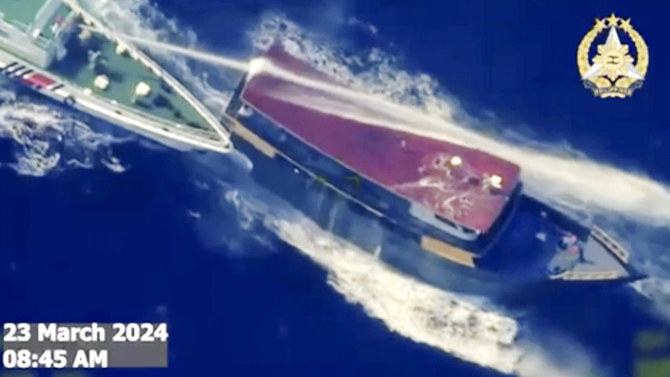

MANILA: The Philippines summoned the Chinese envoy on Monday over a recent incident in the South China Sea and dared Beijing to take its vast sovereignty claims of the disputed waters to international arbitration.
Philippine officials said that China’s coast guard used water cannons on Saturday against one of its vessels at the Ayungin Shoal — the Filipino name for the Second Thomas Shoal. The incident, which damaged one of the boats and injured its crew, is the latest to take place in a series of flare-ups in the past year.
“The Department of Foreign Affairs summoned the charge d’affaires … of the Chinese Embassy this morning to convey the Philippines’ strong protest against the aggressive actions undertaken by the China Coast Guard and Chinese Maritime Militia,” Teresita Daza, the Department of Foreign Affairs spokesperson, said in a statement.
“China’s continued interference with the Philippines’ routine and lawful activities in its own exclusive economic zone is unacceptable. It infringes upon the Philippines’ sovereign rights and jurisdiction. The Philippines demands that Chinese vessels leave the vicinity of Ayungin Shoal and the Philippine exclusive economic zone immediately.”
China claims the South China Sea almost in entirety, including the Second Thomas Shoal that is within the Philippines’ 320-km EEZ. Beijing regularly brushes off rival claims from other countries and has refused to recognize an international ruling that dismissed the expansive Chinese claim.
The skirmish at the weekend took place days after US Secretary of State Antony Blinken visited Manila to reiterate Washington’s “ironclad” support against Chinese influence in the resource-rich territory.
Philippine security chiefs convened a high-level meeting on Monday over the latest incident to prepare recommendations for President Ferdinand Marcos Jr. on how to address the dispute.
The Philippine Defense Secretary Gilbert Teodoro Jr. said China’s continued interference was a “big insult” for Filipinos.
“If they really want, if they are not really scared to broadcast to the entire world their claims, why don’t we enter arbitration under international law so that it can be made clear for everyone the rights of the two parties. Why don’t they do so?” Teodoro told reporters on Monday.
China’s increasing activity in the disputed waters was a test for Manila and its allies to hold Beijing accountable for its actions, said geopolitical analyst Don McLain Gil.
“China is willing to see how far it can go in terms of escalating its belligerent and unlawful activities in the Philippine EEZ. Additionally, Beijing is eager to delegitimize the image of the US Alliance network in the face of its provocations in an ally’s internationally recognized EEZ,” Gil told Arab News.
“The Philippines is today in the front lines of China’s aggression and the need to become resilient is crucial.”


