
MOSCOW: Three of the four suspects charged with carrying out the concert hall attack in Moscow that killed more than 130 people admitted guilt for the incident in a Russian court Sunday.
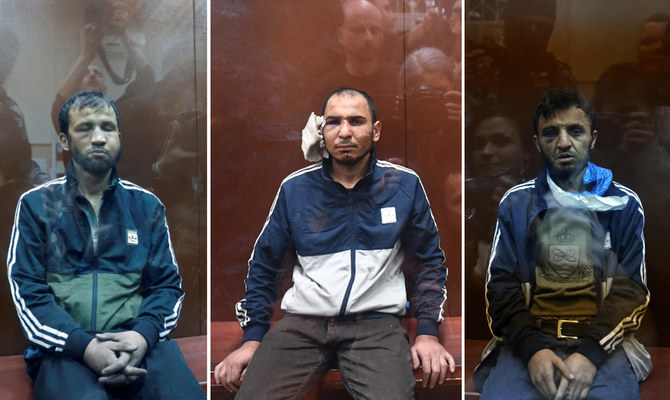
Moscow’s Basmanny District Court formally charged Dalerdzhon Mirzoyev, 32; Saidakrami Rachabalizoda, 30; Mukhammadsobir Faizov, 19; and Shamsidin Fariduni, 25, with committing a group terrorist attack resulting in the death of others. The offense carries a maximum sentence of life imprisonment.
The court ordered that the men, all of whom are citizens of Tajikistan, be held in pre-trial custody until May 22.
Mirzoyev, Rachabalizoda, and Shamsidin Fariduni all admitted guilt after being charged. The fourth, Faizov, was brought to court directly from a hospital in a wheelchair and sat with his eyes closed throughout the proceedings. He was attended by medics while in court, where he wore a hospital gown and trousers and was seen with multiple cuts.
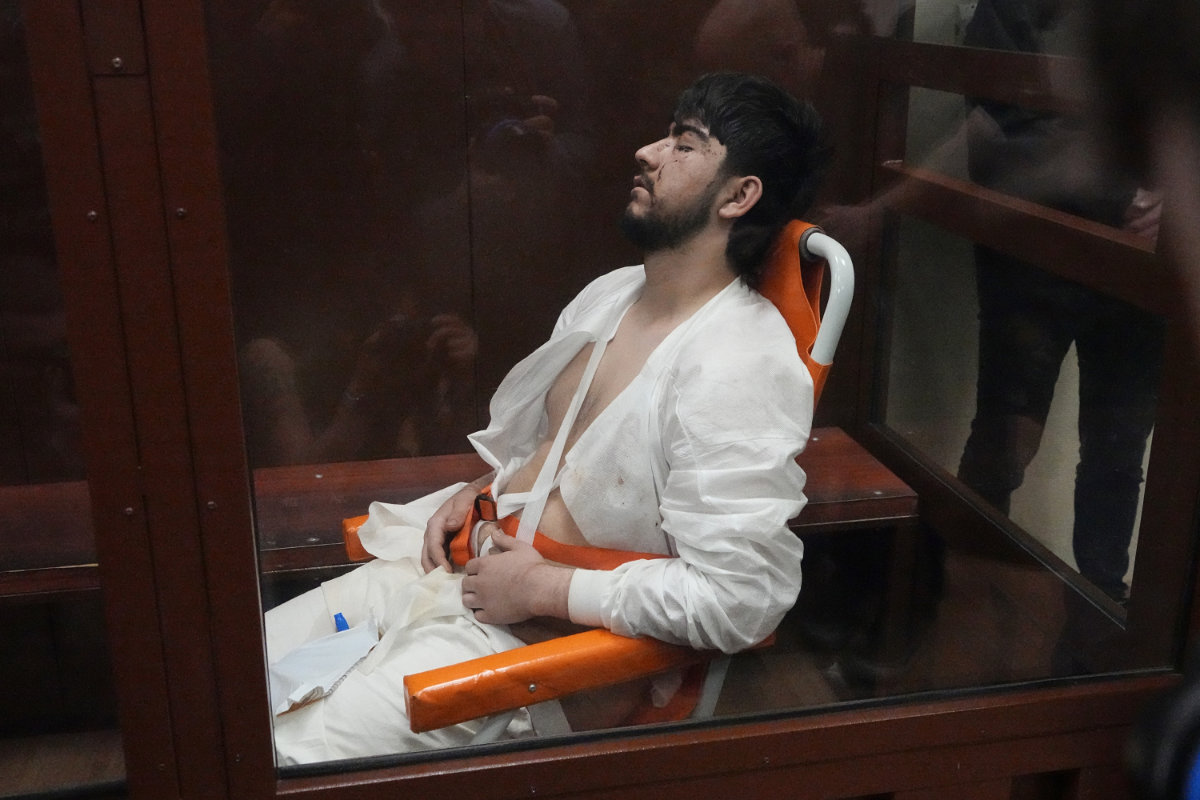
Mukhammadsobir Faizov, one of the four massacre suspects, was brought to court in a wheelchair from a hospital, where he was treated for multiple cuts. (AP)
The other three suspects appeared in court heavily bruised with swollen faces amid reports in Russian media that they were tortured during interrogation by the security services.
One suspect, Saidakrami Rachabalizoda, had a heavily bandaged ear. Russian media reported Saturday that one of the suspects had his ear cut off during interrogation. The Associated Press couldn’t verify the report or the videos which purported to show this.
The hearing came as Russia observed a national day of mourning, following the attack Friday on the suburban Crocus City Hall concert venue that killed at least 137 people.
The attack, which has been claimed by an affiliate of the Daesh group, is the deadliest on Russian soil in years.
Russian authorities arrested the four suspected attackers Saturday, with seven more people detained on suspicion of involvement in the attack, Russian President Vladimir Putin said in an address to the nation Saturday night. He claimed they were captured while fleeing to Ukraine, something that Kyiv firmly denied.
There was a heavy police presence around the court as the suspects were brought in.
One of the suspects was led blindfolded into the courtroom. His blindfold was removed and a black eye was visible.
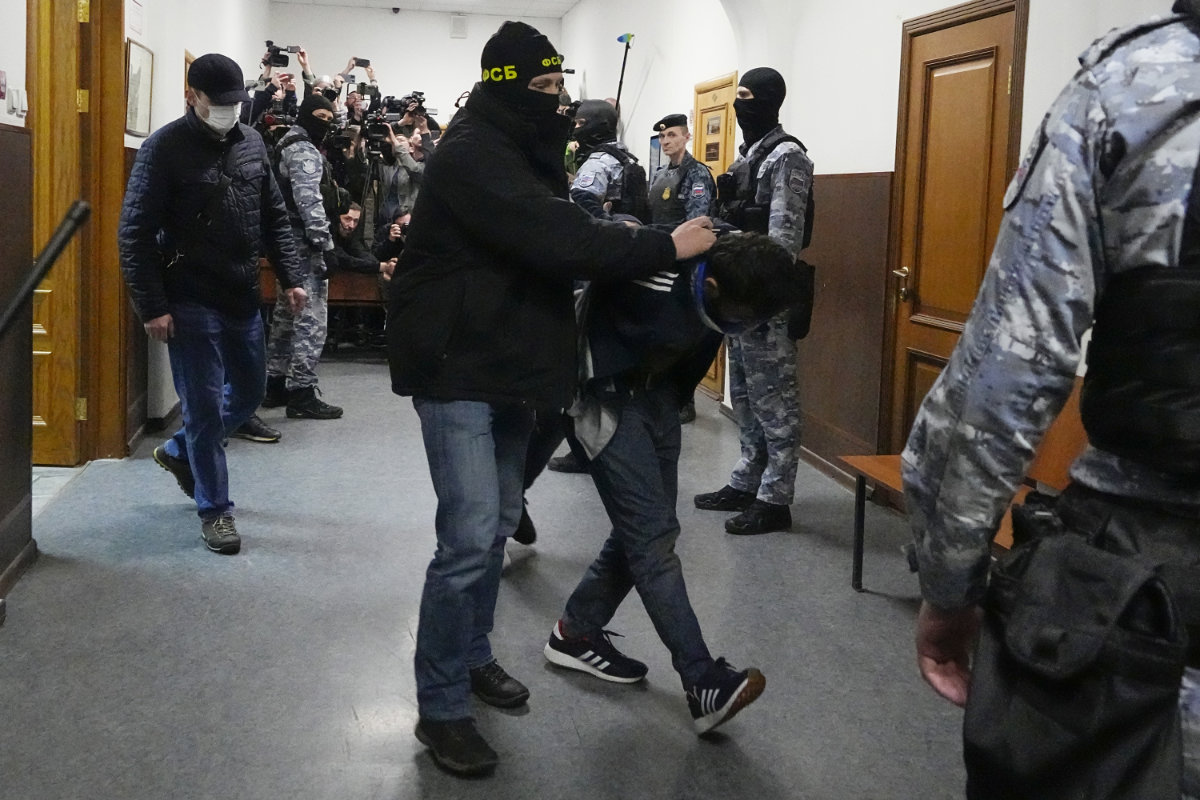
Dalerdzhon Mirzoyev, a suspect in the Crocus City Hall shooting on Friday is escorted by an FSB officer in the Basmanny District Court in Moscow, early on March 25, 2024. (AP Photo)
The attack, which has been claimed by an affiliate of the Daesh group, is the deadliest on Russian soil in years.
Russian authorities arrested four suspected attackers on Saturday, with seven more detained on suspicion of involvement in the attack, Russian President Vladimir Putin said in a nighttime address to the nation, on Saturday. He claimed they were captured while fleeing to Ukraine, something that Kyiv firmly denies.
Family and friends of those still missing waited for news of their loved ones as Russia observed a day of national mourning on Sunday.
Events at cultural institutions were canceled, flags were lowered to half-staff and television entertainment and advertising were suspended, according to state news agency RIA Novosti. A steady stream of people added to a makeshift memorial near the burnt-out concert hall, creating a huge mound of flowers.
“People came to a concert, some people came to relax with their families, and any one of us could have been in that situation. And I want to express my condolences to all the families that were affected here and I want to pay tribute to these people,” Andrey Kondakov, one of the mourners who came to lay flowers at the memorial, told The Associated Press.
“It is a tragedy that has affected our entire country,” kindergarten employee Marina Korshunova said. “It just doesn’t even make sense that small children were affected by this event.” Three children were among the dead.
As rescuers continue to search the damaged building and the death toll rises as more bodies are found, some families still don’t know if relatives who went to the event targeted by gunmen on Friday are alive. Moscow’s Department of Health said Sunday it has begun identifying the bodies of those killed via DNA testing, which will take at least two weeks.
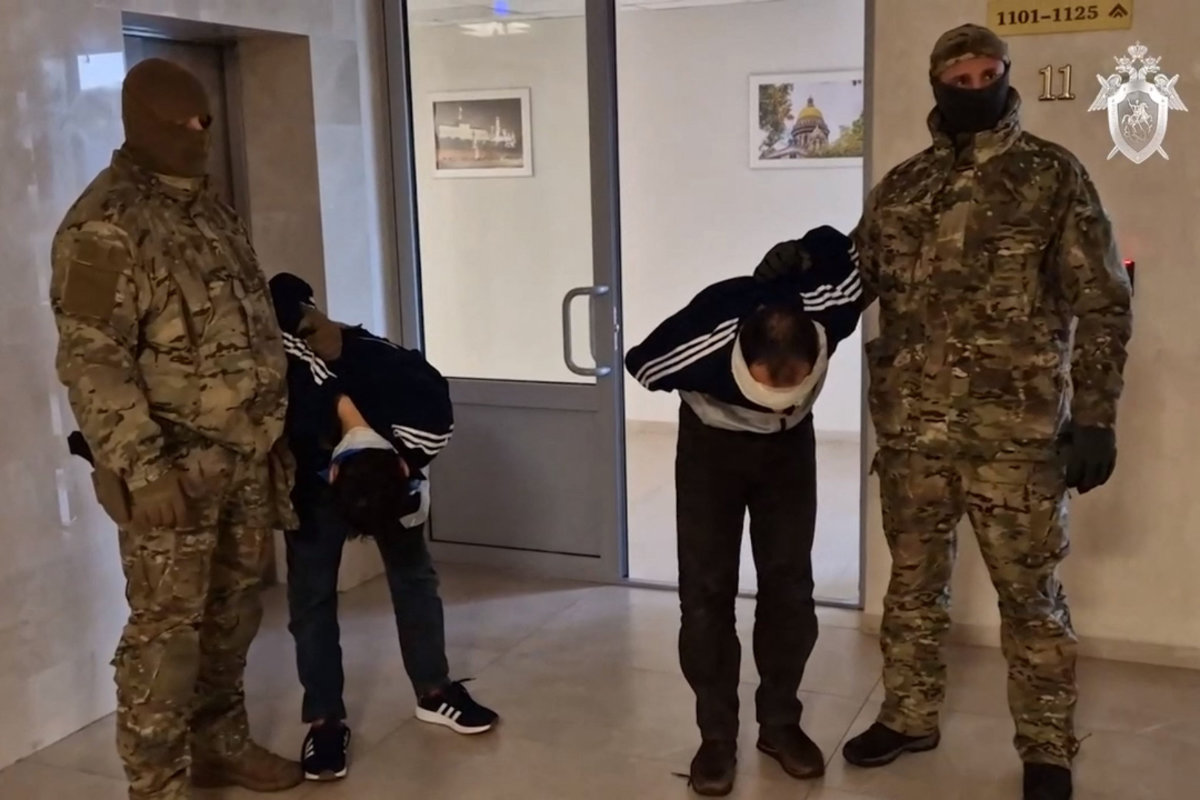
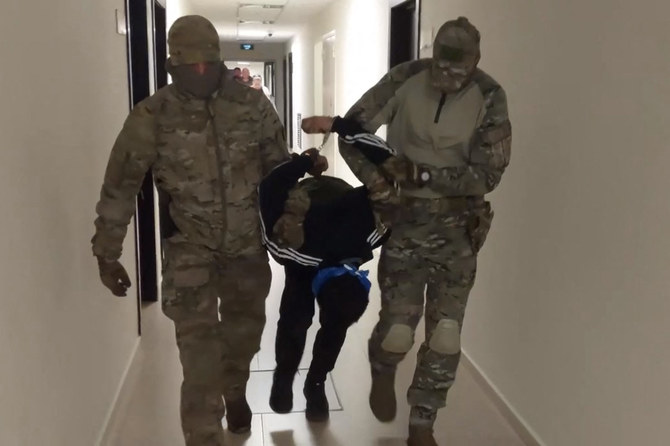
This video grab taken from a handout footage released by Russia's Investigative Committee on March 24, 2024, shows law enforcement officers escorting two of the concert hall attack suspects to court. (AFP)
Igor Pogadaev was desperately seeking any details of his wife’s whereabouts after she went to the concert and stopped responding to his messages.
He hasn’t seen a message from Yana Pogadaeva since she sent her husband two photos from the Crocus City Hall music venue.
After Pogadaev saw the reports of gunmen opening fire on concertgoers, he rushed to the site, but couldn’t find her in the numerous ambulances or among the hundreds of people who had made their way out of the venue.
“I went around, searched, I asked everyone, I showed photographs. No one saw anything, no one could say anything,” Pogadaev told the AP in a video message.
He watched flames bursting out of the building as he made frantic calls to a hotline for relatives of the victims, but received no information.
As the death toll mounted on Saturday, Pogodaev scoured hospitals in the Russian capital and the Moscow region, looking for information on newly admitted patients.
But his wife wasn’t among the 182 reported injured, nor on the list of 60 victims authorities have already identified, he said.
The Moscow Region’s Emergency Situations Ministry posted a video Sunday showing equipment dismantling the damaged music venue to give rescuers access.
Putin has called the attack “a bloody, barbaric terrorist act” and said Russian authorities captured the four suspects as they were trying to escape to Ukraine through a “window” prepared for them on the Ukrainian side of the border.
Russian media broadcast videos that apparently showed the detention and interrogation of the suspects, including one who told the cameras he was approached by an unidentified assistant to an Islamic preacher via a messaging app and paid to take part in the raid.
Putin didn’t mention ISIS, known as Daesh in Arabic, in his speech to the nation, and Kyiv accused him and other Russian politicians of falsely linking Ukraine to the assault to stoke fervor for Russia’s fight in Ukraine, which recently entered its third year.
US intelligence officials said they had confirmed the Daesh affiliate’s claim.
“ISIS bears sole responsibility for this attack. There was no Ukrainian involvement whatsoever,” National Security Council spokeswoman Adrienne Watson said in a statement.
The US shared information with Russia in early March about a planned terrorist attack in Moscow, and issued a public warning to Americans in Russia, Watson said.
The raid was a major embarrassment for the Russian leader and happened just days after he cemented his grip on the country for another six years in a vote that followed the harshest crackdown on dissent since the Soviet times.
Some commentators on Russian social media questioned how authorities, who have relentlessly suppressed any opposition activities and muzzled independent media, failed to prevent the attack despite the US warnings.
Daesh, which fought against Russia during its intervention in the Syrian civil war, has long targeted Russia. In a statement posted by the group’s Aamaq news agency, the Daesh Afghanistan affiliate said that it had attacked a large gathering of “Christians” in Krasnogorsk.
The group issued a new statement Saturday on Aamaq, saying the attack was carried out by four men who used automatic rifles, a pistol, knives and firebombs. It said the assailants fired at the crowd and used knives to kill some concertgoers, casting the raid as part of the Daesh group’s ongoing war with countries that it says are fighting against Islam.
In October 2015, a bomb planted by IS downed a Russian passenger plane over Sinai, killing all 224 people on board, most of them Russian vacationers returning from Egypt.
The group, which operates mainly in Syria and Iraq but also in Afghanistan and Africa, has claimed responsibility for several attacks in Russia’s volatile Caucasus and other regions in past years. It recruited fighters from Russia and other parts of the former Soviet Union.