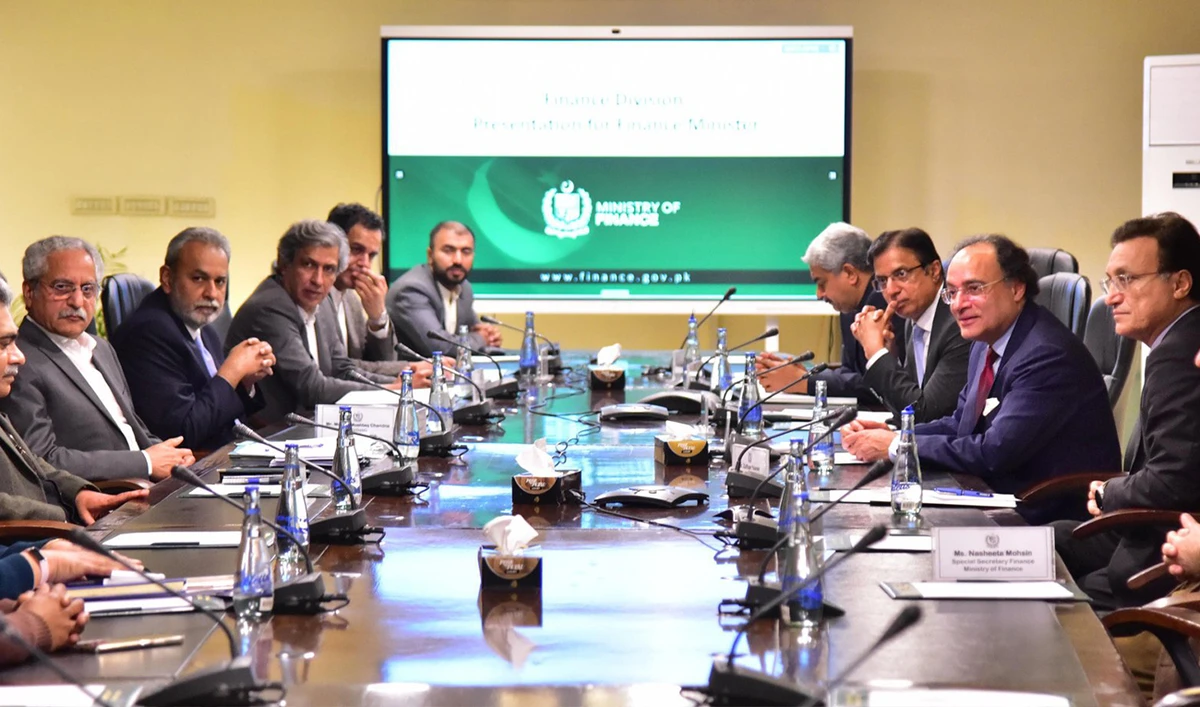
ISLAMABAD: A day after appointing himself chair of the country’s top economic committee, Prime Minister Shehbaz Sharif on Saturday reshuffled it by handing back the committee’s charge to Finance Minister Muhammad Aurangzeb, a notification by the Cabinet Division said.
The Economic Coordination Committee (ECCI) is one of the most important cabinet committees in every government and is tasked with deliberating on the country’s urgent economic matters and putting forward proposals to regulate policies to maximize production and exports, and prevent inflation.
The finance minister of every government usually leads the ECC. However, a notification released by the Cabinet Division on Friday said Sharif had constituted the ECC with himself as its chair, comprising ministers of economic affairs, commerce, power, petroleum and planning.
In a fresh notification on Saturday, however, the Cabinet Division said Sharif had “reconstituted” the committee with the finance minister as its chairman. In the new committee, the prime minister is not a member of the ECC.
“The Prime Minister, in terms of Rule 17 (2) of Rules of Business, 1973, has been pleased to reconstitute the Economic Coordination Committee (ECC) of the Cabinet,” the notification read.
Other members of the committee remained the same: the ministers of economic affairs, commerce, power, petroleum and planning.
It remains unclear why the prime minister reversed his decision and handed the chairmanship of the committee to the finance minister.
Quoting a senior member of the cabinet without naming them, Pakistani newspaper Dawn said the prime minster had “regretted he would be unable to chair the ECC meetings due to his hectic schedule and engagements.”
Last Sunday, the prime minister made an important change in his 19-member cabinet when he replaced Dr. Musadik Masood Malik with Sardar Awais Ahmed Khan Leghari as the minister of power.
Cash-strapped Pakistan is trying to negotiate a long-term bailout program with the International Monetary Fund (IMF) to stave off an economic crisis. The South Asian country’s fragile $350 billion economy needs external financing to avert a balance of payments crisis.
Pakistan’s economic crisis has seen inflation hover around 30 percent and economic growth slow to around 2 percent.
PM Sharif hands over charge of Pakistan’s top economic committee to finance minister
https://arab.news/jr8vj
PM Sharif hands over charge of Pakistan’s top economic committee to finance minister
- PM Sharif appointed himself as chair of the Economic Coordination Committee on Friday
- ECC is a government committee tasked with taking important decisions on Pakistan’s economy
UN rights chief says 56 Afghan civilians killed since Pakistan conflict escalates
- Death toll includes 24 children and six women, with 129 others injured
- UN says about 115,000 Afghans, 3,000 Pakistanis displaced by fighting along border
GENEVA::The United Nations rights chief said Friday that 56 Afghan civilians had been killed — nearly half of them children — since hostilities with neighboring Pakistan intensified last week.
“I plead with all parties to bring an end to the conflict, and to prioritize helping those experiencing extreme hardship,” Volker Turk said in a statement.
The neighbors have clashed along the frontier since February 26, when Afghanistan launched a border offensive in retaliation for Pakistani air strikes.
Islamabad has hit back along the border and with fresh air strikes, bombing multiple sites including the former US air base at Bagram, the capital Kabul and the southern city of Kandahar.
Turk said that since the intensification of hostilities, “56 civilians, including 24 children and six women, have been killed.”
“A further 129 people, including 41 children and 31 women, have been injured,” he said.
And since the start of the year, the numbers are even higher, with 69 civilians killed in Afghanistan and 141 injured, he said.
Pakistan insists it has not killed any civilians in the conflict. Casualty claims from both sides are difficult to verify independently.
The UN refugee agency said Thursday that around 115,000 Afghans and 3,000 people in Pakistan had been displaced by the fighting in the past week.
“Civilians on both sides of the border are now having to flee from air strikes, heavy artillery fire, mortar shelling and gunfire,” Turk said.
He lamented that a new wave of violence was affecting people “whose lives have been tormented by violence and misery for so long.”
He highlighted that over two million Afghans had returned to Afghanistan since Pakistan started to implement its “Illegal Foreigners Repatriation Plan” in September 2023.
And nearly as many were believed to remain in Pakistan, “where many face hardship and constant fear of arrest and deportation,” he said.
“As a result of the violence, humanitarian assistance is unable to reach many of those desperately in need. This is piling misery on misery,” the rights chief said.
He called on “the Pakistan military and Afghan de facto security forces to end immediately their fighting, and to prioritize helping the millions who depend on aid.”