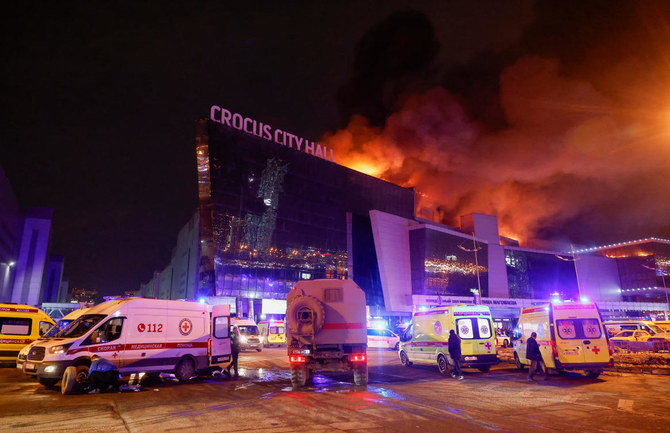
KYIV: Ukrainian President Volodymyr Zelensky on Saturday accused Russia’s Vladimir Putin of seeking to “shift the blame” onto Kyiv for the Moscow concert hall attack that killed 133 people.
“What happened yesterday in Moscow is obvious: Putin and the other scum are just trying to blame it on someone else,” Zelensky announced, after Putin said the suspects had been fleeing toward Ukraine.
“They always have the same methods,” Zelensky added.
In a televised address earlier Saturday, President Putin said the four gunmen arrested for the deadly attack were “traveling toward Ukraine, where, according to preliminary data, a window was prepared for them on the Ukrainian side to cross the state border.”
Kyiv has angrily dismissed the claims by the Russian leader, which come more than two years after Moscow invaded Ukraine.
“That low-life Putin, instead of dealing with his Russian citizens, addressing them, was silent for a day, thinking about how to bring it to Ukraine,” Zelensky said.
“Everything is absolutely predictable.”
The Moscow attack has been claimed by the Daesh group.
It was the deadliest attack in Russia for almost two decades and the deadliest in Europe to have been claimed by Daesh.
Putin made no reference to the group’s claims of responsibility in his address.


Putin wants to blame Ukraine for Moscow attack: Zelensky
https://arab.news/jadhz
Putin wants to blame Ukraine for Moscow attack: Zelensky

- “What happened yesterday in Moscow is obvious: Putin and the other scum are just trying to blame it on someone else,” Zelensky announced
- Kyiv has angrily dismissed the claims by the Russian leader


130 kidnapped Nigerian schoolchildren freed: government
- The religiously diverse African country of 230 million people is the scene of myriad conflicts that have killed both Christians and Muslims
ABUJA: Nigerian authorities have secured the release of 130 kidnapped schoolchildren taken by gunmen from a Catholic school in November, a presidential spokesman said Sunday, after 100 were freed earlier this month.
“Another 130 abducted Niger state pupils released, none left in captivity,” Sunday Dare said in a post on X, accompanied by a photo of smiling children.
In late November, hundreds of students and staff were kidnapped from St. Mary’s co-educational boarding school in north-central Niger state.
The attack came as the country buckled under a wave of mass abductions reminiscent of the infamous 2014 Boko Haram kidnapping of schoolgirls in Chibok.
The west African country suffers from multiple interlinked security concerns, from jihadists in the northeast to armed “bandit” gangs in the northwest.
A UN source told AFP that “the remaining set of girls/secondary school students will be taken to Minna,” the capital of Niger state, on Tuesday.
The exact number of those kidnapped, and those who remain in captivity, has been unclear since the attack on the school, located in the rural hamlet of Papiri.
The Christian Association of Nigeria (CAN) said 315 students and staff were kidnapped.
Some 50 escaped immediately afterwards, and on December 7 the government secured the release of around 100.
That would leave about 165 thought to remain in captivity.
But a statement from President Bola Tinubu at the time put the remaining people being held at 115.
- Spate of mass kidnappings -
It has not been made public who seized the children from their boarding school, or how the government secured their release.
Though kidnappings for ransom are a common way for criminals and armed groups to make quick cash, a spate of mass abductions in November put an uncomfortable spotlight on Nigeria’s already grim security situation.
Assailants across the country kidnapped two dozen Muslim schoolgirls, 38 church worshippers and a bride and her bridesmaids, with farmers, women and children also taken hostage.
The kidnappings came as Nigeria faces a diplomatic offensive from the United States, where President Donald Trump has alleged that there were mass killings of Christians that amounted to a “genocide.”
The Nigerian government and independent analysts reject that framing, which has long been used by the Christian right in the United States and Europe.
The religiously diverse African country of 230 million people is the scene of myriad conflicts that have killed both Christians and Muslims.