Pakistan PM praises Saudi economic support, discusses security issues with kingdom’s defense minister

1 / 2
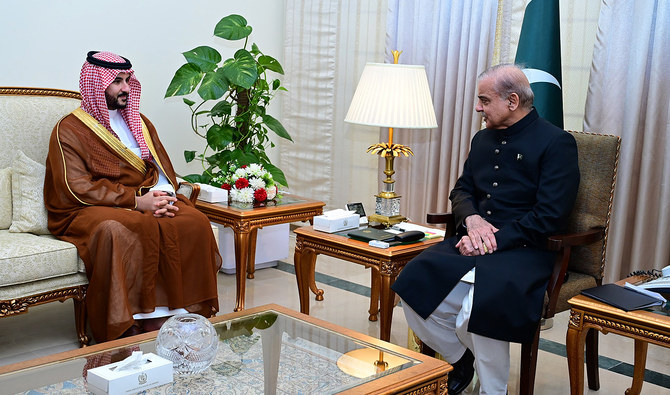
Saudi Arabia’s minister of defense, Prince Khalid bin Salman bin Abdul Aziz Al Saud, meets Pakistan Prime Minister Shehbaz Sharif at the Prime Minister’s House in Islamabad on March 23, 2024. (Photo courtesy: PMO)
2 / 2
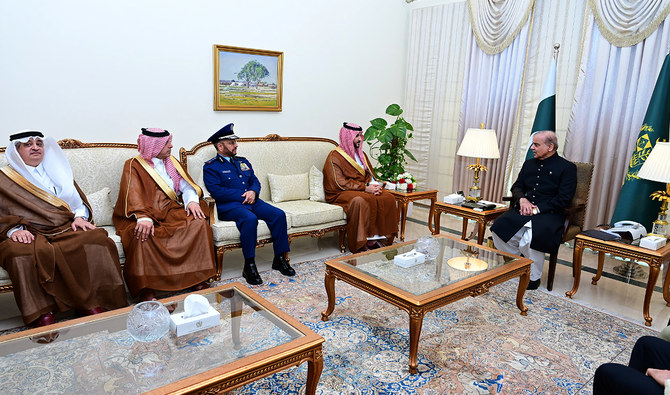
Saudi Arabia’s minister of defense, Prince Khalid bin Salman bin Abdul Aziz Al Saud (4L), meets Pakistan Prime Minister Shehbaz Sharif at the Prime Minister’s House in Islamabad on March 23, 2024. (Photo courtesy: PMO)
Short Url
Updated 23 March 2024
Follow

Pakistan PM praises Saudi economic support, discusses security issues with kingdom’s defense minister

  • Prince Khalid bin Salman arrived in the country on Saturday to attend the Pakistan Day parade as guest of honor
  • PM Sharif tells the Saudi royal his government is waiting for the visit of Crown Prince Mohammed bin Salman

ISLAMABAD: Prime Minister Shehbaz Sharif said on Saturday that Saudi Arabia had played a pivotal role in improving Pakistan’s economic situation during a meeting with the kingdom’s defense minister, Prince Khalid bin Salman, wherein they also discussed the regional peace and security situation.
The Saudi royal arrived in the country earlier in the day to attend the Pakistan Day military parade as a guest of honor and was warmly received by Defense Minister Khawaja Muhammad Asif and Army Chief General Asim Munir at the Nur Khan Airbase in Rawalpindi.
The parade was held on the 84th anniversary of Pakistan Day, marked each year to celebrate the adoption of the Lahore Resolution by the Muslim League, which called for the creation of an independent state for the Muslims of India on March 23, 1940.
The Saudi defense minister witnessed the performance of Pakistan’s military personnel at the Parade Avenue in the federal capital, Islamabad, along with a display of the country’s air defense system and nuclear-capable missiles.
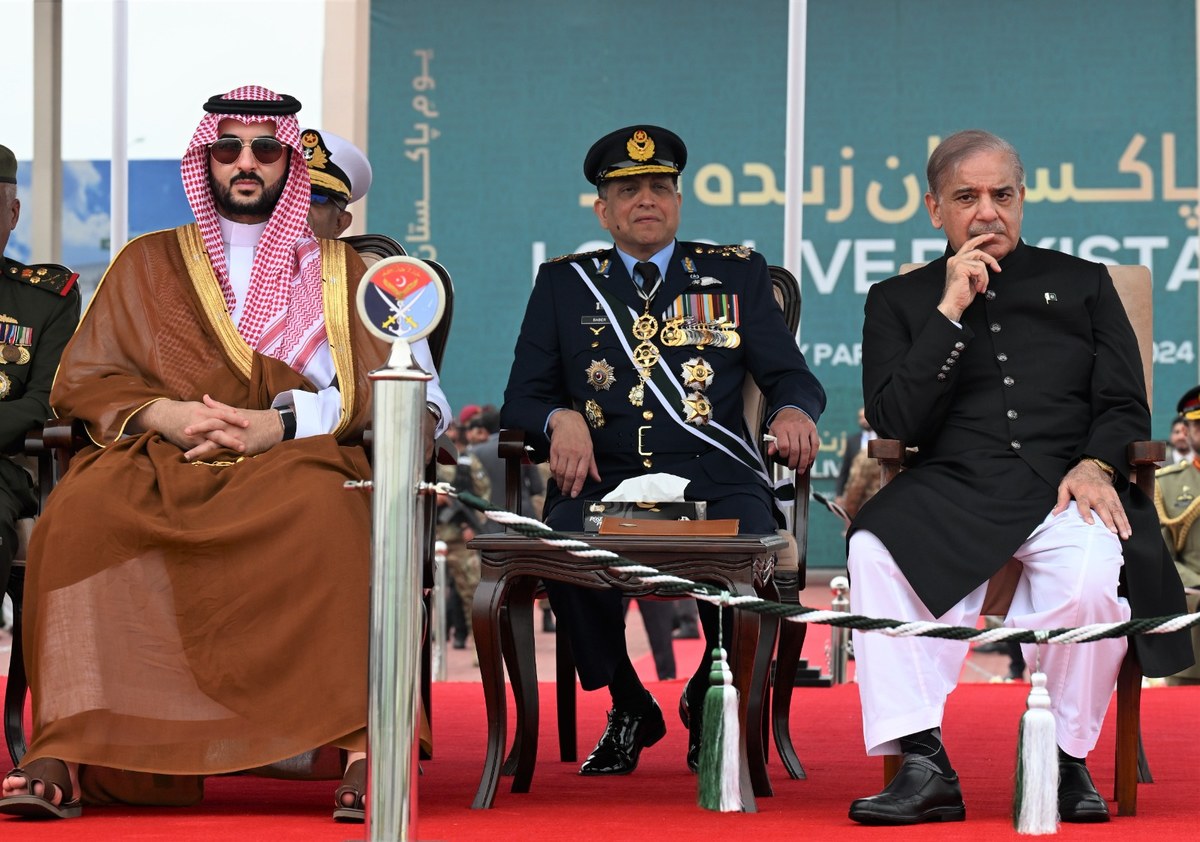


Saudi Arabia’s minister of defense, Prince Khalid bin Salman bin Abdul Aziz Al Saud, and Pakistan Prime Minister Shehbaz Sharif watch Pakistan Day military parade in Islamabad on March 23, 2024. (Photo courtesy: President Office)

According to an official statement, he later met the prime minister to discuss a wide range of issues.
“The meeting exchanged views on regional peace and security,” said the statement. “Discussion also took place on increasing cooperation in the defense and security sectors between the two countries.”
The prime minister said Pakistan and Saudi Arabia had deep-rooted relations that were growing stronger with a passage of time.
“Saudi Arabia has stood by Pakistan on every front,” he was quoted as saying in the statement. “During my previous term as prime minister, Saudi Arabia played a key role in improving Pakistan’s economic situation.”
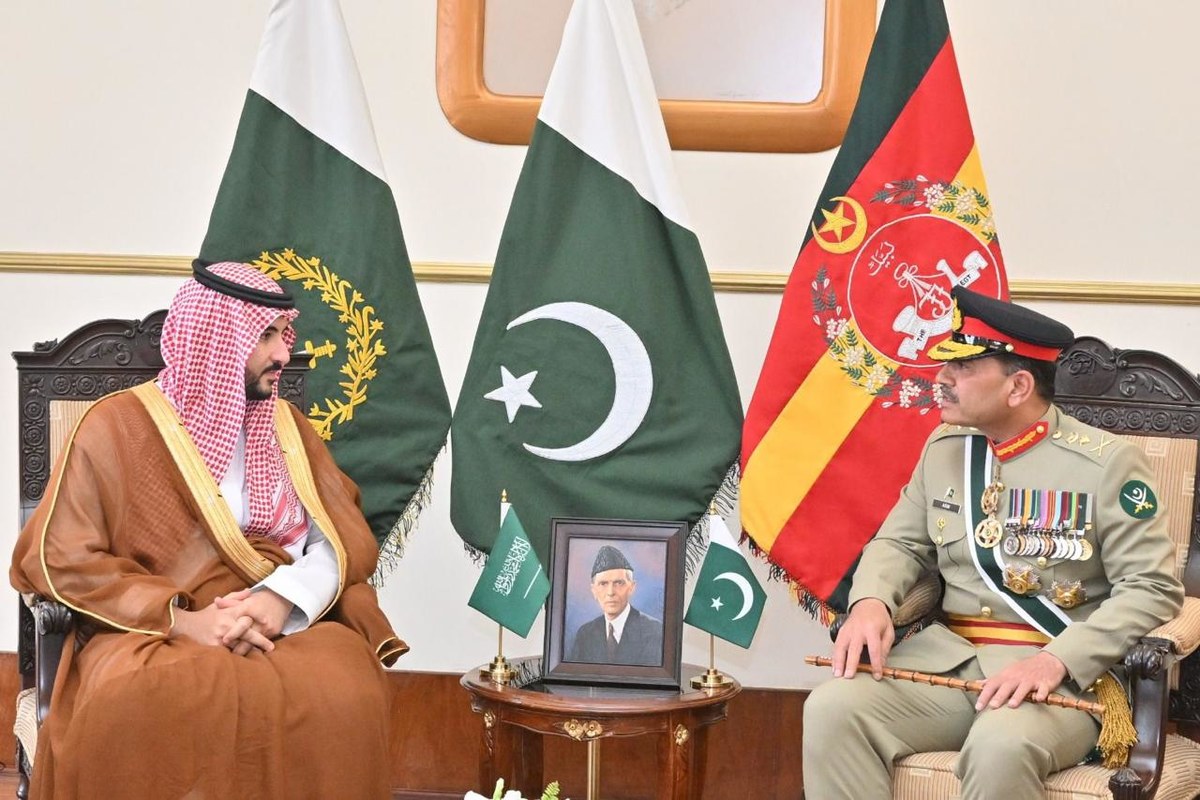


Saudi Arabia’s minister of defense, Prince Khalid bin Salman bin Abdul Aziz Al Saud, meets Pakistan Army Chief General Asim Munir during his day-long visit to attend Pakistan Day parade in Islamabad on March 23, 2024. (Photo courtesy: ISPR)

Sharif told the Saudi defense minister his government was waiting for the visit of Crown Prince Mohammed bin Salman to Pakistan.
Prince Khalid bin Salman thanked the prime minister for inviting him as the guest of honor to the Pakistan Day parade, saying he got to witness the excellent capabilities of the Pakistani armed forces at the event.
He also mentioned the recent visit of Pakistan’s army chief to the kingdom this month, saying it would further boost the defense relations between the two countries.
The Saudi minister later left for Saudi Arabia after his day-long visit to Pakistan.


Pakistan eyes ‘heavy’ Chinese investments in 10 key sectors at Islamabad agriculture summit

Updated 4 sec ago
Follow

Pakistan eyes ‘heavy’ Chinese investments in 10 key sectors at Islamabad agriculture summit

  • More than 300 Chinese and Pakistani firms attended the event focusing on fertilizers, seeds, smart farming and irrigation techniques
  • Islamabad expects the conference to lead to investments in agriculture, food processing, livestock, farm machinery and renewable energy

KARACHI: Pakistan is expecting “heavy” Chinese investments across 10 key sectors, including agriculture, renewable energy and technology, the Pakistani food security minister said on Monday, as officials and business leaders from both countries gathered for a major agriculture investment summit in Islamabad.
The Pakistan-China Agriculture Investment Conference was billed by Pakistan as a platform for deepening bilateral agricultural ties and supporting broader economic engagement between the two countries.
Around 120 Chinese companies and over 190 Pakistani firms participated in the event that focused on fertilizers, seed varieties, machinery, precision farming and smart irrigation systems, according to the organizers.
Speaking at the event, National Food Security Minister Rana Tanveer Hussain said the conference’s objective was to project Pakistan as a place where Chinese enterprises could grow, innovate and succeed alongside Pakistani partners.
“Heavy investments worth millions of dollars are expected, with multiple MoUs [memorandums of understanding] likely to be finalized by the end of the day across 10 key sectors, including agriculture, food processing, livestock, fisheries, agri-inputs, farm machinery, renewable energy, logistics, technology and value-added exports,” Hussain said on Monday evening.
Pakistan’s exports to China reached approximately $2.38 billion in Fiscal Year 2024–25 that ended in June, while imports stood at $16.3 billion, reflecting growing demand on both sides despite global economic headwinds, according to the minister.
This performance demonstrated resilience and expanding opportunities under the China–Pakistan Free Trade Agreement (CPFTA) framework.
Hussain said Islamabad was committed to supporting Chinese investors from regulatory processes to seamless coordination with all government departments and institutions.
“Together, Pakistan and China can push the boundaries of innovation, transform agri-technology, strengthen food security and reshape the economic landscape of the region,” he said.
The completion of the China-Pakistan Economic Corridor (CPEC) Phase I and the launch of CPEC Phase II marked a decisive shift toward industrialization, technology transfer, renewable energy and people-centric development, according to Hussain.
Both sides had signed over 40 MoUs in Sept. 2025, covering modern farming, livestock, fisheries, farm mechanization and advanced technology transfer.
“These initiatives are not just projects; they are lifelines of growth, confidence and mutual trust,” he said, adding that they aim to enhance productivity, expand exports, strengthen food security and ensure sustainable and inclusive economic growth.
Pakistan and China have been expanding cooperation in agriculture under the CPEC framework. Officials say stronger agricultural ties could help Pakistan boost exports, ensure food security and create jobs, while offering Chinese companies access to a large farming market and new investment opportunities.
Addressing the conference, Prime Minister Shehbaz Sharif urged Pakistani and Chinese agriculturists and experts to strengthen their existing partnership, saying that their sustained hard work and productivity gains could turn Pakistan into a surplus agricultural economy.
“Chinese experts are there to assist us and support us all the way to achieve this wonderful target [of becoming a surplus agricultural economy],” he said. “Now it’s up to us to generate this trade surplus through higher yields, comparative cost and, of course, highest quality.”
The prime minister noted that Pakistan’s policy rate was down to 10.5 percent down from 22 percent two years ago, exports were gradually increasing and macroeconomic indicators were stable.
“Now we have to move toward growth,” he said. “But then it requires solid, hard work, untiring efforts, blood and sweat. Without that, you will not be able to achieve your targets.”