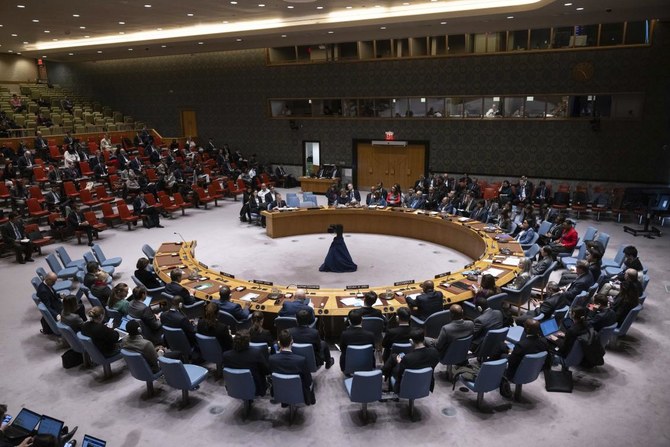
UNITED NATIONS, United States: A vote at the UN Security Council on a new text calling for an “immediate” ceasefire in the Israel-Hamas war was postponed to Monday, diplomatic sources said, after a separate, US-lead draft resolution was vetoed.
The United States, Israel’s main ally and military backer, had put forward a resolution mentioning “the imperative of an immediate and sustained ceasefire” and condemning the October 7 attack by Hamas.
Russia and China on Friday vetoed that resolution, which was also opposed by Arab states for stopping short of explicitly demanding Israel immediately end its campaign in Gaza.
The new ceasefire text was meant to go to a vote on Saturday, but was pushed back to allow further discussions, the diplomatic sources said.
The new, tougher draft resolution, seen by AFP, “demands an immediate ceasefire” for the ongoing Muslim holy month of Ramadan that leads “to a permanent sustainable ceasefire” respected by all sides.
Eight of the council’s 10 non-permanent members have been working on the draft, which also calls for the “immediate and unconditional” release of hostages seized by Hamas and the lifting of “all barriers” to humanitarian aid flowing into the besieged Gaza Strip.
“We as (the) Arab Group unanimously endorse and support the draft resolution,” said Palestinian ambassador to the UN Riyad Mansour, who had denounced the US-led text as biased.
But US Ambassador Linda Thomas-Greenfield indicated opposition, saying the resolution would jeopardize ongoing diplomatic efforts to secure the release of hostages — the same reason the United States gave before vetoing previous ceasefire resolutions.
“In its current form, that text fails to support sensitive diplomacy in the region. Worse, it could actually give Hamas an excuse to walk away from the deal on the table,” she said.
Friday’s text did not explicitly use the word “call,” but simply stated that a ceasefire was imperative, and linked to ongoing talks, led by Qatar with support from the United States and Egypt, to halt fighting in return for Hamas releasing hostages.
“If the US is serious about a ceasefire, then please vote in favor of the other draft resolution, clearly calling for a ceasefire,” China’s representative, Zhang Jun, said.
More than 1,160 people, mostly civilians, died on October 7 when Hamas militants infiltrated Israel in the country’s deadliest attack, according to Israeli official figures.
Israel has vowed to eradicate Hamas, which controls the Gaza Strip. More than 32,000 people, mostly civilians, have died in the retaliatory campaign, according to the Gaza health ministry, and the United Nations has warned of imminent famine in the territory.


![]()

UN Security Council vote on new Gaza ceasefire text postponed to Monday
Short Url
https://arab.news/n47dv
UN Security Council vote on new Gaza ceasefire text postponed to Monday
- New, tougher draft resolution ‘demands an immediate ceasefire’ for the ongoing Muslim holy month of Ramadan
- The US earlier put forward a resolution mentioning ‘the imperative of an immediate and sustained ceasefire,’ but was vetoed


Latest updates


© 2026 SAUDI RESEARCH & PUBLISHING COMPANY, All Rights Reserved And subject to Terms of Use Agreement.