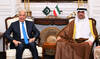
WASHINGTON: President Joe Biden plans to host Iraqi Prime Minister Mohammed Shia Al-Sudani, who is visiting next month as the countries hold formal talks about winding down the mission of a US-led military coalition formed to fight the Daesh group in Iraq.
The meeting is scheduled for April 15, the White House said Friday.
The leaders will “consult on a range of issues,” including the fight against Daesh and “ongoing Iraqi financial reforms to promote economic development and progress toward Iraq’s financial independence and modernization,” the White House said.
The two countries have a delicate relationship due in part to Iran’s considerable sway in Iraq, where a coalition of Iran-backed groups brought Al-Sudani to power in October 2022.
The US in recent months has urged Iraq to do more to prevent attacks on US bases in Iraq and Syria that have further roiled the Middle East in the aftermath of Hamas’ Oct. 7 attack on Israel. It’s also sought to apply financial pressure over Baghdad’s relationship with Tehran, restricting Iraq’s access to its own dollars in an effort to stamp out money laundering said to benefit Iran and Syria.
The US and Iraq, meanwhile, held a first session in January to discuss ending the coalition created to help the Iraqi government fight Daesh, with some 2,000 US troops remaining in the country under an agreement with Baghdad. Iraqi officials have periodically called for a withdrawal of those forces.
The visit will also come a year after the kidnapping in Baghdad of Elizabeth Tsurkov, a Russian-American academic at Princeton University who is believed to be held by an Iran-backed militia, Kataib Hezbollah, that is regarded by Washington as a terrorist group and is seen as one of the most powerful armed groups in Iraq. It was formed during the power vacuum that followed the 2003 US-led invasion of Iraq, with support from Iran’s Islamic Revolutionary Guard Corps.
On Thursday, Tsurkov’s sister, Emma, urged the State Department to declare Iraq a state sponsor of terrorism and called on the White House to make the Al-Sudani meeting contingent on the prime minister arranging for the release of her sister — something she said that he was empowered to do.
“I am appalled that Sudani will be allowed to shake President Biden’s hand while his other hand holds the keys to my sister’s shackles,” Tsurkov said at event outside the Iraqi Embassy in Washington.

Biden to host Iraqi leader with talks underway on winding down coalition against Daesh
Short Url
https://arab.news/25qk8
Biden to host Iraqi leader with talks underway on winding down coalition against Daesh
- The leaders will “consult on a range of issues,” including the fight against Daesh
- The two countries have a delicate relationship due in part to Iran’s considerable sway in Iraq
Syrian army declares a closed military zone east of Aleppo as tensions rise with Kurds
ALEPPO, Syria: The Syrian army on Tuesday declared an area east of the northern city of Aleppo a “closed military zone,” potentially signaling another escalation between government forces and fighters with the Kurdish-led Syrian Democratic Forces.
Several days of clashes in the city of Aleppo last week that displaced tens of thousands of people came to an end over the weekend with the evacuation of Kurdish fighters from the contested neighborhood of Sheikh Maqsoud.
Since then, Syrian officials have accused the SDF of building up its forces near the towns of Maskana and Deir Hafer, about 60 km (37 mi) east of Aleppo city, something the SDF denied.
State news agency SANA reported that the army had declared the area a closed military zone because of “continued mobilization” by the SDF “and because it serves as a launching point for Iranian suicide drones that have targeted the city of Aleppo.”
On Saturday afternoon, an explosive drone hit the Aleppo governorate building shortly after two Cabinet ministers and a local official held a news conference on the developments in the city. The SDF denied being behind the attack.
The army statement Tuesday said armed groups should withdraw to the area east of the Euphrates River.
The tensions come amid an impasse in political negotiations between the central state and the SDF.
The leadership in Damascus under interim President Ahmad Al-Sharaa signed a deal in March with the SDF, which controls much of the northeast, for it to merge with the Syrian army by the end of 2025. There have been disagreements on how it would happen.
Some of the factions that make up the new Syrian army, formed after the fall of former President Bashar Assad in a rebel offensive in December 2024, were previously Turkiye-backed insurgent groups that have a long history of clashing with Kurdish forces.
The SDF has for years been the main US partner in Syria in fighting against the Daesh group, but Turkiye considers the SDF a terrorist organization because of its association with the Kurdistan Workers’ Party, or PKK, which has waged a long-running insurgency in Turkiye. A peace process is now underway.
Despite the long-running US support for the SDF, the Trump administration in the US has also developed close ties with Al-Sharaa’s government and has pushed the Kurds to implement the March deal.
Shams TV, a station based in Irbil, the seat of northern Iraq’s semi-autonomous Kurdish region, had been set to air an interview with Al-Sharaa on Monday but later announced it had been postponed for “technical” reasons without giving a new date for airing it.
Several days of clashes in the city of Aleppo last week that displaced tens of thousands of people came to an end over the weekend with the evacuation of Kurdish fighters from the contested neighborhood of Sheikh Maqsoud.
Since then, Syrian officials have accused the SDF of building up its forces near the towns of Maskana and Deir Hafer, about 60 km (37 mi) east of Aleppo city, something the SDF denied.
State news agency SANA reported that the army had declared the area a closed military zone because of “continued mobilization” by the SDF “and because it serves as a launching point for Iranian suicide drones that have targeted the city of Aleppo.”
On Saturday afternoon, an explosive drone hit the Aleppo governorate building shortly after two Cabinet ministers and a local official held a news conference on the developments in the city. The SDF denied being behind the attack.
The army statement Tuesday said armed groups should withdraw to the area east of the Euphrates River.
The tensions come amid an impasse in political negotiations between the central state and the SDF.
The leadership in Damascus under interim President Ahmad Al-Sharaa signed a deal in March with the SDF, which controls much of the northeast, for it to merge with the Syrian army by the end of 2025. There have been disagreements on how it would happen.
Some of the factions that make up the new Syrian army, formed after the fall of former President Bashar Assad in a rebel offensive in December 2024, were previously Turkiye-backed insurgent groups that have a long history of clashing with Kurdish forces.
The SDF has for years been the main US partner in Syria in fighting against the Daesh group, but Turkiye considers the SDF a terrorist organization because of its association with the Kurdistan Workers’ Party, or PKK, which has waged a long-running insurgency in Turkiye. A peace process is now underway.
Despite the long-running US support for the SDF, the Trump administration in the US has also developed close ties with Al-Sharaa’s government and has pushed the Kurds to implement the March deal.
Shams TV, a station based in Irbil, the seat of northern Iraq’s semi-autonomous Kurdish region, had been set to air an interview with Al-Sharaa on Monday but later announced it had been postponed for “technical” reasons without giving a new date for airing it.
© 2026 SAUDI RESEARCH & PUBLISHING COMPANY, All Rights Reserved And subject to Terms of Use Agreement.