

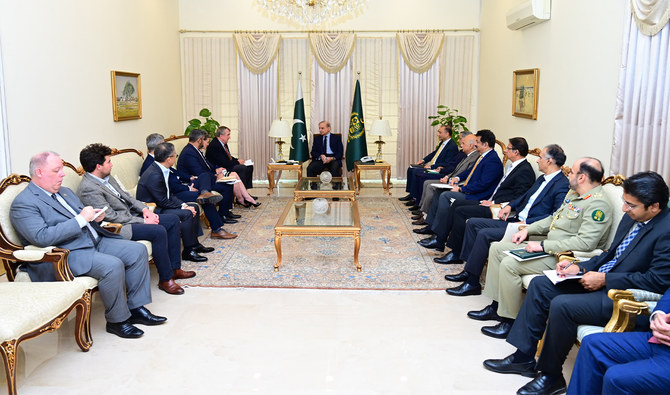

ISLAMABAD: Prime Minister Shehbaz Sharif on Friday termed Reko Diq mining project pivotal to the development of the impoverished Balochistan province on Friday, as he met the top official of the company leading the implementation of the initiative who mentioned various corporate social responsibility measures taken by his organization.
Located in Pakistan’s southwestern Chagai district, Reko Diq contains one of the biggest undeveloped copper and gold deposits in the world, with the potential to produce a large amount of these precious commodities for decades.
The project underwent legal and financial disputes, though it is considered highly significant for Pakistan’s mining sector and the broader economy, with the potential to transform the economic landscape of Balochistan and contribute substantially to the country’s overall development.
“Reko Diq project will prove to be a game changer for the development of Balochistan and the region,” the prime minister was quoted as saying in a statement issued by his office after his meeting with CEO Mark Bristow of Barrick Gold Corporation.
“Planning will be done for utilizing Balochistan’s mineral-rich benefits, especially in terms of communication infrastructure, including railway lines,” he added.
Sharif encouraged Barrick Gold to invest in other mineral projects in Balochistan while asking it to collaborate with the government that plans to establish a technical university in Chagai.
The people of Balochistan have long expressed discontent with Pakistan’s handling of their province’s vast mineral resources.
Many of them feel marginalized and believe the central government has exploited the province’s wealth without adequately investing in the local infrastructure, health care, education or providing sufficient economic benefits to the indigenous population.
The perceived neglect and exploitation have contributed to political unrest and demands for greater autonomy or even independence, as well as a fairer distribution of the revenue generated from their natural resources.
The Barrick Gold delegation briefed the prime minister on the progress of the project, saying its feasibility will be completed by the end of the year.
“Preference is being given to locals and those with Balochistan domicile for working on the Reko Diq project,” the official statement said while quoting the delegation. “Barrick Gold has also established three schools near Reko Diq under corporate social responsibility. It has also provided technical training to 100 individuals, including women.”
The prime minister also encouraged the company to invest in other mineral projects in Balochistan.
Given the lucrative potential of the mining site, Saudi Arabia has reportedly expressed interest in acquiring a partial stake in Reko Diq.
However, the CEO of Barrick Gold mentioned last month that no agreement had been finalized during the discussions between Pakistani and Saudi officials.


