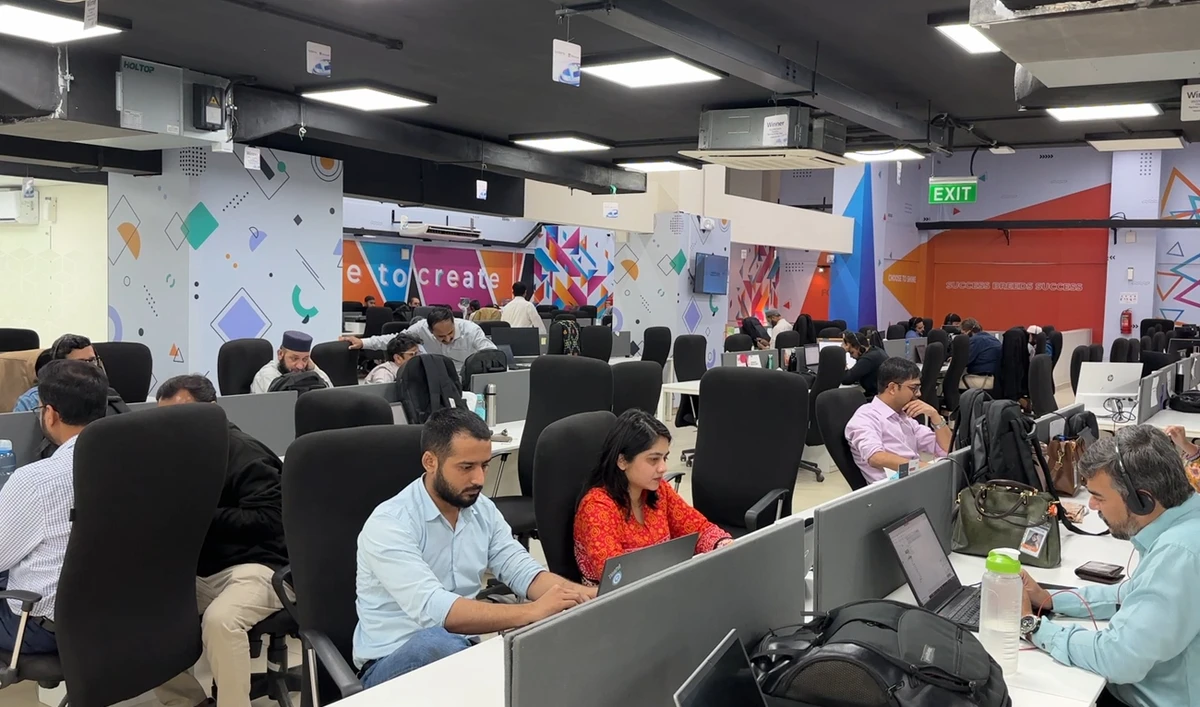
- IT exports have increased by 15 percent to $2 billion on annual basis since July 2023 due to enhance retention limit, stable currency
- Pakistani firms secured projects worth up to $10 million during LEAP event in Riyadh, generated leads worth almost $80 million
KARACHI: Pakistani information technology (IT) exporters hope to hit the $3.5 billion export milestone this year on the back of favorable policies at home and by successfully signing major deals with foreign, especially Saudi, firms.
The South Asian nation recorded monthly IT exports of $257 million in February this year, 32 percent more than exports recorded in the same month last year. Monthly IT exports in Feb. 2024 were higher than the last 12-month average of $233 million, according to central bank data released this week.
Pakistan’s IT exports in eight months of the current fiscal year, which began in July 2023, increased by 15 percent to $2 billion on an annual basis, compared to $1.7 billion recorded during the same period of last fiscal year (8MFY23).
Pakistani exporters attribute the surge to supportive policies that encouraged local companies to bring export proceeds back home and the formation of the Special Investment Facilitation Council (SIFC), a civil-military hybrid forum, aimed at boosting foreign investment in the country.
“The increase in the retention limit by the central bank and formation of SIFC which gives confidence to the people that if they will have any problem, it would be resolved, have led to the export surge from Pakistan,” Zohaib Khan, chairman of the Pakistan Software Houses Association (P@SHA), told Arab News.
“This year, we will hit an export target of $3.15 billion to $3.5 billion and next year, we will take it up to $5 billion because with the convenience of cross-border payments, the money of our companies that is lying abroad will come to Pakistan.”
The jump in IT exports has occurred due to a relaxation in the permissible retention limit by the State Bank of Pakistan (SBP), which increased it from 35 percent to 50 percent in the Exporters’ Specialized Foreign Currency Accounts, and stable currency which encouraged IT companies to repatriate their foreign income and deposit it in local accounts, according to a report by Karachi-based Topline Securities brokerage house.
Khan said the central bank was facilitating exporters with measures that would yield further results in the coming years.
“The central bank has introduced corporate debit cards, these products have now started coming out,” he said. “These products will allow exporters to bring in the money they have parked in foreign accounts because it will ensure cross-border payments.”
Currently, the P@SHA chief said, exporters were unable to make direct payments from Pakistan to companies or individuals abroad, but if the central bank allowed cross-border payments there would be no reason to keep export proceeds abroad.
Pakistani authorities are also focusing on harnessing the potential of IT exports and Finance Minister Muhammad Aurangzeb in a recent interview expressed hope that the country’s IT exports would likely increase to $3.5 billion this year.
Pakistan’s market for computer software has also seen steady growth for the past several years, with the total size of the software sector at approximately $3.2 billion.
The United States is Pakistan’s largest market for IT, accounting for 54.5 percent in FY 2023, according to the International Trade Administration (ITA). Pakistan’s IT sector consists primarily of software development and IT-enabled services (ITeS) for data centers, technical service/call centers, and telecom services, with 60 percent ITeS serving international customers. Much of the growth is driven by the work of freelancers and tech start-ups.
“SAUDI FACTOR”
The export push also comes from Saudi Arabia where dozens of Pakistani IT firms this month presented their innovative ideas and products at the LEAP tech exhibition, according to Khan.
“Projects ranging from $8 to $10 million have been spot-closed, and a pipeline for projects worth $70 to $80 million has been generated,” he said, adding that Pakistanis who recently attended tech events in Saudi Arabia, Kuwait and Dubai were registering their companies there.
Last year, LEAP 2023 generated a whopping $9 billion in IT business and Pakistani companies generated leads worth upwards of $100 million on the sidelines in business-to-business (B2B) matchmaking, according to P@SHA.
Khan estimated that there had been an increase of up to $100 million IT exports to Saudi Arabia in the last two years.