

Creature named Kermit the Frog offers clues on amphibian evolution

1 / 2
A composite image shows the fossil skull of the Permian Period proto-amphibian Kermitops (L) alongside a modern frog skull (Lithobates palustris), in this undated handout. (Brittany M. Hance, Smithsonian/Handout via REUTERS)
2 / 2
A fossil of the skull of the largest dolphin in history that inhabited the Peruvian Amazon 16 million years ago and was discovered in an expedition sponsored by the National Geographic Society is exhibited at the Museum of Natural History in Lima, Peru, on March 20, 2024. (REUTERS)
Short Url
Updated 27 March 2024
Follow

Creature named Kermit the Frog offers clues on amphibian evolution

  • Scientists described the fossilized skull of a creature called Kermitops gratus that lived in what is now Texas about 270 million years ago
  • Amphibians are one of the four groups of living terrestrial vertebrates, along with reptiles, birds and mammals

WASHINGTON: There definitely were no muppets during the Permian Period, but there was a Kermit — or at least a forerunner of modern amphibians that has been named after the celebrity frog.

Scientists on Thursday described the fossilized skull of a creature called Kermitops gratus that lived in what is now Texas about 270 million years ago. It belongs to a lineage believed to have given rise to the three living branches of amphibians — frogs, salamanders and limbless caecilians.
While only the skull — measuring around 1.2 inches (3 cm) long — was discovered, the researchers think Kermitops had a stoutly built salamander-like body roughly 6-7 inches (15-18 cm) long, though salamanders would not evolve for another roughly 100 million years.
Amphibians are one of the four groups of living terrestrial vertebrates, along with reptiles, birds and mammals. The unique features of the Kermitops skull — a blend of archaic and more advanced features — are providing insight into amphibian evolution.
“Kermitops helps us understand the early history of amphibians by revealing there isn’t a clear trend of step by step becoming more like the modern amphibian,” said Calvin So, a George Washington University paleontology doctoral student and lead author of the study published in the Zoological Journal of the Linnean Society.
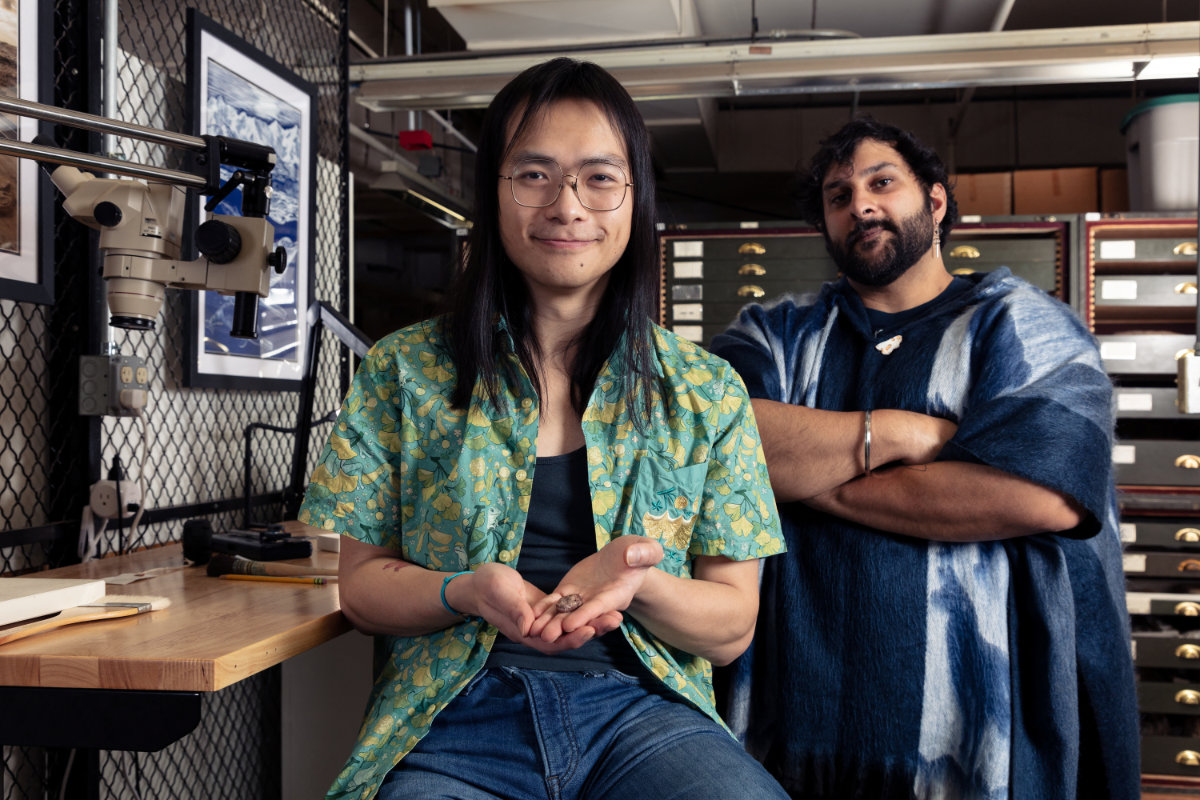


Calvin So (L), a doctoral student at George Washington University, and Arjan Mann, a Smithsonian postdoctoral paleontologist, pose with the fossil skull of the Permian period proto-amphibian Kermitops in the Smithsonianâ's National Museum of Natural History fossil collection, in Washington, D.C., in this undated handout picture. (Phillip R. Lee./Handout via REUTERS)

The fossil was collected in 1984 near Lake Kemp in Texas and kept in the expansive collection of the Smithsonian Institution’s National Museum of Natural History in Washington, but was not thoroughly studied until recently.
Kermitops had a rounded snout, not unlike frogs and salamanders. Preserved in its eye sockets were palpebral bones — or eyelid bones — a feature absent in today’s amphibians. Its skull is constructed of roof-like bones, in contrast to the thin and strut-like bones of modern amphibians.
“The length of the skull in front of the eyes is longer than the length of the skull behind the eyes, which differs from the other fossil amphibians living at the same time. We think this might have allowed Kermitops to snap its jaws closed faster, enabling capture of fast insect prey,” So said.
The fossil record of early amphibians and their forerunners is spotty, making it difficult to figure out the origins of modern amphibians.
“Kermitops, with its unique anatomy, really exemplifies the importance of continuing to add new fossil data to understanding this evolutionary problem,” said National Museum of Natural History paleontologist and study co-author Arjan Mann.
Kermit the Frog was created by the late American puppeteer Jim Henson in 1955, and a Kermit puppet made in the 1970s is in the collection of the Smithsonian’s National Museum of American History as an important cultural object.
Kermitops means “Kermit face,” a nod to the muppet’s humorous look.
“We thought that the eyelid bones gave the fossil a bug-eyed look, and combined with a lopsided smile produced by slight crushing during the preservation of the fossil, we really thought it looked like Kermit the Frog,” So said.
Kermitops belonged to a group called temnospondyls that arose a few tens of millions of years after the first land vertebrates evolved from fish ancestors. The biggest temnospondyls superficially resembled crocodiles, including two that each were around 20 feet (6 meters) in length, Prionosuchus and Mastodonsaurus.
Temnospondyls are considered the progenitor lineage of modern amphibians, Mann said.
Kermitops existed about 20 million years before the worst mass extinction in Earth’s history and about 40 million years before the first dinosaurs. It lived alongside other members of the amphibian lineage as well as the impressive sail-backed Dimetrodon, a predator related to the mammalian lineage.
The environment in which Kermitops lived appears to have alternated between warm and humid seasons and hot and arid seasons.
“This environment would be similar to modern-day monsoons that take place in the Southwest US and Southeast Asia,” So said.


Filipinos master disaster readiness, one roll of the dice at a time

Updated 29 December 2025
Follow

Filipinos master disaster readiness, one roll of the dice at a time

  • In a library in the Philippines, a dice rattles on the surface of a board before coming to a stop, putting one of its players straight into the path of a powerful typhoon

MANILA: In a library in the Philippines, a dice rattles on the surface of a board before coming to a stop, putting one of its players straight into the path of a powerful typhoon.
The teenagers huddled around the table leap into action, shouting instructions and acting out the correct strategies for just one of the potential catastrophes laid out in the board game called Master of Disaster.
With fewer than half of Filipinos estimated to have undertaken disaster drills or to own a first-aid kit, the game aims to boost lagging preparedness in a country ranked the most disaster-prone on earth for four years running.
“(It) features disasters we’ve been experiencing in real life for the past few months and years,” 17-year-old Ansherina Agasen told AFP, noting that flooding routinely upends life in her hometown of Valenzuela, north of Manila.
Sitting in the arc of intense seismic activity called the “Pacific Ring of Fire,” the Philippines endures daily earthquakes and is hit by an average of 20 typhoons each year.
In November, back-to-back typhoons drove flooding that killed nearly 300 people in the archipelago nation, while a 6.9-magnitude quake in late September toppled buildings and killed 79 people around the city of Cebu.
“We realized that a lot of loss of lives and destruction of property could have been avoided if people knew about basic concepts related to disaster preparedness,” Francis Macatulad, one of the game’s developers, told AFP of its inception.
The Asia Society for Social Improvement and Sustainable Transformation (ASSIST), where Macatulad heads business development, first dreamt up the game in 2013, after Super Typhoon Haiyan ravaged the central Philippines and left thousands dead.
Launched six years later, Master of Disaster has been updated this year to address more events exacerbated by human-driven climate change, such as landslides, drought and heatwaves.
More than 10,000 editions of the game, aimed at players as young as nine years old, have been distributed across the archipelago nation.
“The youth are very essential in creating this disaster resiliency mindset,” Macatulad said.
‘Keeps on getting worse’ 
While the Philippines has introduced disaster readiness training into its K-12 curriculum, Master of Disaster is providing a jolt of innovation, Bianca Canlas of the Department of Science and Technology (DOST) told AFP.
“It’s important that it’s tactile, something that can be touched and can be seen by the eyes of the youth so they can have engagement with each other,” she said of the game.
Players roll a dice to move their pawns across the board, with each landing spot corresponding to cards containing questions or instructions to act out disaster-specific responses.
When a player is unable to fulfil a task, another can “save” them and receive a “hero token” — tallied at the end to determine a winner.
At least 27,500 deaths and economic losses of $35 billion have been attributed to extreme weather events in the past two decades, according to the 2026 Climate Risk Index.
“It just keeps on getting worse,” Canlas said, noting the lives lost in recent months.
The government is now determining if it will throw its weight behind the distribution of the game, with the sessions in Valenzuela City serving as a pilot to assess whether players find it engaging and informative.
While conceding the evidence was so far anecdotal, ASSIST’s Macatulad said he believed the game was bringing a “significant” improvement in its players’ disaster preparedness knowledge.
“Disaster is not picky. It affects from north to south. So we would like to expand this further,” Macatulad said, adding that poor communities “most vulnerable to the effects of climate change” were the priority.
“Disasters can happen to anyone,” Agasen, the teen, told AFP as the game broke up.
“As a young person, I can share the knowledge I’ve gained... with my classmates at school, with people at home, and those I’ll meet in the future.”