JERUSALEM: Rachel Goldberg said it still does not feel real 167 days after her son was taken hostage by Hamas, as prayers echoed at Jerusalem’s Western Wall Thursday for the Gaza captives.
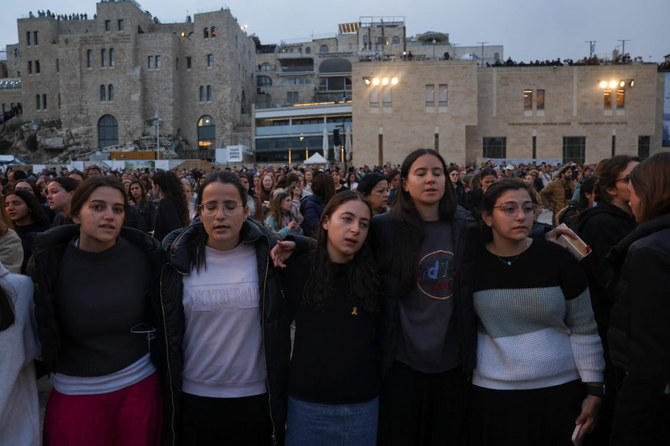
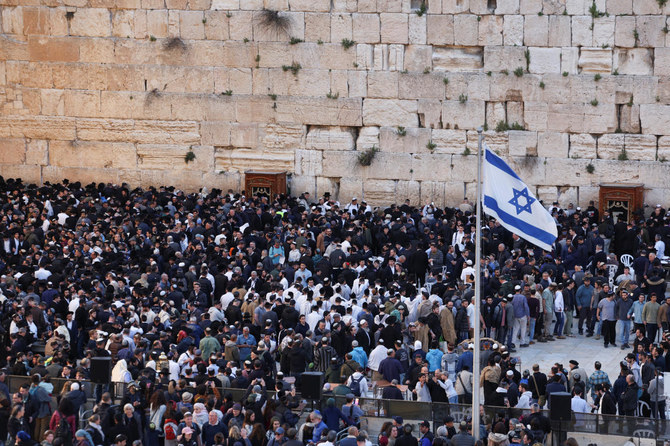
She spoke as thousands stood at the holy site for a mass Jewish prayer seeking the return of the 130 hostages Israel believes remain in the Palestinian territory — including Hersh Goldberg-Polin, 23.
“People say ‘We can’t image what you’re going through’ and we always say, we can’t imagine what we’re going through,” said Goldberg, seated next to her husband Jonathan Polin.
Both wore strips of masking tape on their chests that had “167” written on them in black marker for the days their son has been held.
Goldberg-Polin was snatched at the Nova music festival in southern Israel where nearly a third of the deaths occurred in the October 7 attack and many hostages were taken.
Families of the hostages have pushed to keep the attention of the public and leaders on their loved ones’ fates, which depend largely on a negotiated exchange with the militants that took them.
The thousands who gathered at the Western Wall, the holiest site where Jews can pray at the foot of the Al-Aqsa Mosque, Islam’s third holiest shrine, chanted the Shema prayer — an affirmation of Judaism — to the sound of a ram’s horn instrument known as the “shofar.”
“I think it’s really touching that all of these people come together,” said Shai Zohar, uncle to hostage Omer Neutra, 22.
Hostages’ families, friends and supporters, some wearing T-shirts bearing their pictures, were part of the crowd closest to the wall.
The area is revered by Jews, who come from across the world to pray at the Western Wall, also known as the Wailing Wall, a remnant of the biblical Second Temple.
The Hostages Families Forum, which represents some of the families, said in a statement that “the strength you give us allows us to continue the difficult struggle in our lives: the struggle for the release of our loved ones.”
The bloodiest-ever Gaza war broke out after Hamas’s attacks resulted in about 1,160 deaths in Israel, mostly civilians, according to an AFP tally of Israeli official figures.
Israel’s military has waged a retaliatory offensive against Hamas that has killed 31,988 people, most of them women and children, according to Gaza’s health ministry.
Militants also seized about 250 hostages, of whom Israel believes 130 remain in Gaza, including 33 who are presumed dead.
The mass prayer came just weeks ahead of the six-month mark since the attack.
“Somehow or other as a world, it’s crazy to me that we’ve let it get to six months,” Jonathan Polin told AFP.


![]()
![]()

Thousands pray in Jerusalem for Gaza hostages’ return
Short Url
https://arab.news/z6fab
Thousands pray in Jerusalem for Gaza hostages’ return
- Families of the hostages have pushed to keep the attention of the public and leaders on their loved ones’ fates
- Hostages’ families, friends and supporters, some wearing T-shirts bearing their pictures, were part of the crowd closest to the wall


Latest updates


© 2026 SAUDI RESEARCH & PUBLISHING COMPANY, All Rights Reserved And subject to Terms of Use Agreement.