

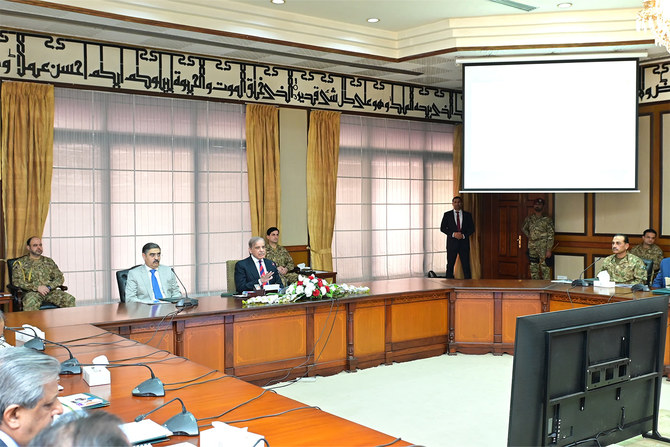

ISLAMABAD: Prime Minister Shehbaz Sharif said on Thursday that Pakistan needed another long-term bailout from the International Monetary Fund (IMF) and structural reforms to stabilize its fragile $350 billion economy in the long run.
The Pakistani premier’s comments came a day after the South Asian country signed a staff-level agreement with the international lender, which would see the disbursement of $1.1 billion for Islamabad next month.
Pakistan and the IMF agreed to a stand-by arrangement (SBA) in 2023, a last-gasp deal secured by Islamabad to avoid a sovereign default. The arrangement expires on April 11 and the IMF has said it would formulate a medium-term program if Islamabad applies for it.
“We have to take this macro-level stability forward,” Sharif told a meeting of the Special Investment Facilitation Council’s apex committee on Thursday.
“And it is inevitable that without another agreement [with the IMF], we cannot survive.”
Sharif, however, said another IMF program would not ensure that Pakistan’s growth trajectory increases significantly.
“This program whose duration could be two to three years, we have to bring deep-rooted, structural reforms with it,” he said, adding that failure to do so would not stop Pakistan’s economy from “bleeding” badly.
The prime minister sought the support of all political parties and provincial governments to successfully implement an agenda that ensures macroeconomic stability in Pakistan.
“For this we will have to work together,” he said. “With the support of all the provinces, we will together resolve all the challenges and difficulties faced by the country.”
Pakistan’s debt-ridden economy has been under extreme stress with low reserves, a balance of payment crisis, inflation at 23 percent, policy interest rates at 22 percent and record depreciation of its currency.
A shaky coalition cobbled together by Sharif’s Pakistan Muslim League-Nawaz (PML-N) featuring representatives of other political parties in the cabinet, will have to take tough economic decisions to commit to a new IMF program.
This would mean taking steps needed to stay on a narrow path to recovery, limiting policy options to provide relief to a deeply frustrated population and catering to industries that are looking for government support to spur growth.


