ISLAMABAD: A senior United States administration official said on Wednesday his country was trying to prevent the construction of Iran-Pakistan (IP) gas pipeline after the administration in Islamabad approved its 80-kilometer segment in February.
Originally intended to supply gas from Iran to both Pakistan and neighboring India, the IP project remained stalled for significant period due to the international sanctions targeting Iran.
The US expressed opposition to it from the outset, raising concerns that Pakistan could face financial penalties if it proceeded with it.
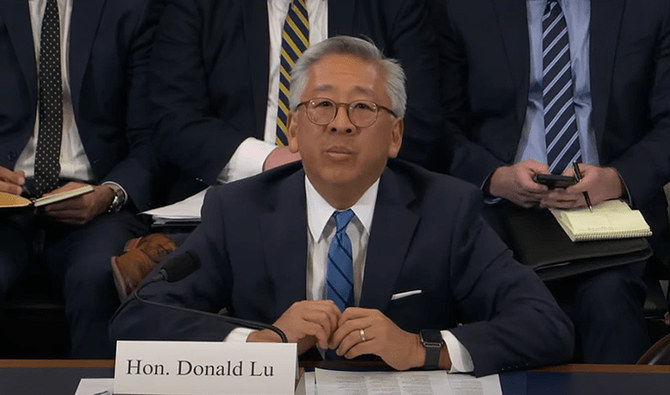
The issue came up for discussion during a Congressional hearing where US Assistant Secretary of State Donald Lu presented a testimony related to the political situation in Pakistan and answered a broad range of questions.
“I fully support the efforts by the US government to prevent this pipeline from happening,” he said in response to a query. “We are working toward that goal.”
The Petroleum Division of Pakistan’s Energy Ministry announced last month the country would build the pipeline from its border with Iran to Gwadar in the first phase.
The IP project, agreed upon by both countries, includes stipulations that could lead to financial penalties if either party fails to meet the construction deadlines or breaches the contract terms.
The US official dismissed the possibility that Pakistan’s decision to build the 80-kilometer stretch of the pipeline reflected its strategic alignment with Iran, pointing out that the two countries “traded missiles and drone strikes a few weeks ago.”
“We are tracking this planned pipeline between Iran and Pakistan,” he added. “Honestly, I don’t know where the financing for such a project would come from. I don’t think that many international donors would be interested in funding such an endeavor.”
He noted Pakistan had not sought any waiver related to the US sanctions that “would certainly result from such a project.”
“We are in consultation with the Pakistani government on this issue,” he continued. “The administration will uphold both in letter and spirit all sanction laws related to Iran.”


US working on ‘goal’ to prevent Iran-Pakistan gas pipeline project — US diplomat Lu
https://arab.news/csrcg
US working on ‘goal’ to prevent Iran-Pakistan gas pipeline project — US diplomat Lu

- Donald Lu tells a Congressional hearing Pakistan’s decision to build the pipeline will lead to US sanctions
- Pakistan approved construction of 80-kilometer pipeline segment last month from its border with Iran to Gwadar

UN experts slam Pakistan lawyer convictions
- Imaan Mazari, husband Hadi Ali Chattha were sentenced to 10 years last month for “anti-state” social media posts
- Five UN special rapporteurs say couple jailed for exercising rights guaranteed by international human rights law
GENEVA, Switzerland: Five UN special rapporteurs on Wednesday condemned the conviction and lengthy jail sentences imposed on a prominent rights activist and her fellow lawyer husband in Pakistan over “anti-state” social media posts.
Imaan Mazari, a 32-year-old lawyer and vocal critic of Pakistan’s military, “disseminated highly offensive” content on X, according to an Islamabad court.
She and her husband Hadi Ali Chattha were jailed on January 25, with a court statement saying they “will have to remain in jail for 10 years.”
The UN experts said they had been jailed for “simply exercising rights guaranteed by international human rights law.”
“Lawyers, like other individuals, are entitled to freedom of expression. The exercise of this right should never be conflated with criminal conduct, especially not terrorism,” they said in a joint statement.
“Doing so risks undermining and criminalizing the work of lawyers and human rights defenders across Pakistan and has a chilling effect on civil society in the country.”
Mazari shot to prominence tackling some of Pakistan’s most sensitive topics while defending ethnic minorities, journalists facing defamation charges and clients branded blasphemers.
As a pro bono lawyer, Mazari has worked on some of the most sensitive cases in Pakistan, including the enforced disappearances of ethnic Balochs, as well as defending the community’s top activist, Mahrang Baloch.
Mazari and her husband have been the subject of multiple prosecutions in the past, but have never previously been convicted of wrongdoing.
“This pattern of prosecutions suggests an arbitrary use of the legal system as an instrument of harassment and intimidation in order to punish them for their work advocating for victims of alleged human rights violations,” the UN experts said.
“States must ensure lawyers are not subject to prosecution for any professional action, and that lawyers are not identified with their clients.”
The statement’s signatories included the special rapporteurs on human rights defenders, the independence of judges, freedom of opinion, freedom of association and on protecting rights while countering terrorism.
UN special rapporteurs are independent experts mandated by the UN Human Rights Council to report their findings. They do not speak in the name of the United Nations itself.
The UN experts have put their concerns to Islamabad.


