​US working on ‘goal’ to prevent Iran-Pakistan gas pipeline project — US diplomat Lu

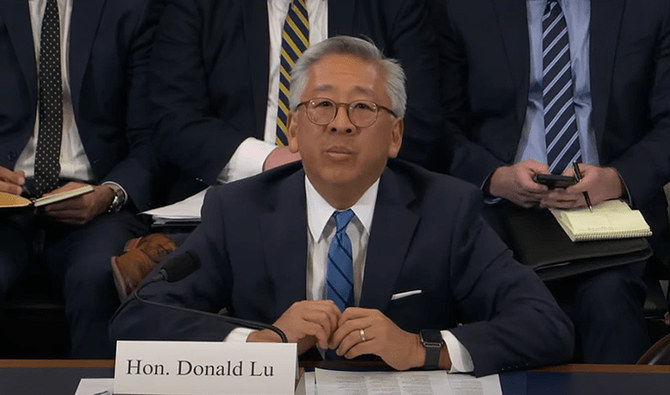
US Assistant Secretary of State Donald Lu testifies before a subcommittee of the US House Committee on Foreign Affairs in the US House of Representatives in US in March 20, 2024. (US Capitol)
Short Url
Updated 21 March 2024
Follow

​US working on ‘goal’ to prevent Iran-Pakistan gas pipeline project — US diplomat Lu

  • Donald Lu tells a Congressional hearing Pakistan’s decision to build the pipeline will lead to US sanctions
  • Pakistan approved construction of 80-kilometer pipeline segment last month from its border with Iran to Gwadar

ISLAMABAD: A senior United States administration official said on Wednesday his country was trying to prevent the construction of Iran-Pakistan (IP) gas pipeline after the administration in Islamabad approved its 80-kilometer segment in February.
Originally intended to supply gas from Iran to both Pakistan and neighboring India, the IP project remained stalled for significant period due to the international sanctions targeting Iran.
The US expressed opposition to it from the outset, raising concerns that Pakistan could face financial penalties if it proceeded with it.
The issue came up for discussion during a Congressional hearing where US Assistant Secretary of State Donald Lu presented a testimony related to the political situation in Pakistan and answered a broad range of questions.
“I fully support the efforts by the US government to prevent this pipeline from happening,” he said in response to a query. “We are working toward that goal.”
The Petroleum Division of Pakistan’s Energy Ministry announced last month the country would build the pipeline from its border with Iran to Gwadar in the first phase.
The IP project, agreed upon by both countries, includes stipulations that could lead to financial penalties if either party fails to meet the construction deadlines or breaches the contract terms.
The US official dismissed the possibility that Pakistan’s decision to build the 80-kilometer stretch of the pipeline reflected its strategic alignment with Iran, pointing out that the two countries “traded missiles and drone strikes a few weeks ago.”
“We are tracking this planned pipeline between Iran and Pakistan,” he added. “Honestly, I don’t know where the financing for such a project would come from. I don’t think that many international donors would be interested in funding such an endeavor.”
He noted Pakistan had not sought any waiver related to the US sanctions that “would certainly result from such a project.”
“We are in consultation with the Pakistani government on this issue,” he continued. “The administration will uphold both in letter and spirit all sanction laws related to Iran.”


Pakistan terms climate change, demographic pressures as ‘pressing existential risks’

Updated 06 December 2025
Follow

Pakistan terms climate change, demographic pressures as ‘pressing existential risks’

  • Pakistan has suffered frequent climate change-induced disasters, including floods this year that killed over 1,000
  • Pakistan finmin highlights stabilization measures at Doha Forum, discusses economic cooperation with Qatar 

ISLAMABAD: Pakistan’s Finance Minister Muhammad Aurangzeb on Saturday described climate change and demographic pressures as “pressing existential risks” facing the country, calling for urgent climate financing. 

The finance minister was speaking as a member of a high-level panel at the 23rd edition of the Doha Forum, which is being held from Dec. 6–7 in the Qatari capital. Aurangzeb was invited as a speaker on the discussion titled: ‘Global Trade Tensions: Economic Impact and Policy Responses in MENA.’

“He reaffirmed that while Pakistan remained vigilant in the face of geopolitical uncertainty, the more pressing existential risks were climate change and demographic pressures,” the Finance Division said. 

Pakistan has suffered repeated climate disasters in recent years, most notably the 2022 super-floods that submerged one-third of the country, displaced millions and caused an estimated $30 billion in losses. 

This year’s floods killed over 1,000 people and caused at least $2.9 billion in damages to agriculture and infrastructure. Scientists say Pakistan remains among the world’s most climate-vulnerable nations despite contributing less than 1 percent of global greenhouse-gas emissions.

Aurangzeb has previously said climate change and Pakistan’s fast-rising population are the only two factors that can hinder the South Asian country’s efforts to become a $3 trillion economy in the future. 

The finance minister noted that this year’s floods in Pakistan had shaved at least 0.5 percent off GDP growth, calling for urgent climate financing and investment in resilient infrastructure. 

When asked about Pakistan’s fiscal resilience and capability to absorb external shocks, Aurangzeb said Islamabad had rebuilt fiscal buffers. He pointed out that both the primary fiscal balance and current account had returned to surplus, supported significantly by strong remittance inflows of $18–20 billion annually from the Middle East and North Africa (MENA) and Gulf Cooperation Council (GCC) regions. 

Separately, Aurangzeb met his Qatari counterpart Ali Bin Ahmed Al Kuwari to discuss bilateral cooperation. 

“Both sides reaffirmed their commitment to strengthening economic ties, particularly by maximizing opportunities created through the newly concluded GCC–Pakistan Free Trade Agreement, expanding trade flows, and deepening energy cooperation, including long-term LNG collaboration,” the finance ministry said. 

The two also discussed collaboration on digital infrastructure, skills development and regulatory reform. They agreed to establish structured mechanisms to continue joint work in trade diversification, technology, climate resilience, and investment facilitation, the finance ministry said.