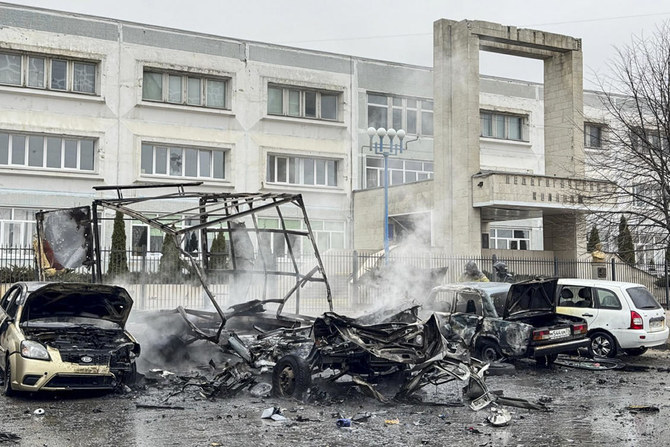
KYIV: Russia launched a missile attack on Kyiv, the Ukrainian capital, early on Thursday, injuring at least 10 people and damaging residential buildings and industrial facilities, city officials said, although air defenses downed all the missiles.
The first large attack in recent weeks targeted the city with both ballistic and cruise missiles, said Serhiy Popko, the head of its military administration.
“After a pause of 44 days, the enemy launched another missile attack on Kyiv,” he said. “All emergency services are working on sites. Clearing the consequences of the missile attack is underway.”
Mayor Vitali Klitschko said at least 10 people were injured across the city. An 11-year-old girl was among the two people taken to hospital, city officials said.
Ukraine’s air defenses shot down all 31 Russian missiles targeting the capital, the air force commander said.
Popko said the Russian military used strategic bombers and also launched some missiles from its territory, while following complicated maneuvers in neighboring regions, the missiles targeted the city from different directions.
Air alerts lasted for nearly three hours.
Klitschko said missile debris hit several residential buildings, industrial sites, and a kindergarten across the city.
Residents of a multi-story building in the central district of Shevchenkivskyi were evacuated after one of the apartments caught fire. The attack also shattered windows in several houses nearby, and set private cars ablaze, Popko said.

Russia launches missile attack on Kyiv, 10 injured
Short Url
https://arab.news/jfgwk
Russia launches missile attack on Kyiv, 10 injured
- It was the first large missile attack on Kyiv in recent weeks
Thai and Cambodian top diplomats meet in China to solidify ceasefire
BEIJING: Top diplomats from Thailand and Cambodia kicked off two days of talks in China on Sunday as Beijing seeks to strengthen its role in mediating the two countries’ border dispute, a day after they signed a new ceasefire.
The ceasefire agreement signed on Saturday calls for a halt to weeks of fighting along their contested border that has killed more than 100 people and displaced over half a million in both countries.
Thai Foreign Minister Sihasak Phuangketkeow and Cambodian Foreign Minister Prak Sokhonn were set to meet in China’s southwestern Yunnan province for talks mediated by their Chinese counterpart, Wang Yi.
The talks aim to ensure a sustained ceasefire and promote lasting peace between the countries, according to a statement by Sihasak’s office.
Wang was scheduled to join both bilateral meetings with each of the diplomats and a trilateral talk on Monday.
China has welcomed the ceasefire announcement, which freezes the front lines and allows for displaced civilians to return to their homes near the border.
“China stands ready to continue to provide (the) platform and create conditions for Cambodia and Thailand to have fuller and more detailed communication,” a Chinese Foreign Ministry statement read.
The ceasefire agreement comes with a 72-hour observation period, at the end of which Thailand agreed to repatriate 18 Cambodian soldiers it has held as prisoners since earlier fighting in July. Their release has been a major demand of the Cambodian side.
China has sought to position itself as a mediator in the crisis, along with the United States and Malaysia.
A July ceasefire was brokered by Malaysia and pushed through by pressure from US President Donald Trump, who threatened to withhold trade privileges unless Thailand and Cambodia agreed.
Despite those deals, Thailand and Cambodia carried on a bitter propaganda war, and minor cross-border violence continued, erupting into heavy fighting in early December.
Prak Sokhonn, in a statement after his meeting with Wang, expressed deep appreciation for China’s “vital role” in supporting the ceasefire.
China also announced 20 million yuan ($2.8 million) of emergency humanitarian aid for Cambodia to assist the displaced.
The first batch of Chinese aid, including food, tents and blankets, arrived in Cambodia on Sunday, Wang Wenbin, Chinese ambassador to Cambodia, wrote on Facebook.
Sihasak said Sunday he hoped the meetings would convey to China that it should both support a sustainable ceasefire and send a signal to Cambodia against reviving the conflict or attempting to create further ones.
“Thailand does not see China merely as a mediator in our conflict with Cambodia but wants China to play a constructive role in ensuring a sustainable ceasefire by sending such signals to Cambodia as well,” he said.
The ceasefire agreement signed on Saturday calls for a halt to weeks of fighting along their contested border that has killed more than 100 people and displaced over half a million in both countries.
Thai Foreign Minister Sihasak Phuangketkeow and Cambodian Foreign Minister Prak Sokhonn were set to meet in China’s southwestern Yunnan province for talks mediated by their Chinese counterpart, Wang Yi.
The talks aim to ensure a sustained ceasefire and promote lasting peace between the countries, according to a statement by Sihasak’s office.
Wang was scheduled to join both bilateral meetings with each of the diplomats and a trilateral talk on Monday.
China has welcomed the ceasefire announcement, which freezes the front lines and allows for displaced civilians to return to their homes near the border.
“China stands ready to continue to provide (the) platform and create conditions for Cambodia and Thailand to have fuller and more detailed communication,” a Chinese Foreign Ministry statement read.
The ceasefire agreement comes with a 72-hour observation period, at the end of which Thailand agreed to repatriate 18 Cambodian soldiers it has held as prisoners since earlier fighting in July. Their release has been a major demand of the Cambodian side.
China has sought to position itself as a mediator in the crisis, along with the United States and Malaysia.
A July ceasefire was brokered by Malaysia and pushed through by pressure from US President Donald Trump, who threatened to withhold trade privileges unless Thailand and Cambodia agreed.
Despite those deals, Thailand and Cambodia carried on a bitter propaganda war, and minor cross-border violence continued, erupting into heavy fighting in early December.
Prak Sokhonn, in a statement after his meeting with Wang, expressed deep appreciation for China’s “vital role” in supporting the ceasefire.
China also announced 20 million yuan ($2.8 million) of emergency humanitarian aid for Cambodia to assist the displaced.
The first batch of Chinese aid, including food, tents and blankets, arrived in Cambodia on Sunday, Wang Wenbin, Chinese ambassador to Cambodia, wrote on Facebook.
Sihasak said Sunday he hoped the meetings would convey to China that it should both support a sustainable ceasefire and send a signal to Cambodia against reviving the conflict or attempting to create further ones.
“Thailand does not see China merely as a mediator in our conflict with Cambodia but wants China to play a constructive role in ensuring a sustainable ceasefire by sending such signals to Cambodia as well,” he said.
© 2025 SAUDI RESEARCH & PUBLISHING COMPANY, All Rights Reserved And subject to Terms of Use Agreement.


