KARACHI: The International monetary Fund (IMF) and Pakistani authorities have reached a staff-level agreement on the second and final review carried out under a stand-by arrangement signed last year, clearing the way for the disbursement of the final tranche of nearly $1.1 billion, the fund announced on Wednesday.
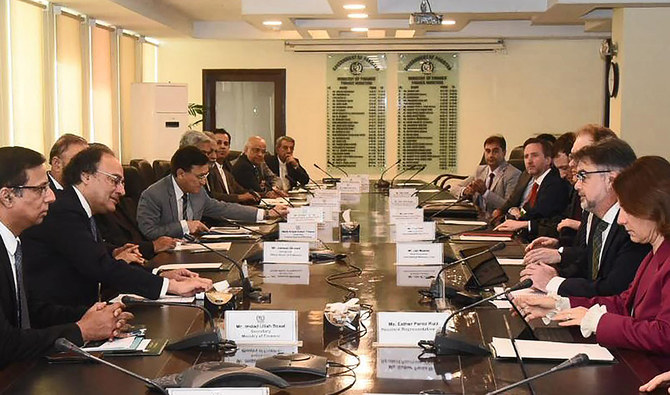
An IMF delegation, led by Nathan Porter, visited Islamabad from March 14-19 to hold discussions on the second review of Pakistan’s economic program supported by the short-term financial arrangement.
Subject to the approval of the international lender’s executive board, Pakistan will now be able to access about $1.1 billion. The IMF board is expected to give the final approval during a meeting in the month of April.
The staff-level agreement followed the IMF’s recognition of strong program implementation by the State Bank of Pakistan and the country’s caretaker administration which was managing its financial affairs before the February 8 general elections.
“Pakistan’s economic and financial position has improved in the months since the first review, with growth and confidence continuing to recover on the back of prudent policy management and the resumption of inflows from multilateral and bilateral partners,” Porter said in a statement.
However, he added the growth was expected to remain modest this year and inflation well above the target.
The IMF official emphasized the ongoing policy and reform efforts should continue to address the country’s deep-seated economic vulnerabilities amid the challenges posed by elevated external and domestic financing needs and an unsettled external environment.
“The new government is committed to continue the policy efforts that started under the current SBA to entrench economic and financial stability for the remainder of this year,” Porter said.
He noted Pakistan’s central bank was committed to maintaining a prudent monetary policy to lower inflation and ensure exchange rate flexibility and transparency in the operations of the forex market.
The Pakistani authorities also expressed interest in a successor medium-term IMF-supported program with the aim of permanently resolving the country’s fiscal and external sustainability weaknesses, strengthening its economic recovery, and laying the foundations for strong, sustainable and inclusive growth.
The IMF statement said the upcoming discussions are set to focus on strengthening public finances by gradually consolidating fiscal policies and broadening the tax base. This will include integrating undertaxed sectors and enhancing tax administration to improve debt sustainability and allow increased spending on development and social assistance for the vulnerable.
Additionally, plans are in place to restore the energy sector’s viability through cost-reducing reforms, such as improving electricity transmission and distribution, transitioning captive power demand to the grid, enhancing governance in distribution companies and intensifying efforts to combat theft.
Efforts to bring inflation back to the target will also be supported by a more transparent and flexible foreign exchange market, aiding external rebalancing and the replenishment of foreign reserves.
Moreover, promoting private sector-led activity, coupled with the removal of market distortions, advancing state-owned enterprise reforms, and increasing investment in human capital, aims to foster resilient and inclusive growth, enabling Pakistan to achieve its economic potential.


Pakistan and IMF reach staff-level agreement under $3 billion loan facility
https://arab.news/vm3a7
Pakistan and IMF reach staff-level agreement under $3 billion loan facility

- Talks for medium-term Fund-supported program for long term stabilization are expected to start in the coming months
- Pakistan is expected to receive the final tranche of $1.1 billion from IMF after its executive board meeting in April

Pakistan rice exports slump 40% as India’s return hits pricing power
- Statistics show non-Basmati shipments have fallen over 50 percent in July-January period
- Government offers 9 percent tax drawback on premium Basmati exports to support sector
ISLAMABAD: Pakistan’s rice exports fell 40.5 percent to $1.31 billion in the first seven months of the fiscal year, official data showed on Tuesday, as India’s return to the global market squeezed Islamabad’s market share and pricing power.
According to the Pakistan Bureau of Statistics (PBS), non-Basmati exports dropped 50.8 percent to $827.8 million, with volumes falling to 2.0 million tons from 3.15 million tons a year ago. Basmati exports declined 6.62 percent to $477.7 million, with volumes easing to 436,484 tons from 487,278 tons.
The Ministry of National Food Security told a parliamentary committee in two separate meetings in December and January that India’s re-entry into the global rice market was a key factor behind the decline, saying increased Indian supplies had made Pakistani rice less competitive.
Officials told lawmakers that India benefits from free trade agreements and provides substantial support to its rice sector, putting additional pressure on Pakistani exporters.
In response, the Ministry of Commerce last month issued a notification under the “Drawback of Local Taxes and Levies for Rice Order, 2026,” allowing a rebate of 9 percent of the free-on-board (FOB) value for Basmati exports priced above $750 per metric ton.
The government said the measure, announced on January 23, aims to ease liquidity pressures on exporters and improve competitiveness.
While PBS data for July-January shows a 40.5 percent decline, figures from the Federal Board of Revenue (FBR) for July-December show an even steeper 47 percent drop to $973 million from $1.82 billion in the same period last year, reflecting a deficit of over $800 million.
Industry representatives say they are now focusing on market diversification to counter the slowdown.
“Currently Basmati is mainly exported to Middle East and EU. Non-Basmati is exported to Philippines, Indonesia, Malaysia and African countries,” Malik Faisal Jahangir, chairman of the Pakistan Rice Exporters Association, told Arab News last week.
“For the new markets for our non-basmati rice exports, we are looking to increase our volumes to China, Philippines, Indonesia and Bangladesh,” he added.


