

Israel’s war undermining top UN court, South Africa says

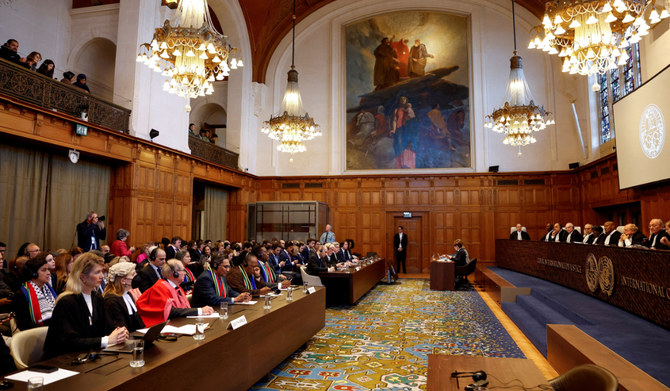
Judges at the International Court of Justice (ICJ) rule on emergency measures against Israel following accusations by South Africa that the Israeli military operation in Gaza is a state-led genocide, in The Hague, Netherlands, January 26, 2024. (REUTERS)
Short Url
Updated 20 March 2024
Follow

Israel’s war undermining top UN court, South Africa says

  • Naledi Pandor, South Africa’s foreign minister, said on Tuesday that Israel had defied a January ruling by the ICJ that it should take action to prevent acts of genocide as it fights Hamas in the Gaza Strip

WASHINGTON: South Africa’s foreign minister on Tuesday accused Israel of setting a precedent for leaders to defy the top UN court, as she again alleged a campaign of “starvation” in Gaza.
South Africa has hauled Israel before the International Court of Justice to allege genocide in the war triggered by the Oct. 7 Hamas attack, infuriating Israel and drawing US criticism.
Naledi Pandor, South Africa’s foreign minister, said on Tuesday that Israel had defied a January ruling by the ICJ that it should take action to prevent acts of genocide as it fights Hamas in the Gaza Strip.


South African Foreign Minister Naledi Pandor. (AFP)

“The provisional measures have been entirely ignored by Israel,” Pandor said at the Carnegie Endowment for International Peace during a visit to US capital Washington.

HIGHLIGHTS

• South Africa has hauled Israel before the International Court of Justice to allege genocide in the war.

• A UN-backed food security assessment determined that Gaza is facing imminent famine.

“We’re seeing mass starvation now and famine before our very eyes,” she said.
“I think we, as humanity, need to look at ourselves in horror and dismay and to be worried that we have set an example.”
Pandor added that Israel’s actions may mean other nations believe that “there’s license — I can do what I want and I will not be stopped.”
She said that South Africa’s post-apartheid democracy — in going through international institutions — was “merely practicing what is preached to us every day” by the West.
“The ICJ has not been respected. And the day Africans disrespect (it), I hope we don’t go to that leader and say, ‘Listen, you’re out of bounds — because you’re an African, we expect you to obey,’” she said.
South Africa has again petitioned the court in The Hague to order measures for Israel to stop “widespread starvation” triggered by its Gaza offensive.
A UN-backed food security assessment determined that Gaza is facing imminent famine, with around 1.1 million people — about half the population — experiencing “catastrophic” hunger.


Police target Ukrainians and Russian in ransomware probe

Updated 42 min 33 sec ago
Follow

Police target Ukrainians and Russian in ransomware probe

  • As part of a coordinated operation between Germany, the Netherlands, Switzerland, Ukraine and Britain, police searched the homes of two Ukrainian suspects

BERLIN: Police have carried out raids against two members of a ransomware group known as “Black Basta” in Ukraine, and issued an arrest warrant for its Russian head, German prosecutors said Thursday.
The group is accused of using malware to encrypt systems and then demanding money to restore them.
Between March 2022 and February 2025, its members extorted hundreds of millions of euros from around 600 companies and public institutions around the world, the prosecutors said in a statement.
The victims were mainly “companies in Western industrialized nations” but also included hospitals and other public institutions.
As part of a coordinated operation between Germany, the Netherlands, Switzerland, Ukraine and Britain, police searched the homes of two Ukrainian suspects and seized evidence, the prosecutors said.
Investigators have also identified and issued an arrest warrant for a Russian citizen accused of being the founder and head of the group, they said.
German police named the suspect as Oleg Evgenievich Nefedov, 35.
Nefedov “decided on targets, recruited employees, assigned them tasks, participated in ransom negotiations, managed the proceeds and used them to pay the members of the group,” the police said.
The searches in Ivano-Frankivsk and Lviv were directed against suspected members of the group accused of so-called hash cracking, a method of guessing passwords.
Ukrainian officials also searched the home of another member of the group near Kharkiv in August, whose job was allegedly to help ensure the malware was not detected by antivirus programs.
Black Basta extorted some 20 million euros ($23 million) from around 100 companies and institutions in Germany alone, the prosecutors said.