Israeli claims over legal use of US weapons ‘not credible’

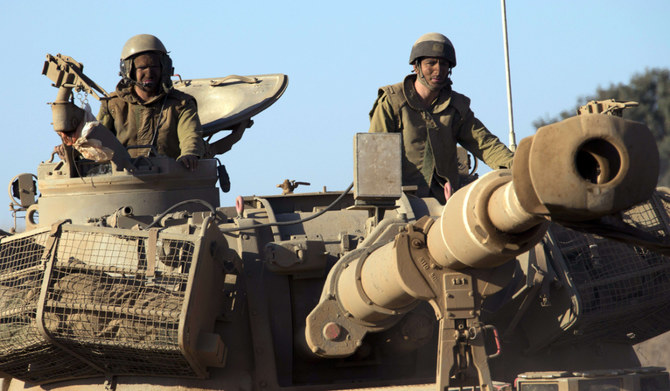
Israeli soldiers ride on top of a mobile artillery vehicle as it drives through sandy terrain during a military exercise in the Israeli-occupied Golan Heights, north of Israel. (AFP file photo)
Short Url
Updated 20 March 2024
Follow

Israeli claims over legal use of US weapons ‘not credible’

  • Washington is violating its own humanitarian regulations by supplying arms to Tel Aviv, Human Rights Watch and Oxfam say
  • In a report following an investigation, the organizations urge President Joe Biden to ‘immediately suspend’ weapons transfers

LONDON: Israel’s claim that it abides by US humanitarian regulations governing weapons transfers is “not credible,” two major international nongovernmental organizations have found.

As a result of their findings, contained in a joint report submitted to the US government, Human Rights Watch and Oxfam on Tuesday called on President Joe Biden to “follow US law and immediately suspend arms transfers to Israel.”

It comes after the organizations conducted an investigation into Israel’s application of US National Security Memorandum-20. This requires any state that receives arms transfers from the US to avoid violations of international humanitarian law and arbitrary blocking of US humanitarian assistance.

During their investigations of Israeli activities in Gaza and Lebanon since October, the organizations said they found significant evidence that Israel is failing to meet the requirements of NSM-20.

Sarah Yager, HRW’s Washington director, said: “There are good reasons why US law prohibits arms support for governments that block life-saving aid or violate international law with US weapons.

“Given ongoing hostilities in Gaza, the Israeli government’s assurances to the Biden administration that it is meeting US legal requirements are not credible.”

The report highlighted several Israeli violations of international humanitarian law, including the use of US-supplied white phosphorus munitions and indiscriminate strikes on or near major hospitals in Gaza.

In addition, it said Israel had engaged in “systematic blocking of assistance, including aid substantially provided by the US, from reaching about 300,000 Palestinians remaining in northern Gaza.”

Vital water infrastructure has also been bombarded, again in clear violation of humanitarian law, HRW and Oxfam added.

The organizations accused Israel of submitting faulty “assurances” to the US State Department concerning its adherence to NSM-20. Researchers said they were “confident that the examples we cite here reflect a broader pattern of conduct than is currently being assessed by the US government.”

As part of the requirements of NSM-20, countries supplied with American arms must submit assurances to the departments of State and Defense, to be reviewed and assessed by top officials. But based on their public statements, US Secretary of State Antony Blinken and Secretary of Defense Lloyd Austin appear to have accepted the Israeli assurances, despite mounting evidence of humanitarian violations in Gaza and Lebanon.

Both officials must also consider “expected future violations” when judging the credibility of the Israeli submissions, HRW and Oxfam said.

Their report follows growing international concerns of an “imminent” famine in northern Gaza. The US has resorted to airdrops in the absence of sufficient access to routes for the delivery of humanitarian aid by road in the enclave, many of which effectively have been blocked by Israeli authorities.

Scott Paul, associate director for peace and security at Oxfam America, said: “We have laid out clearly for the Biden administration why any assurances from Israel that they have not delayed, restricted and impeded aid into Gaza cannot be relied upon. Despite this, the US has continued to provide Israel with deadly weapons.

“The time has long passed for the Biden administration to end lethal arms sales to Israel, and we call on them to do so now and work to end the death and suffering in Gaza.”


First responders enter devastated Aleppo neighborhood after days of deadly fighting

Updated 12 January 2026
Follow

First responders enter devastated Aleppo neighborhood after days of deadly fighting

  • The US-backed SDF, which have played a key role in combating the Daesh group in large swaths of eastern Syria, are the largest force yet to be absorbed into Syria’s national army

ALEPPO, Syria: First responders on Sunday entered a contested neighborhood in Syria’ s northern city of Aleppo after days of deadly clashes between government forces and Kurdish-led forces. Syrian state media said the military was deployed in large numbers.
The clashes broke out Tuesday in the predominantly Kurdish neighborhoods of Sheikh Maqsoud, Achrafieh and Bani Zaid after the government and the Syrian Democratic Forces, the main Kurdish-led force in the country, failed to make progress on how to merge the SDF into the national army. Security forces captured Achrafieh and Bani Zaid.
The fighting between the two sides was the most intense since the fall of then-President Bashar Assad to insurgents in December 2024. At least 23 people were killed in five days of clashes and more than 140,000 were displaced amid shelling and drone strikes.
The US-backed SDF, which have played a key role in combating the Daesh group in large swaths of eastern Syria, are the largest force yet to be absorbed into Syria’s national army. Some of the factions that make up the army, however, were previously Turkish-backed insurgent groups that have a long history of clashing with Kurdish forces.
The Kurdish fighters have now evacuated from the Sheikh Maqsoud neighborhood to northeastern Syria, which is under the control of the SDF. However, they said in a statement they will continue to fight now that the wounded and civilians have been evacuated, in what they called a “partial ceasefire.”
The neighborhood appeared calm Sunday. The United Nations said it was trying to dispatch more convoys to the neighborhoods with food, fuel, blankets and other urgent supplies.
Government security forces brought journalists to tour the devastated area, showing them the damaged Khalid Al-Fajer Hospital and a military position belonging to the SDF’s security forces that government forces had targeted.
The SDF statement accused the government of targeting the hospital “dozens of times” before patients were evacuated. Damascus accused the Kurdish-led group of using the hospital and other civilian facilities as military positions.
On one street, Syrian Red Crescent first responders spoke to a resident surrounded by charred cars and badly damaged residential buildings.
Some residents told The Associated Press that SDF forces did not allow their cars through checkpoints to leave.
“We lived a night of horror. I still cannot believe that I am right here standing on my own two feet,” said Ahmad Shaikho. “So far the situation has been calm. There hasn’t been any gunfire.”
Syrian Civil Defense first responders have been disarming improvised mines that they say were left by the Kurdish forces as booby traps.
Residents who fled are not being allowed back into the neighborhood until all the mines are cleared. Some were reminded of the displacement during Syria’s long civil war.
“I want to go back to my home, I beg you,” said Hoda Alnasiri.