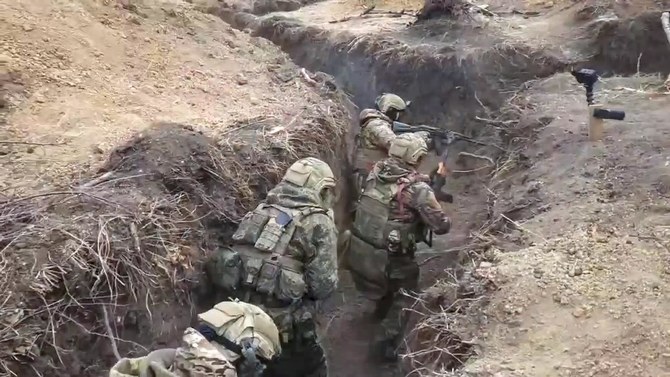
MOSCOW: Russia said Tuesday that its troops had made gains in eastern Ukraine, building on recent advances against Ukrainian forces in critical need of Western aid.
Facing a difficult situation on the front lines, Kyiv has responded with an increasing number of incursions and attacks on Russian territory bordering Ukraine.
Some of these incursions were carried out by Russians who volunteered to fight in pro-Ukrainian units, which Putin has called to “punish.”
“On the Avdiivka front, units of the ‘Center’ grouping of troops liberated the village of Orlivka,” the Russian defense ministry said.
It is the latest in a string of gains for Moscow, which has built on the capture of Avdiivka a month ago.
Avdiivka’s seizure had forced Ukrainian troops to withdraw to defensive lines along Tonenke, Berdychi and Orlivka.
The Ukrainian army has not addressed the potential seizure of Orlivka.
But Kyiv has acknowledged a difficult situation on the battlefield and urged the West to keep up and deliver on its promises of support.
European deliveries have fallen behind, and its industrial capacities remain limited.
Kyiv has urged the US Congress to unblock a $60 billion aid package, which has been stalled due to political infighting.
President Volodymyr Zelensky on Monday told US Senator Lindsey Graham that is was “critically important” for the US to make a swift decision.
“We are at a critical moment for the future of the armed conflict,” Graham told reporters after his meeting with Zelensky.
Kyiv has intensified its attacks on Russian territory, with shelling and incursions in the regions of Belgorod and Kursk.
In the past week these attacks killed 16 people and wounded nearly a hundred in the region of Belgorod, its governor Vyacheslav Gladkov said.
Speaking at a meeting of ruling party members, he also announced the evacuation of thousands of children from areas at risk.
“We are evacuating a large number of villages, and now we are planning to evacuate about 9,000 children because of the shelling by the Ukrainian armed forces,” Gladkov said.
The surge in strikes took place ahead of elections that saw Putin win a predictable fifth term as president, after running against no real opposition.
“I am proud that the residents of the region did not succumb to the difficult situation and that many more people came to the polling stations than ever before,” Gladkov said.
Putin addressed the border assaults, which have marred his re-election week, in a meeting with his FSB security services.
He claimed Russian troops inflicted “heavy losses” on units that he said where made up of regular Ukrainian soldiers, foreign mercenaries and pro-Ukrainian Russian fighters.
“About these traitors... we must not forget who they are, we must identify them by name. We will punish them without statute of limitations, wherever they are,” Putin said, calling them “scum.”
Ukraine-based militias — made up of Russian citizens who oppose Moscow’s offensive and have taken up arms for Kyiv — have claimed to be behind previous incursions into Russian territory.
One of them is the Russian Volunteer Corps. Its head of staff, identified as Aleksandr, gave an interview on Ukrainian television, denying heavy losses.
“There are losses, but absolutely not of the scale claimed by Putin or the defense ministry,” he said.
On the naval front, Ukrainian forces claim to have destroyed more than two dozen Russian ships since the conflict began in February 2022, including a military patrol boat earlier this month.
Russian state media earlier confirmed Moscow had replaced the head of its navy, after reports the previous naval chief had been sacked for repeatedly losing Black Sea warships to Ukrainian attacks.


![]()

Russia claims new advances in east as Kyiv awaits Western support
Short Url
https://arab.news/zukbt
Russia claims new advances in east as Kyiv awaits Western support
- Facing a difficult situation on the front lines, Kyiv has responded with an increasing number of incursions and attacks on Russian territory bordering Ukraine
- Some of these incursions were carried out by Russians who volunteered to fight in pro-Ukrainian units


Latest updates




© 2026 SAUDI RESEARCH & PUBLISHING COMPANY, All Rights Reserved And subject to Terms of Use Agreement.