GENEVA: The UN weather agency is sounding a “red alert” about global warming, citing record-smashing increases last year in greenhouse gases, land and water temperatures and melting of glaciers and sea ice, and warning that the world’s efforts to reverse the trend have been inadequate.
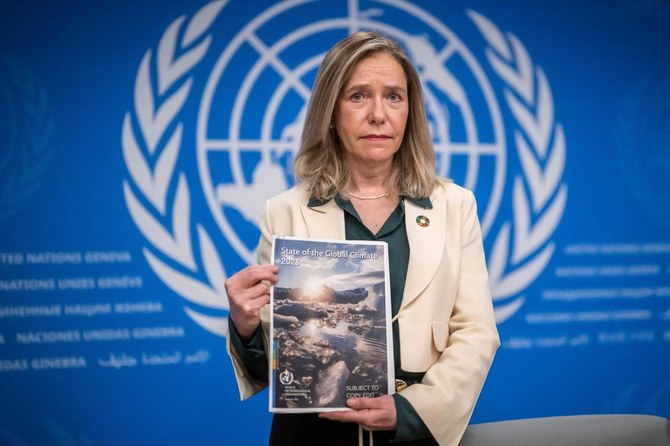
The World Meteorological Organization, in a “State of the Global Climate” report released Tuesday, ratcheted up concerns that a much-vaunted climate goal is increasingly in jeopardy: That the world can unite to limit planetary warming to no more than 1.5 degrees Celsius (2.7 degrees Fahrenheit) from pre-industrial levels.
“Never have we been so close – albeit on a temporary basis at the moment – to the 1.5° C lower limit of the Paris agreement on climate change,” said Celeste Saulo, the agency’s secretary-general. “The WMO community is sounding the red alert to the world.”
The 12-month period from March 2023 to February 2024 pushed beyond that 1.5-degree limit, averaging 1.56 C (2.81 F) higher, according to the European Union’s Copernicus Climate Service. It said the calendar year 2023 was just below 1.5 C at 1.48 C (2.66 F), but a record hot start to this year pushed beyond that level for the 12-month average.
“Earth’s issuing a distress call,” UN Secretary-General Antonio Guterres said. “The latest State of the Global Climate report shows a planet on the brink. Fossil fuel pollution is sending climate chaos off the charts.”
The latest WMO findings are especially stark when compiled in a single report. In 2023, over 90 percent of ocean waters experienced heat wave conditions at least once. Glaciers monitored since 1950 lost the most ice on record. Antarctic sea ice retreated to its lowest level ever.
“Topping all the bad news, what worries me the most is that the planet is now in a meltdown phase — literally and figuratively given the warming and mass loss from our polar ice sheets,” said Jonathan Overpeck, dean of the University of Michigan School for Environment and Sustainability, who wasn’t involved in the report.
Saulo called the climate crisis “the defining challenge that humanity faces” and said it combines with a crisis of inequality, as seen in growing food insecurity and migration.
WMO said the impact of heatwaves, floods, droughts, wildfires and tropical cyclones, exacerbated by climate change, was felt in lives and livelihoods on every continent in 2023.
“This list of record-smashing events is truly distressing, though not a surprise given the steady drumbeat of extreme events over the past year,” said University of Arizona climate scientist Kathy Jacobs, who also wasn’t involved in the WMO report. “The full cost of climate-change-accelerated events across sectors and regions has never been calculated in a meaningful way, but the cost to biodiversity and to the quality of life of future generations is incalculable.”
But the agency also acknowledged “a glimmer of hope” in trying to keep the Earth from running too high a fever. It said renewable energy generation capacity from wind, solar and waterpower rose nearly 50 percent from 2022 to a total of 510 gigawatts.
The report comes as climate experts and government ministers are to gather in the Danish capital, Copenhagen, on Thursday and Friday to press for greater climate action, including increased national commitments to fight global warming.
“Each year the climate story gets worse; each year WMO officials and others proclaim that the latest report is a wake-up call to decision makers,” said University of Victoria climate scientist Andrew Weaver, a former British Columbia lawmaker.
“Yet each year, once the 24-hour news cycle is over, far too many of our elected ‘leaders’ return to political grandstanding, partisan bickering and advancing policies with demonstrable short-term outcomes,” he said. “More often than not everything else ends up taking precedence over the advancement of climate policy. And so, nothing gets done.”


![]()

UN weather agency issues ‘red alert’ on climate change after record heat, ice-melt increases in 2023
Short Url
https://arab.news/yckdh
UN weather agency issues ‘red alert’ on climate change after record heat, ice-melt increases in 2023
- WMO in a “State of the Global Climate” report released Tuesday, ratcheted up concerns that a much-vaunted climate goal is increasingly in jeopardy
- The 12-month period from March 2023 to February 2024 pushed beyond that 1.5-degree limit

Latest updates




© 2026 SAUDI RESEARCH & PUBLISHING COMPANY, All Rights Reserved And subject to Terms of Use Agreement.