

Blinken’s Manila visit triggers protest against US presence in Philippines

Short Url
Updated 19 March 2024
Follow

Blinken’s Manila visit triggers protest against US presence in Philippines

  • Philippines allowed US troops last year to increase their footprint in the country
  • Blinken says US stands by ‘ironclad’ commitments to defend Philippines

Manila: Protesters rallied against American presence in the Philippines on Tuesday as US Secretary of State Antony Blinken visited Manila to reinforce support against Chinese influence in the region.

The Philippines is Washington’s key security partner in Asia under a decades-long alliance, which allows the US to rotate troops into the Philippines for extended stays and build and operate facilities on Philippine military bases.

In the past two years, the partnership has expanded under President Ferdinand Marcos Jr., who in February last year permitted American troops to increase their footprint in the country.

China claims the disputed area almost in entirety and its military activity in the territory has been increasing, regularly encroaching on the Philippine part of the waters, the West Philippine Sea.

“These waterways are critical to the Philippines, to its security, to its economy, but they’re also critical to the interests of the region, the United States and the world,” Blinken said at a joint press conference with his Philippine counterpart Enrique Manalo.

“That’s why we stand with the Philippines and stand by our ironclad defense commitments, including under the mutual defense treaty.”

The 1951 agreement obliges the US to defend its ally in the case of external attack.

Philippine vessels have been regularly attacked by Chinese ships in the parts of the South China Sea that are internationally recognized as belonging to the Philippines.

American troops have been patrolling the maritime area with Philippine forces since November, despite protests from Beijing, which says the US is not a party to the maritime dispute.

“Article 4 of that treaty extends to any armed attacks on Filipino armed forces, on public vessels, on aircraft, and that would include its coast guard and that would also be anywhere in the South China Sea,” Blinken said.

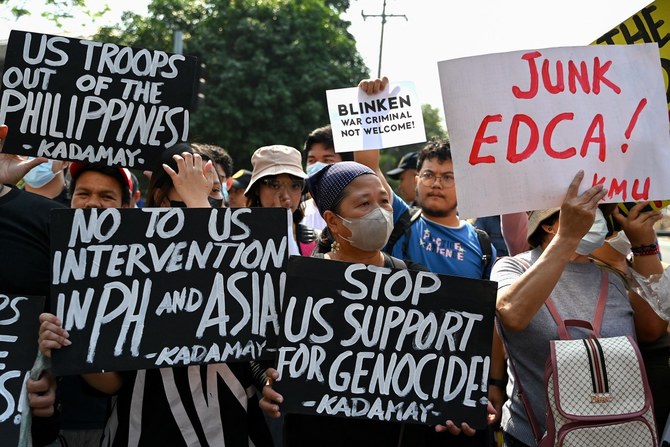
As he told reporters that the two countries have seen an “extraordinary expansion” in their partnership, protesters in Manila carried banners reading: “US troops out of the Philippines,” “Blinken war criminal, not welcome,” “No to US intervention in PH and Asia.”

The demonstration was organized by civil society, including BAYAN — the Philippines’ largest alliance of grassroots groups — near the Presidential Palace, ahead of Blinken’s meeting with Marcos.

BAYAN said in a statement that Marcos was “advancing the geopolitical interest of the US in the region” and “offering the Philippines as an extension” of the US military network.

“The country’s assertion of sovereignty in the West Philippine Sea against China’s aggression should not involve the opportunistic meddling of a former colonizer whose real motive is to preserve and expand its imperialist hegemony in the Asia-Pacific,” the group said.

It also drew attention to Gaza, where Washington’s other key ally, Israel, has killed over 30,000 Palestinians in daily airstrikes and land assaults since October.

BAYAN said the US was “the main supporter and enabler of the ongoing genocide in Palestine” and was “actively fanning proxy wars and conflicts in various parts of the world.”


Modi starts Mideast-Africa tour as India-Oman free-trade pact nears completion

Updated 15 December 2025
Follow

Modi starts Mideast-Africa tour as India-Oman free-trade pact nears completion

  • Oman’s Shoura Council approved the trade deal’s draft last week
  • Modi begins trip in Amman, heading to Addis Ababa and Muscat

NEW DELHI: Prime Minister Narendra Modi left New Delhi on Monday for a tour covering Jordan, Oman and Ethiopia, as his government looks to strengthen partnerships with West Asia and Africa and finalize a free-trade deal with Muscat.

Modi’s four-day trip will start in Amman, at the invitation of King Abdullah.

“I am sure this visit will boost bilateral linkages between our nations,” Modi said on social media upon his arrival in Jordan, where he was received by Prime Minister Jafar Hassan.

On Tuesday, he is scheduled to arrive in Addis Ababa for his first state visit to Ethiopia. A day later, he will be in Muscat, where the Shoura Council last week approved the draft Comprehensive Economic Partnership Agreement with India.

“If it is signed during this visit, it will significantly deepen the economic ties between India and Oman. And it will open up a new chapter in the history of India-Oman trade and commercial relationship,” Ministry of External Affairs Secretary Arun Chatterjee told reporters ahead of Modi’s departure.

He said Modi would be accompanied by a high-level delegation for his second visit to Oman, after his last trip in February 2018. It also follows the visit of Oman’s Sultan Haitham bin Tariq to India in December 2023.

Free-trade negotiations between India and Oman began in November 2023, with the first round in New Delhi and the second in Muscat.

When the talks concluded in March 2024, Oman sought revisions on market-access terms and the final signature was postponed.

Announcements of the deal’s possible finalization have been made in the past few months by India’s Commerce and Industry Minister Piyush Goyal and the Omani ambassador to New Delhi, Issa Saleh Al-Shibani.

It would be its second with a GCC country after a 2022 trade deal with the UAE, as India has been trying to reach a similar agreement with the whole bloc.

“The framework is expected to be the same as the UAE’s, that is, a Comprehensive Economic Partnership Agreement. This is significant given that the progress on India-GCC FTA has been slow and non-consequential so far,” said Muddassir Quamar, associate professor at the School of International Studies, Jawaharlal Nehru University.

While Oman is one of Delhi’s smaller GCC trading partners — trailing behind the UAE and Saudi Arabia, with bilateral trade about $10 billion — it remains strategically important, particularly in energy and logistics.

“The FTA is likely to give a boost to India-Oman economic and trade relations, especially of goods and services. (It is) important given India has worked to enhance its trade and economic relations with the Gulf countries that are (among) the most dynamic and fast-expanding global economies,” Quamar told Arab News.

“It is also important because there is immense potential for Indian businesses and industries to partner with their Gulf and Omani partners in contributing to the diversification and economic growth plans.”