UN reports a 35 percent increase in people affected by violence in South Sudan

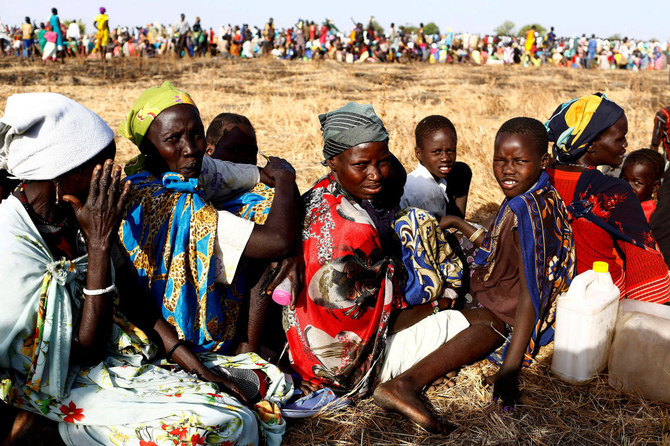
Women and children wait to be registered prior to a food distribution carried out by the United Nations World Food Programme (WFP) in Thonyor, Leer state, South Sudan. (REUTERS)
Updated 19 March 2024
Follow

UN reports a 35 percent increase in people affected by violence in South Sudan

  • There is a 35 percent increase in the number of victims reported from the previous quarter
  • Violence caused by ethnic tensions and disputes over resources such as land has increased in various parts of the country

JUBA: The number of people affected by violence in South Sudan surged by 35 percent in the last three months of 2023, the United Nations reported.
The UN Mission in South Sudan, or UNMISS, documented 233 incidents of violence affecting 862 people. Of that, 406 were killed, 293 were injured, 100 were abducted and 63 subjected to conflict-related sexual violence, it said in a report released Monday.
It was a 35 percent increase in the number of victims reported from the previous quarter.
South Sudan is to hold elections later this year, the first since a 2018 peace deal between President Salva Kiir and his former rival, Riek Machar, that ended a five-year conflict that killed hundreds of thousands.
Violence caused by ethnic tensions and disputes over resources such as land has increased in various parts of the country in recent months, particularly in the oil-rich region of Abyei.
The head of UNMISS, Nicholas Haysom, said it is “doing all it can to prevent violence and build peace in the affected areas” and urged the South Sudan government to intervene and “resolve underlying grievances and build peace.”
It said it has conducted at least 10,000 peacekeeping patrols by land, air and boat over the past year.
South Sudan, one of the world’s youngest nations, also suffers from drought and flooding, making living conditions difficult for residents.
The World Food Program in its latest country brief said South Sudan “continues to face a dire humanitarian crisis” due to violence, economic instability, climate change and an influx of people fleeing the conflict in neighboring Sudan.


US sanctions Larijani and other Iranian officials over protest crackdown

Updated 3 sec ago
Follow

US sanctions Larijani and other Iranian officials over protest crackdown

WASHINGTON: The United States imposed sanctions Thursday on Iranian security officials and financial networks, accusing them of orchestrating a violent crackdown on peaceful protests and laundering billions in oil revenues.
Treasury Secretary Scott Bessent announced the measures in the wake of the biggest anti-government protests in the history of the Islamic republic, although the demonstrations appear to have diminished over the last few days in the face of repression and an almost week-long Internet blackout.
“The United States stands firmly behind the Iranian people in their call for freedom and justice,” Treasury Secretary Scott Bessent said in a statement, adding that the action was taken at President Donald Trump’s direction.
Among those sanctioned is Ali Larijani, secretary of Iran’s Supreme Council for National Security, whom Washington accused of coordinating the crackdown and calling for force against protesters.
Four regional commanders of Iran’s Law Enforcement Forces and Revolutionary Guard were also sanctioned for their roles in the crackdown in Lorestan and Fars provinces.
Security forces in Fars “have killed countless peaceful demonstrators” with hospitals “so inundated with gunshot wound patients that no other types of patients can be admitted,” the Treasury said.
The Treasury additionally designated 18 individuals and entities accused of operating “shadow banking” networks that launder proceeds from Iranian oil sales through front companies in the UAE, Singapore and Britain.
These networks funnel billions of dollars annually using cover companies and exchange houses, as Iranian citizens face economic hardship, according to the Treasury.
The sanctions freeze any US assets of those designated and prohibit Americans from doing business with them. Foreign financial institutions risk secondary sanctions for transactions with the designated entities.
The action builds on the Trump administration’s “maximum pressure” campaign against Iran. In 2025, the Treasury sanctioned more than 875 persons, vessels and aircraft as part of this effort, it said.