

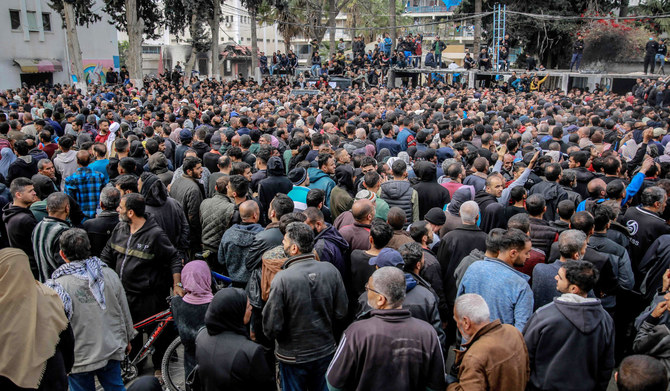


JERUSALEM: Israel has vowed to let Palestinians crammed into southern Gaza leave before its planned invasion of Rafah, but experts have warned it was practically impossible to get those civilians out of harm’s way.
The roughly 1.5 million Gazans in the territory’s southernmost tip have the Mediterranean Sea to their west and sealed borders to the south and east, while Israeli forces are poised to push in from the north.
“Where will we go if they enter Rafah, and where will we get a tent, mattress and blankets?” said Sabah Al-Astal, 50, already displaced inside Gaza by the Israel-Hamas war.
Israeli Prime Minister Benjamin Netanyahu has insisted on sending troops into Rafah to root out Hamas in the area that borders Egypt and Israel.
But Netanyahu has also pledged to enable Gazans to leave, saying Sunday that his troops would not move in “while keeping the population locked in place.”
Israel, though, remains vague regarding how or when this massive evacuation would take place, a challenge that aid experts consider impossible in the devastated territory.
“People don’t know where to go. There’s nowhere safe in Gaza,” said Nadia Hardman, an expert on refugees at Human Rights Watch (HRW).
The bloodiest ever Gaza war broke out after Hamas launched an unprecedented attack on October 7 that resulted in about 1,160 deaths in Israel, mostly civilians, according to an AFP tally based on official Israeli figures.
Militants also seized about 250 hostages, of whom Israel believes 130 remain in Gaza, including 33 who are presumed dead.
Israel has carried out a relentless bombing campaign and ground offensive that Gaza’s health ministry says has killed at least 31,726 people, most of them women and children.
Foreign Minister Israel Katz remained evasive Monday, telling Kan public radio that “before any massive operation, we will evacuate citizens.”
“Not to the north, but to the west. There are Arab countries that can help by setting up tents, or something else” in the tiny area between Rafah and the Mediterranean, he added.
Rear Admiral Daniel Hagari, Israel’s military spokesman, told the press last week about the establishment of “humanitarian islands.”
Such tent cities on Gaza’s territory would be spared the fighting and created with the international community, Hagari said.
But UN humanitarian coordinator for the Palestinian territories, Jamie McGoldrick, said: “I honestly don’t know where they are supposedly being established.”
“How will they move people from wherever they are now? Will they be pushed, forced, encouraged?” he asked.
“That’s not something the UN will participate in because we’re not a part of any forced displacement.”
German Chancellor Olaf Scholz, on a visit to Israel on Sunday, voiced concern over the planned Israeli offensive.
“The military logic is one consideration, but there is a humanitarian logic as well,” he said.
“How should more than 1.5 million people be protected? Where should they go?“
Netanyahu has agreed to US President Joe Biden’s request to send a delegation of senior Israeli officials to Washington to discuss Israel’s Rafah plans and a possible “alternative approach,” the White House said Monday.
HRW’s Hardman was categorical: Moving “1.5 million people in an area that is already devastated” is “absolutely impossible,” she said.
Israel has declared certain areas protected humanitarian spaces, notably in Al-Mawasi, a coastal area in the south of the territory between south Gaza’s main city of Khan Yunis and Rafah.
But hundreds of thousands of people are already sheltering in tents there, and the area has been bombed several times since the war began more than five months ago.
Netanyahu has doubled down on plans for a Rafah offensive, announced more than a month ago, despite growing international pressure.
However, according to David Khalfa, Middle East specialist at the Jean-Jaures Foundation, the threat also involves psychological warfare.
“The Israelis maintain a strategic vagueness around their plans because they do not want to devalue their cards in order to keep Hamas in uncertainty,” he said.
Khalfa called the threat of a major offensive in Rafah “a card in a game of liar’s poker” with Hamas, a means to force the militants to soften their positions in ongoing truce negotiations.


