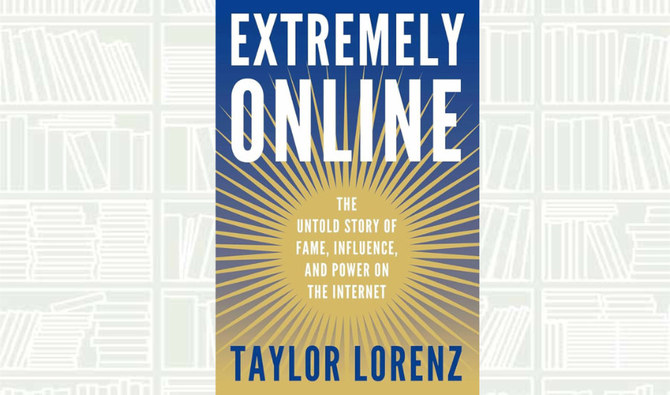
What We Are Reading Today: ‘Extremely Online’ documents the fleeting and permanent nature of the internet

Photo/Supplied
Short Url
Updated 18 March 2024
Follow

What We Are Reading Today: ‘Extremely Online’ documents the fleeting and permanent nature of the internet

Everyone assumes the internet is “forever” but, is it? One person who knows how much the internet is both permanent and fleeting is technology journalist Taylor Lorenz.

Her 2023 book “Extremely Online: The Untold story of Fame, Influence, and Power on the Internet” is a compilation of a grassroots effort that simultaneously encouraged people to be brands and become members of a community.

In about 300 pages, Lorenz showcases a sample of the rise and fall of internet personalities who shifted the culture. Wildly popular platforms like MySpace or Tumblr were abandoned one day without notice, and previously unknown personalities became household names overnight. So, what’s the story?

Lorenz captures the fleeting trends and the forgotten history of the tangled webs within the World Wide Web. She sprinkles in thoughtful, original reporting, something she has been doing for the last decade for outlets including the Washington Post and New York Times. She is a reliable narrator who is both a witness and a participant.

Lorenz is archiving what many in legacy media deem frivolous — the TikTok dancers and the Instagram famous. But with equal fervor, she also documents citizen journalists in war zones who use smartphones to amplify what is happening on the ground. Social media has become the newsfeed many currently rely on, from boomers to gen-alpha and everyone in-between.

For this, Lorenz went back in time. Not only to the mommy bloggers of the early aughts — who she credits for being pioneers in the content creators’ economy — but even earlier than that.

Lorenz explained that even before Facebook ranked trends and algorithms measured the metrics that labeled you worthy of visibility or not, the elite of 1800s New York society were put in a chokehold over anonymously-written “it” lists. The originators of the lists, it was discovered, were people who were not famous. This has, Lorenz says, inspired many books and shows such as cult classics “Gossip Girl” and, more recently, Netflix’s “Bridgerton.” In many ways, history has been repeating itself on different platforms.

Lorenz’s “Extremely Online” is like a series of screenshots — or digital receipts — that document the internet from dialup to smartphones. This book attempts to cover nearly two decades of internet history.

It might just keep you offline long enough to read it.


Hafsa Lodi’s debut novel ‘Turbulence’ centers on a woman’s spiritual journey

Updated 03 March 2026
Follow

Hafsa Lodi’s debut novel ‘Turbulence’ centers on a woman’s spiritual journey

JEDDAH: For Dubai-based journalist and author Hafsa Lodi, whose nonfiction book “Modesty: A Fashion Paradox” examined the politics of dress, the recent publication of her debut novel, “Turbulence,” “feels like a blessing.”

“I didn’t even know if it was even going to be published,” she told Arab News recently. The manuscript was completed four years ago, but its original publisher went out of business and the work was in limbo.

An independent press in the UAE, The Dreamwork Collective, stepped in and published it within months.

The novel follows Dunya, a British Muslim woman living in the Gulf, who goes into labor on a flight after making a shocking discovery.

It is a tender interrogation of what it means to be a Muslim woman in modern times, encapsulating belief, doubt and autonomy, and the fragile negotiations between faith, feminism and family.

The book’s striking cover invites the reader into the story’s emotional landscape before the first page is turned.

Mariam Ajami, the Beirut-based visual artist who designed it, was inspired by “the image of gazing at a reflection in an airplane window, and Rumi’s idea of polishing the soul.”

Two pairs of eyes meet the viewer: one in color, one in black and white.

“My approach was to create a whimsical, surreal landscape that reflects the contrast between the protagonist’s past and present selves,” Ajami said.

Lodi added: “One depicts the earlier, optimistic version of Dunya and the other, the later disillusioned version.”

Speaking about the story, she said: “I wanted Dunya and the reader with her to explore grey areas of faith, culture and society, see all the contradictions, and find her way.”

The seed of the novel was planted in her mind from a news article.

During the COVID-19 pandemic, Lodi read about a woman who went into labor on a flight from the UAE. Shortly after, Lodi discovered she was pregnant and planned to travel to Canada to give birth and secure her child’s passport.

“That story stayed with me,” she recalled, adding that feelings of fear and anxiety sparked her imagination. She gave Dunya a marriage, and then had the union fracture.

“I thought, what would cause some dramatic trigger? What would rock a pregnant wife’s world?” Lodi said. “I had the conflict, I had the plot, so I just had to work backwards.”

The Gulf city where Dunya lives is deliberately unnamed, but reflects a reality many expatriates in the region understand: transience, displacement, class, and privilege.

“If I were to call it Dubai or Riyadh or Bahrain or Kuwait, I felt like this city could be any of those cities,” she explained.

“I wanted to highlight the expat nature of Dunya’s identity and belonging in the Gulf, rather than name some tourist hotspot the world already talks about so much.”

The ambiguity also pushes back against Western assumptions about conservative restrictions and the invisibility of Muslim women’s complex private lives.

She said the literary landscape for Muslim women’s stories, while growing, has long suffered from a particular binary.

Female Muslim characters tend to come in two configurations: the pious, uncomplicated exemplar or the rebellious woman fleeing her faith toward a Western-coded freedom.

Lodi was not interested in either. “I wanted someone in the middle. Someone like me, someone like my friends,” she said. “Women who are Muslim, who are deeply rooted in our faith, but who still have questions.”

Crucially, she wanted faith to be Dunya’s core, not a backdrop or tension to be resolved.

In the opening sequence of “Turbulence,” Dunya hovers between life and death, signaling from the outset that this is a novel where the soul matters, where faith is key to the story’s architecture.

“A lot of contemporary Muslim women’s fiction has faith as just a part of the character,” she said. “I wanted faith to be central to her questioning. I know that might alienate some non-Muslim readers, but authenticity was my mission with this book.”

Writing fiction also gave her the freedom that nonfiction scholarship could not. It was a way to make weighty theological and feminist ideas breathable and accessible.

“Exploring heavy themes — Muslim feminism, gender in Islam — through fiction gave me a chance to make them more relatable to modern Muslim women,” she added.

“I felt so liberated on the page. Fiction really gave me that flexibility and freedom.”

This is most alive in the novel’s scenes involving females, where Dunya joins a group of girls studying Islam through a feminist lens.

The scenes draw directly from Lodi's own experience in UK-based Dr. Sofia Rehman’s virtual Islam and Gender read-alongs. “The texts Dr. Sofia introduced us to, and the way she discusses them, has been mind-expanding,” Lodi said.

“I feel very lucky and privileged to be part of this group, but I feel like there are so many women around me who would never think of joining it. And if they were to sit in one session, they would just be so enlightened.”

There is still a particular taboo around female Islamic scholarship and a reflexive skepticism that can dissolve, she believes, the moment women actually encounter it.

“Islam was a feminist message when it was first revealed. For people who are questioning aspects of faith, or faith and feminism, (female scholarship) has been really validating.”

Where “Turbulence” distinguishes itself most sharply within the landscape of women’s fiction (Muslim or otherwise) is its ending. Dunya gets something more hard-won and, arguably, more radical than a fairytale ending.

It is an unconventional happy conclusion that refuses to conflate marriage with success or failure, with the ultimate triumph being a Muslim woman’s choice to do what honors her God-given dignity.

Tamreez Inam, a Dubai-based writer and curator who moderated a panel about the novel at the Emirates Airline Festival of Literature in January, told Arab News about how she viewed the work’s intent.

“Dunya’s journey, all the little compromises she makes along the way in order to be a good wife and mother, are frustrating but also relatable. It’s a wake-up call to be true to ourselves.”

“Maybe having it all isn’t the road to happiness,” Lodi explained. “In the end, she salvages herself, her self-respect and her self-worth.”

Lodi’s counsel for women, both through Dunya and in conversation, is nuanced: the stakes lie in choosing wisely.

“I’ve been blessed with a very supportive husband who is nothing like Rahim (Dunya’s husband),” Lodi said. “I have faith there are men like that out there … It comes down to the partner you find and being on the same page.”

Female friendship, in Lodi’s telling, is a form of protection and spiritual sustenance. “The lack of (female friendship) is also why she dealt with all of this alone in the end.”

In a literary landscape still learning how to hold Muslim women in their full complexity, “Turbulence” is about the price of shrinking yourself, and finding the long way home.