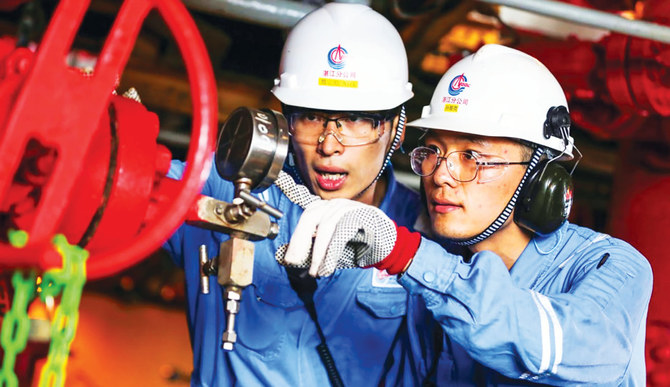

RIYADH: China’s CNOOC Ltd. has made a major oilfield discovery in the Bohai Sea, adding over 100 million tonnes of oil equivalent proved in-place volume, the state-owned oil and gas giant said on Monday.
The discovery was made at the Qinhuangdao 27-3 oilfield located in the north-central waters of the Bohai Sea, the company said in a statement. The field has been tested to produce about 742 barrels of crude oil per day from a single well, it added.
Earlier in the month, CNOOC announced the discovery of a new reserve in the South China Sea, which contains over 100 million tonnes of oil equivalent proved in-place.
The announcements come as CNOOC invests heavily in the development of China’s offshore oil and gas reserves as part of a broader push to offset declining output from aging onshore fields.
The oil and gas giant in January raised its 2024 production target by about 8 percent to a record 700 million to 720 million barrels of oil equivalent, citing higher annual capital spending, with production reaching about 675 million boe in 2023.
Industrial output
China’s factory output and retail sales beat expectations in the January-February period, marking a solid start for 2024 and offering some relief to policymakers even as weakness in the property sector remains a drag on the economy and confidence.
Monday’s data join recent better-than-expected exports and consumer inflation indicators, providing an early boost to Beijing’s hopes of reaching what analysts have described as an ambitious 5 percent gross domestic product growth target for this year.
FASTFACTS
• The discovery was made at the Qinhuangdao 27-3 oilfield located in the north-central waters of the Bohai Sea.
• The field has been tested to produce about 742 barrels of crude oil per day from a single well.
• The announcements come as CNOOC invests heavily in the development of China’s offshore oil and gas reserves.
“China’s activity data broadly stabilized at the start of the year. But there are still reasons to think some of the strength could be one-off,” said Louise Loo, China economist at Oxford Economics.
Industrial output rose 7 percent in the first two months of the year, data released by the National Bureau of Statistics showed on Monday, above expectations for a 5 percent increase in a Reuters poll of analysts and faster than the 6.8 percent growth seen in December. It also marked the quickest growth in almost two years.
Retail sales, a gauge of consumption, rose 5.5 percent, slowing from a 7.4 percent increase in December but beating an expected 5.2 percent gain.
The eight-day Lunar New Year holiday in February saw a solid return of travel, which supported revenue of tourism and hospitality sectors. That also led to a 3 percent growth in oil refinery throughput to meet strong demand for transport fuels.
Property sector
A protracted crisis in the property sector, a key pillar of the economy, remains a major concern for policymakers, consumers and investors.
Monday’s data offered little relief on that front with declines in property investment narrowing in January-February, but still far from levels of reaching stability.
The frailty of the sector was highlighted by the poor demand. Property sales by floor area logged a 20.5 percent slide in January-February from a year earlier, compared with a 23 percent fall in December last year.