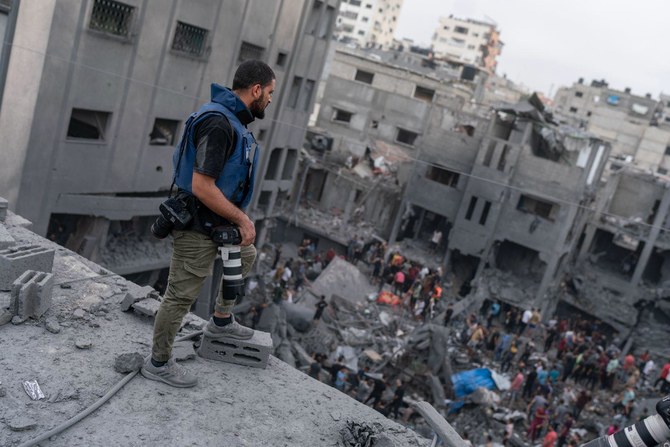
Photographer Ali Jadallah documents appalling violence that has gripped Gaza

Palestinian journalist Ali Jadallah surveys the extensive damage to residential areas caused by Israel's war on Gaza. (Lynn Tehini)
Short Url
Updated 19 March 2024
Follow

Photographer Ali Jadallah documents appalling violence that has gripped Gaza

  • ‘From the very first days of the war, I lost my home. My wife and children survived by a miracle,’ Ali Jadallah tells Arab News in French
  • For decades, award-winning photographer has used his camera to document daily life in Gaza

PARIS: Since the start of the war in Gaza, Ali Jadallah has lost 15 members of his family, including his father, his two brothers, his sister and his aunt. It is a tragedy that still resonates in his mind, especially as his sister’s body has never been found.


Palestinian journalist Ali Jadallah, clad in a protective vest, stands against the backdrop of a landscape scarred by Israel’s war on Gaza. (Supplied)

“From the very first days of the war, I lost my home, which was totally destroyed by Israeli bombing. My wife and children survived by a miracle,” the photographer told Arab News en Français.

The rest of his family was less fortunate.

“On Oct. 11, I was taking a photo of a house that had been bombed. It was near the street where my parents lived with my two brothers and my sister. I heard an explosion and realized that the family home had been hit. I ran toward it and saw that it was in ruins,” Jadallah said.

“I got closer and started digging with my bare hands, screaming as I tried to find my family, who had been completely buried under the rubble. And then I saw a hand appear between the stones. It was my mother’s. She was the only survivor.”


Flames and smoke rise into the night sky as Israel’s airstrikes target  buildings in Gaza. (Ali Jadallah)

Jadallah has been using his camera for decades to document the difficult daily lives of the people of Gaza. His photos have won awards in the Arab world and internationally, including in the prestigious Sharjah Photo Contest.

The journalist was born and grew up in Gaza. From his first internship at Reuters when he was just a teenager, he knew would make a career of it. A few years later, he worked as a freelancer for a number of local and international news agencies before joining the Turkish Anadolu Agency.


Amid the chaos of a hospital's emergency room, a woman cradles a young boy wounded during Israel’s latest war in Gaza. (Ali Jadallah)

“I’ve covered several wars, but I never imagined such violence,” he said in reference to the war in Gaza.

Like the local journalists who have been working non-stop since Oct. 7, Jadallah continues to visually document the appalling violence that has spared no one in Gaza.
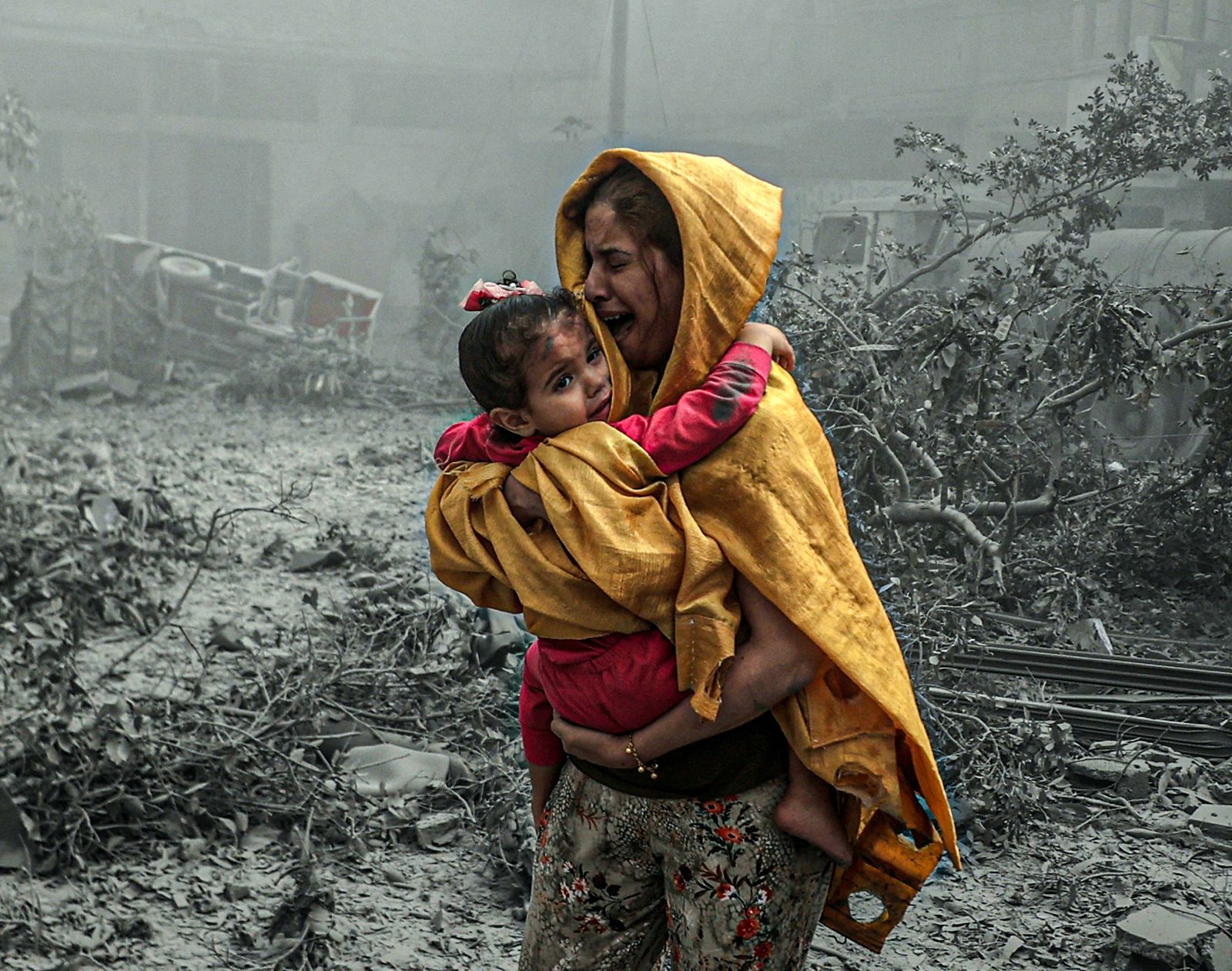


A women and child stand amidst the devastation left in the wake of an Israeli offensive in Gaza. (Ali Jadallah)

“We have to show the whole world the horror we are going through, particularly in the absence of foreign journalists, who are banned by Israel from entering the Gaza Strip,” he said.

Today, the journalist is part of a team of six photographers who live and work together at a hospital in the southern Gaza Strip, the north being inaccessible.

“Whether we are correspondents for local or foreign media, our daily lives as journalists are those of the 2.4 million Gazans subjected to the Israeli army’s bombardments and blockade, suffering from a lack of everything: clothing, food, fuel, etc.,” he said.


Paramedics rush a wounded civilian to the emergency room in Gaza. (Ali Jadallah)

Faced with the personal tragedy he has experienced, the journalist thinks of his mother, wife and two young children — “All I have left after losing everything,” he said.

Thanks to the support of the Turkish agency he works for, he was able to evacuate them to Turkiye.


A man lies trapped under the rubble of a building destroyed by an Israeli airstrike as rescuers scramble to free him following an airstrike in Gaza. (Ali Jadallah)

“I haven’t seen them for over three months and I certainly miss them, but at least I know they’re in a safe place,” he said.

“The most important thing now is to report what’s happening,” he reiterated.


An elderly man, surrounded by family members, is injured amid Israel’s war on Gaza. (Ali Jadallah)

Despite arduous circumstances, he has managed to post his painful odyssey on his Instagram account, which is followed by around 2 million people. Two of his photos were selected by Time magazine as among the 100 photos with the greatest impact on the world in 2023.

One photo — for which Jaddallah won special recognition from the jury in the international Picture of the Year competition — shows a woman, wrapped in a simple curtain, fleeing her bombed-out home with her baby in her arms.

“I would have liked to have received this recognition for a photo illustrating the beauty of the world rather than the distress and horror experienced by my own people,” said Jadallah.


A mother comforts her injured child at a local medical facility in Gaza. (Ali Jadallah)


Egypt vows to prevent escalation between Lebanon and Israel amid tensions over Hezbollah

Updated 4 sec ago
Follow

Egypt vows to prevent escalation between Lebanon and Israel amid tensions over Hezbollah

  • “Egypt will spare no effort in continuing its tireless endeavors to keep Lebanon away from any escalation,” Madbouly told reporters
  • Madbouly’s visit also focused on strengthening bilateral ties and addressing pressing regional development

BEIRUT: Egypt is doing all it can to prevent further escalation between Lebanon and Israel amid tension between the two neighbors over the disarmament process of the militant Hezbollah group, the country’s prime minister said Friday during a visit to the Lebanese capital.
Egypt, which signed a peace treaty with Israel in 1979, has been working for months to deescalate the regional tensions and Prime Minister Mustafa Madbouly’s visit to Beirut comes after similar trips to the small Arab nation by Egypt’s foreign minister and intelligence chief.
“Egypt will spare no effort in continuing its tireless endeavors to keep Lebanon away from any escalation,” Madbouly told reporters during a joint briefing with his Lebanese counterpart Nawaf Salam.
Madbouly’s visit also focused on strengthening bilateral ties and addressing pressing regional developments.
Madbouly’s meetings in Beirut came as the committee monitoring the enforcement of a US-brokered ceasefire that halted the latest war between Israel and Hezbollah a year ago held another meeting Friday.
Friday’s gathering along the Lebanon-Israel border was the second meeting of the mechanism after Israel and Lebanon appointed civilian members to a previously military-only committee. The group also includes the United States, France and the UN peacekeeping force deployed along the border.
A statement issued by the US Embassy in Beirut said that military participants offered operational updates and remained focused on deepening the cooperation by finding ways to increase coordination through the mechanism. It added that all participants agreed that a strengthened Lebanese army, the guarantors of security in the border area known as the south Litani Sector, “is critical to success.”
The embassy added that civilian participants meanwhile focused on setting conditions for residents to return safely to their homes, advancing reconstruction, and addressing economic priorities. It added that they underscored that durable political and economic progress is essential to reinforcing security gains and sustaining lasting peace.
The embassy said meeting participants reaffirmed that progress on security and political tracks remain mutually reinforcing and essential “to ensuring long-term stability and prosperity for both parties.”
The Lebanese government has said that the army should have the whole border area south of the Litani River cleared from Hezbollah’s armed presence by the end of the year.
The latest Israel-Hezbollah war began on Oct. 8, 2023, a day after Hamas-led militants attacked southern Israel, after Hezbollah fired rockets into Israel in solidarity with Hamas. Israel launched a widespread bombardment of Lebanon in September 2024 that severely weakened Hezbollah, followed by a ground invasion.
Israel has carried out almost daily airstrikes since then, mainly targeting Hezbollah members, but also killing 127 civilians, according to the office of the UN High Commissioner for Human Rights.
Also Friday, the Israeli military said that a Hezbollah operative who was captured from Lebanon last year played a major role in the group’s secretive maritime force. The military added that Imad Amhaz was trained in Iran and Lebanon to carry out maritime operations.
A Hezbollah official said the group will not comment on the video released by the Israeli military of Amhaz, describing him as “a Lebanese citizen who was kidnapped.” The official spoke on condition of anonymity because he was not authorized to speak to the media.