

Thai tourist hotspot Chiang Mai tops world’s most polluted cities

1 / 3
An airplane flies over a busy road as it lands at Chiang Mai International Airport amid high levels of air pollution in Chiang Mai on March 15, 2024. (AFP)
2 / 3
An airplane flies over a busy road as it lands at Chiang Mai International Airport amid high levels of air pollution in Chiang Mai on March 15, 2024. (AFP)
3 / 3
A man steers a boat on a lake amid high air pollution at the Srilanna National Park in the northern Thai province of Chiang Mai on March 16, 2024. (AFP)
Short Url
Updated 17 March 2024
Follow

Thai tourist hotspot Chiang Mai tops world’s most polluted cities

  • High levels of pollution frequently hit Chiang Mai during the early months of the year when farmers often burn crops to clear land
  • Located in the north, Thailand's second largest city has a population of 1.2 million people as of 2022

CHIANG MAI, Thailand: Thai tourist hotspot Chiang Mai was blanketed by hazy smog Friday, as residents and visitors to the usually picturesque northern city were left wheezing in the toxic air.

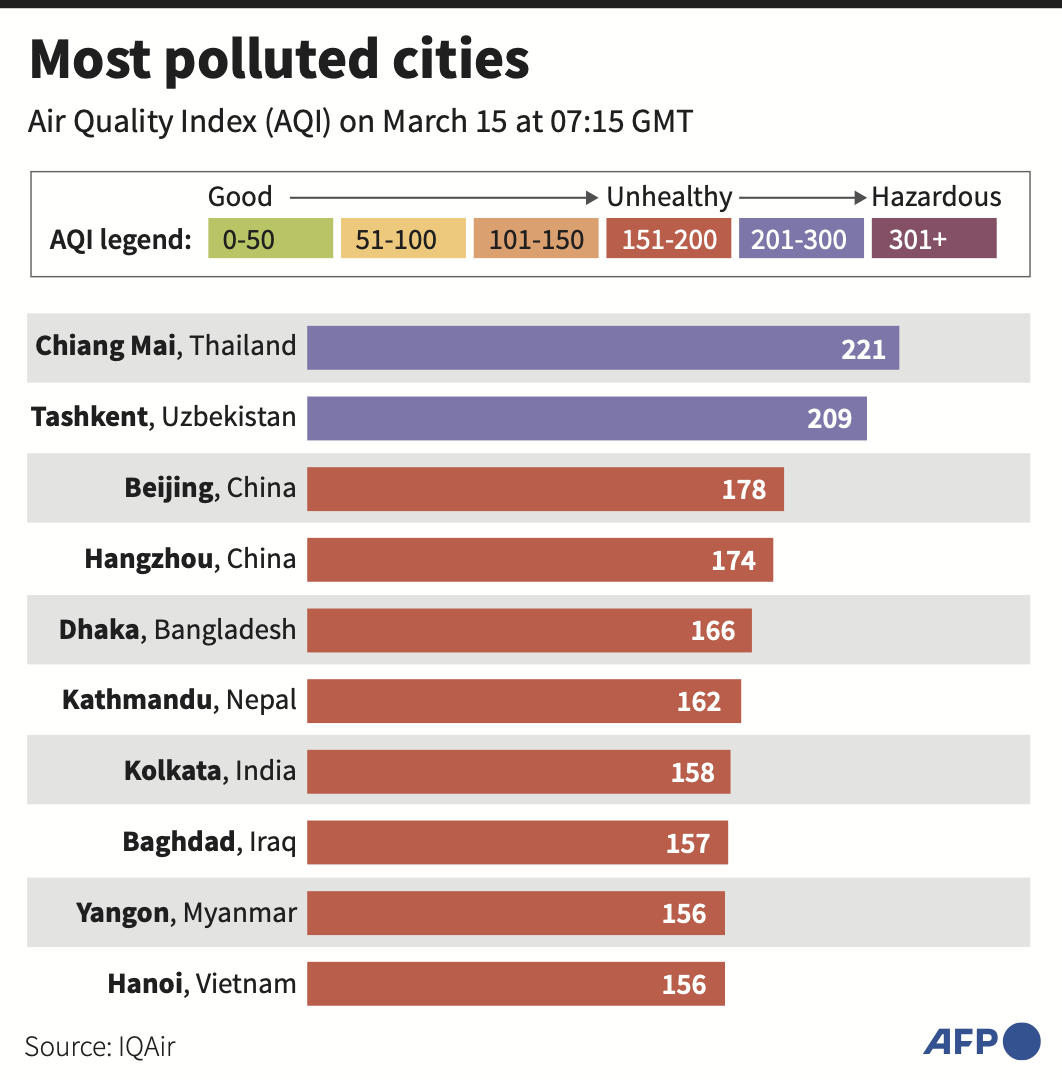
The country's second largest city topped air monitoring website IQAir’s table of the world’s most polluted cities early Friday.
Levels of PM2.5 pollutants — cancer-causing microparticles small enough to enter the bloodstream through the lungs — were classified as “very unhealthy” and hit more than 35 times the World Health Organization’s annual guideline.
“It’s very high. All I have is this mask which is the same one I used for Covid,” orange seller Kamol, 62, told AFP at the city’s Warorot Market.
Thailand’s former prime minister Thaksin Shinawatra, who was recently freed early from a jail sentence for graft and abuse of power following 15 years in self-exile, visited the market on Friday, donning a face mask while he posed for photos with well-wishers.
High levels of pollution frequently hit Thaksin’s hometown of Chiang Mai during the early months of the year when farmers often burn crops to clear land, and forest fires and exhaust fumes also add to the problem.
Rising awareness of the health implications has prompted some action from the government, with Prime Minister Srettha Thavisin’s cabinet approving a Clean Air Act to tackle the issue in January.
The premier is also due to visit later Friday and is expected to meet with organizations tackling forest fires on Saturday.
But Chiang Mai residents — like orange seller Kamol, who sighed and shook his head when asked — said they had received no help.
“I need to get my health checked every year, especially for respiratory diseases,” he said.
A government agency warned this month that more official action was needed, saying at least 10 million people required treatment for pollution-related health problems last year.
“The pollution is always high, especially this time of year,” said 50-year-old Sariya while shopping for groceries in Chiang Mai.
“There is nothing we can do about it since it’s always high.”
Sariya, who gave only one name, also said the city’s location — nestled between hills, trapping the toxic smog — made the situation worse.
But he was “more worried” about people living there with underlying health issues, adding: “We need to help ourselves.”

Last year, sky-rocketing levels of pollution saw international tourists discouraged from visiting, with vendors despairing for business, as the Thai Hotel Association Northern Chapter also warned domestic visitors were canceling bookings.
But in Chiang Mai on Friday, the streets were filled with ambling tourists who seemed unperturbed by the smog.
“I’m not afraid of the pollution,” said 32-year-old Chinese tourist Andy, visiting from Chengdu, who said his country also suffered from poor air pollution.
“I just enjoy the city because it’s very nice.”
French programmer Guillaume Tieufri, 44, said the pollution had not spoilt his four-day trip.
“You just have to go on and live your day.”


New ‘superfood’ transforms livelihoods in India’s rural east

A farmer harvests makhana, or lotus seeds, in Kapchhahi village in India’s eastern state of Bihar. (Mahesh Mukhia)
Updated 08 December 2025
Follow

New ‘superfood’ transforms livelihoods in India’s rural east

  • Known as fox nut or lotus seed, makhana is rich in protein, dietary fiber, minerals
  • Most of the world’s makhana production is in Bihar, one of India’s poorest states

BIHAR: Wading through knee-deep, stagnant water, Mahesh Mukhia plunges his hands into the mud, pulling up handfuls of sludge that he and others toss into a large, partially submerged basket.

After a while, they shake the basket to drain away the water and debris. What remains is makhana — round black seeds that have lately gained popularity as India’s new superfood.

A regional Indian snack, also known as fox nut or lotus seed, makhana is the edible seed of the prickly waterlily. The plant grows in freshwater ponds and wetlands in southern and eastern Asia.

After makhana seeds are handpicked from pond beds, cleaned, and sun-dried, they are roasted at high heat so their hard black shells crack open and release the white, popcorn-like puffed kernels, which are eaten as snacks or used in dishes.

It has long been known for its nutritional value — high in plant-based protein and dietary fiber, the seeds are also rich in minerals and gluten-free — which over the past few years have helped it gain global attention and are transforming farmlands in Bihar, one of India’s poorest states.

“Earlier, people were not researching it but now, after research, makhana’s nutritional values have been highlighted. Now this is a superfood. That’s why demand is growing everywhere,” said Mahesh Mukhia, a farmer in Kapchhahi village in Bihar’s Darbhanga district, whose family has been harvesting the seeds for generations.

“The difference is that my forefathers did farming in a traditional way, but we’ve learnt to do it in a scientific way,” Mukhia told Arab News.

“There is Bhola Paswan Shastri Agricultural College in the neighboring Purnea district. I went there for training. After I started practicing farming the way I learnt, the yield increased by more than 30 percent.”

Makhana farming is highly labor-intensive, starting with the cultivation of water lilies in shallow ponds. The plants require constant monitoring as they are sensitive to water levels and pests.

Harvesting takes place between August and October. Workers pluck the seeds by hand and then dry them under the sun for several days before they can be processed.

The processing and roasting of makhana also require significant effort. The dried seeds are first de-shelled by manually cracking them, followed by multiple rounds of roasting to make them crisp.

Whole families are involved in the production, which has been expanding since 2020, when the state government introduced the Makhana Development Scheme.

Besides training in farming and processing, growers who cultivate fox nut receive $820 per hectare.

“The rate has also gone up. The makhana that we used to sell at 200-300 ($2-$3) rupees per kg is now selling at 1,000 ($12) or 1,500 rupees per kg,” Mukhia said.

“Makhana farmers are now making a profit. Those who are growing makhana are earning well, those who are popping it are also doing well, and those involved in trading are making profits too. We are getting good demand from everywhere. I just received an order for 25 tonnes recently.”

Bihar currently produces over 85 percent of India’s makhana and accounts for most of the world’s production, according to Ministry of Commerce and Industry estimates.

According to reports by the Indian Brand Equity Foundation and the Agricultural and Processed Food Products Export Development Authority, India accounts for roughly 85 to 90 percent of the world’s production.

Farmland where the crop is grown has increased many times over the past decade and can now be compared to the area covering half of New York City.

More than 600,000 people are involved in the makhana industry in Bihar, according to Niraj Kumar Jha, Darbhanga district’s horticulture officer.

“Earlier, we were cultivating 5,000 hectares in the Kosi and Mithlanchal regions. But now it has expanded to 35,000 hectares, and with many supportive schemes, farmers are increasingly encouraged to grow makhana,” he said.

“We are strengthening our marketing channels. We’ll reach the metro cities as well as world markets ... We can see that makhana is growing very popular, not only in India.”