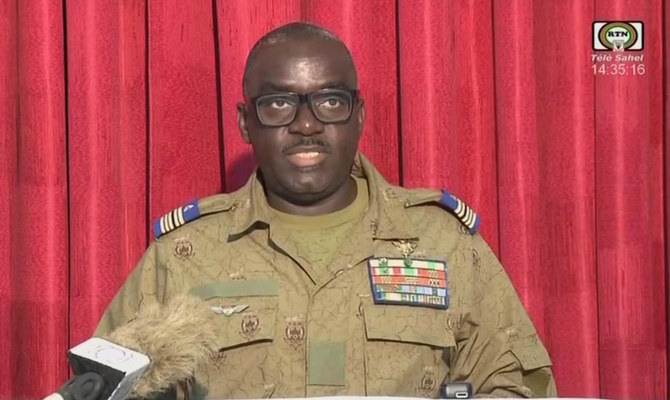
NIAMEY: Niger’s ruling military junta has revoked with immediate effect a military accord that allows military personnel and civilian staff from the US Department of Defense on its soil, junta spokesperson Col. Amadou Abdramane said on Saturday.
The decision follows a visit by US officials this week which was led by Assistant Secretary of State for African Affairs Molly Phee and included General Michael Langley, commander of the US Africa Command.
Abdramane, speaking on television in the West African nation, said the US delegation did not follow diplomatic protocol, and that Niger was not informed about the composition of the delegation, the date of its arrival or the agenda.
He added that the discussions were around the current military transition in Niger, military cooperation between the two countries and Niger’s choice of partners in the fight against militants linked to Al-Qaeda and Islamic State.
Since seizing power in July last year, the Niger junta, like the military rulers in neighboring Mali and Burkina Faso, have kicked out French and other European forces, and turned to Russia for support.
“Niger regrets the intention of the American delegation to deny the sovereign Nigerien people the right to choose their partners and types of partnerships capable of truly helping them fight against terrorism,” Abdramane said
“Also, the government of Niger forcefully denounces the condescending attitude accompanied by the threat of retaliation from the head of the American delegation toward the Nigerien government and people,” he added.
There were about 1,100 US troops in Niger as of last year, where the US military operates out of two bases including a drone base known as Air Base 201, built near Agadez in central Niger at a cost of more than $100 million.
Since 2018 the base has been used to target Daesh militants and Jama’at Nusrat Al-Islam wal Muslimeen (JNIM), an Al-Qaeda affiliate, in the Sahel region.
Abdramane said the status and presence of US troops in Niger was illegal and violated constitutional and democratic rules because, according to the spokesperson, it was unilaterally imposed on the African nation in 2012.
He said Niger was not aware of the number of US civilian and military personnel on its soil or the amount of equipment deployed and, according to the agreement, the US military had no obligation to respond to any request for help against militants.
“In light of all the above, the government of Niger, revokes with immediate effect the agreement concerning the status of United States military personnel and civilian employees of the American Department of Defense on the territory of the Republic of Niger,” Abdramane said.
The US Department of Defense did not immediately respond to a request for comment.


![]()

Niger revokes military accord with US, junta spokesperson says
Short Url
https://arab.news/8dbtu
Niger revokes military accord with US, junta spokesperson says
- There were about 1,100 US troops in Niger as of last year, where the US military operates out of two bases including a drone base known as Air Base 201


Latest updates




© 2026 SAUDI RESEARCH & PUBLISHING COMPANY, All Rights Reserved And subject to Terms of Use Agreement.