

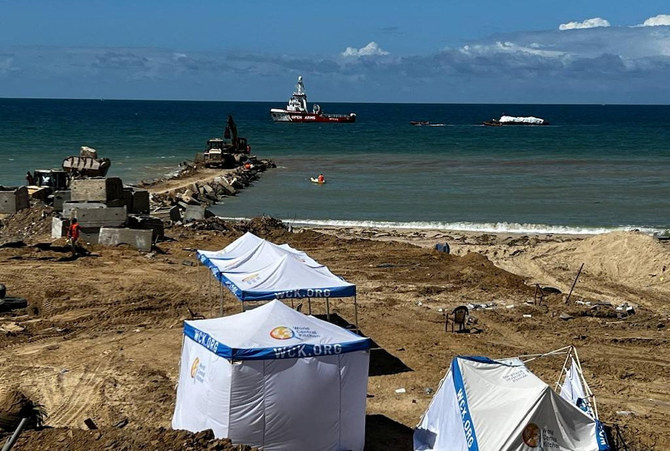


GAZA CITY, Palestinian Territories: A US charity said Saturday its team in war-ravaged Gaza had finished unloading the first maritime aid shipment to reach the besieged territory.
“All cargo was offloaded and is being readied for distribution in Gaza,” World Central Kitchen said in a statement, noting that the aid was “almost 200 tons of food.”
Earlier footage showed the Open Arms, which set sail from Cyprus on Tuesday, towing a barge that the Spanish charity of the same name says is loaded with 200 tons of food for Gazans threatened with famine after more than five months of war.
World Central Kitchen it was readying another boat with supplies of beans, canned meat, flour, rice and dates in the Cypriot port of Larnaca but stressed the need for more road access to bring aid into Gaza.
“Our ambition is having a highway of aid going into Gaza,” the group’s Juan Camilo Jimenez said in a video posted on social media platform X.
#UPDATE
Despite the darkness and difficulties, activity does not stop on the ground in #Gaza to unload the 200 tons of food by @WCKitchen while the @openarms_found team provides support from the water. We witness from the sea the devastation on land. Hopefully, this corridor we… pic.twitter.com/Q8tm0E6NgG— Open Arms ENG (@openarms_found) March 15, 2024
The Israeli military said it had deployed troops to “secure the area” around the jetty while the cargo of aid was unloaded. The “vessel underwent a comprehensive security inspection,” it said.
A spokesman for the Hamas-ruled territory’s health ministry said early on Saturday that 123 people had been killed across Gaza in the past 24 hours, including 36 people in a strike on a house sheltering displaced people in central Nuseirat.
Witnesses reported air strikes and fighting in the southern Gaza Strip’s main city Khan Yunis as well as areas of the north where humanitarian conditions have been particularly dire.
As Muslim worshippers marked the first Friday of the fasting month of Ramadan, thousands attended prayers in the revered Al-Aqsa mosque compound in Israeli-annexed east Jerusalem, amid a heavy security presence and restrictions on entry.
“It’s the first year I see so many forces (police), and their eyes... Two years ago, I could argue with them, but now... they’re giving us no chance,” said Amjad Ghalib, a 44-year-old carpenter.
In southern Gaza’s Rafah, the last major population center yet to be subjected to a ground assault, AFPTV footage showed worshippers praying by the rubble of a destroyed mosque.
The office of Israeli Prime Minister Benjamin Netanyahu said on Friday he had approved the military’s plan for an operation in Rafah, where most of the Gaza Strip’s population has sought refuge, without providing details or a timeline.
The White House, which has said an assault on Rafah would be a “red line” without credible civilian protection plans, said it had not seen the plan approved by Netanyahu.
“We certainly would welcome the opportunity to see it,” National Security Council (NSC) spokesman John Kirby said, adding that the United States could not support any plan without “credible” proposals to shelter more than one million Gazans.
In negotiations aimed at securing a new truce and hostage deal, Hamas has put forward a new proposal for a six-week ceasefire and the exchange of several dozen Israeli hostages for Palestinian prisoners, an official from the militant group told AFP.
Hamas would want this to lead to “a complete (Israeli) withdrawal from the Gaza Strip and a permanent ceasefire,” the official said.
The proposal would involve the release of some 42 hostages, who would be exchanged for Palestinian prisoners at a ratio of between 20 and 50 prisoners per hostage, the official said, down from a previous proposal of roughly 100 to one.
Palestinian militants seized about 250 Israeli and foreign hostages during the Hamas attack of October 7, dozens of whom were released during a week-long truce in November. Israel believes about 130 captives remain in Gaza, including 32 presumed dead.
Israel said it was sending a delegation to Qatar for a new round of negotiations.
The White House said it was “cautiously optimistic” about the chances for a ceasefire but stressed that talks were far from over.
“We’re cautiously optimistic that things are moving in the right direction,” Kirby said, adding that the Hamas proposal was “within the bounds” of what negotiators had been discussing in recent months.
The United States, which provides Israel with billions of dollars in military assistance, has grown increasingly critical of Netanyahu over his handling of the war.
US Senate leader Chuck Schumer called for a snap Israeli election, describing Netanyahu as one of several “major obstacles” to peace in a speech praised by US President Joe Biden.
“I think he expressed serious concern shared not only by him, but by many Americans,” Biden said.
Netanyahu’s right-wing Likud party retorted that Israel was “not a banana republic but an independent and proud democracy.”
The United Nations has repeatedly warned of looming famine, with only a fraction of the supplies needed to sustain Gaza’s 2.4 million people being let in.
With fewer aid trucks entering by road, efforts have multiplied to get relief in by air and sea.
Cyprus, the nearest European Union member country to Gaza, has also said a second, bigger aid vessel is being prepared.
“God willing, they will bring food for the children, that’s all we ask for,” displaced Gazan Abu Issa Ibrahim Filfil told AFPTV.
Hamas’s October 7 attack resulted in about 1,160 deaths in Israel, mostly civilians, according to an AFP tally of official figures.
Israel’s retaliatory campaign against Hamas has killed at least 31,490 people in Gaza, most of them women and children, according to the health ministry.
The ministry on Thursday accused Israeli troops of opening fire from “tanks and helicopters” as Palestinians waited for aid at a roundabout in Gaza City, killing 20 people and wounding dozens.
The Israeli military denied firing on the crowd.
“Armed Palestinians opened fire while Gazan civilians were awaiting the arrival of the aid convoy,” and then “continued to shoot as the crowd of Gazans began looting the trucks,” a military statement said.


