

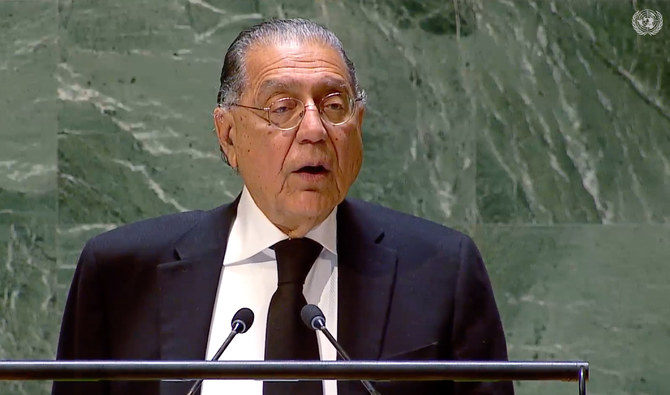
UN adopts Pakistan-led OIC resolution calling for special envoy to combat global Islamophobia

The screengrab taken from the UN Web TV shows Pakistan's Ambassador Munir Akram addressing the 62nd plenary meeting of the 78th UN session in New York, US, on March 15, 2024. (UN Web TV)
Short Url
Updated 16 March 2024
Follow

UN adopts Pakistan-led OIC resolution calling for special envoy to combat global Islamophobia

  • Ambassador Munir Akram says Muslims around the world face discrimination despite global recognition of the problem
  • The Pakistani diplomat says it is ‘evident that bold and decisive actions are needed to counter and combat Islamophobia’

ISLAMABAD: The United Nations General Assembly adopted a resolution on Friday, presented by Pakistan on behalf of the Organization of Islamic Cooperation (OIC), calling for measures to combat Islamophobia that it said regularly manifests itself at both societal and state levels.

The resolution, advocating for the appointment of a special envoy to address the issue, coincided with International Day to Combat Islamophobia, observed on March 15. This date commemorates the anniversary of the Christchurch mosque shootings in New Zealand, where 51 worshippers were killed during Friday prayers.

The initiative to establish a day against Islamophobia was also spearheaded by Pakistan for the OIC and unanimously approved by the 193-member world body in 2022, with support from 55 predominantly Muslim countries.

Pakistan’s chief diplomat at the UN, Ambassador Munir Akram, introduced the follow-up resolution, emphasizing that Muslims globally continued to encounter significant discrimination, despite international acknowledgment of Islamophobia’s prevalence.

“Islamophobia is as old as Islam itself,” he said while addressing the world body. “It was generated by atavistic fears and prejudice. It was manifested by the racist colonization and brutalization of much of the Islamic world in the past few centuries.”

Akram noted the problem became more pronounced after the September 11, 2001, attacks in New York and Washington.

“Despite the General Assembly’s adoption of the resolution on Islamophobia two years ago … the incidents of Islamophobia, of discrimination, prejudice and violence against Muslims and all that they hold sacred have risen exponentially both at the societal and state level,” he continued.

The Pakistani diplomat said Muslims were discriminated against in the immigration policies of various countries and faced travel bans to different parts of the world. He also described the ongoing war in Gaza and the refusal of western countries to call for an immediate ceasefire as manifestations of the same problem.

Akram noted Muslims faced hateful acts like the desecration of the Holy Qur’an, pointing out that seven such incidents had been recorded in last year alone.

“For those who adhere to the principles of inter-religious and inter-cultural harmony, it is entirely evident that bold and decisive actions are needed to counter and combat Islamophobia,” he said. “This is also the purpose of the draft resolution.”

He noted that Muslims did not agree that deliberate acts of burning and desecration of their holy book could be justified in the name of freedom of expression, adding the OIC had also consistently called for the criminalization of such acts.

The Pakistani diplomat said it was important for the UN to appoint a special envoy to tackle the worldwide issue of hatred against Muslims and their religion while highlighting the demand made in the resolution.

Pakistan’s Permanent Mission to the United Nations later announced the success of the resolution in a social media post.

“In a major development,” it said, “the UN General Assembly just adopted the Resolution on ‘Measures to Combat Islamophobia’. The resolution, inter alia, calls for the appointment of the UN Special Envoy to combat Islamophobia. Pakistan facilitated the resolution on behalf of the OIC.”


Pakistan making diplomatic efforts to de-escalate Middle East tensions, FM says

Updated 4 sec ago
Follow

Pakistan making diplomatic efforts to de-escalate Middle East tensions, FM says

  • The statement came as Iran pressed on with a third day of strikes in the Gulf in response to US-Israeli air raids
  • Pakistan’s position is clear that all countries must abide by principles of UN Charter, international law, FM says

ISLAMABAD: Pakistan is making diplomatic efforts to de-escalate heightened tensions in the Middle East, Foreign Minister Ishaq Dar said on Monday, amid US-Israeli strikes on Iran and Tehran’s counterstrikes against US bases in Gulf countries.

Tensions escalated across the Middle East on Saturday after coordinated US-Israel strikes killed Supreme Leader Ali Khamenei among other senior Iranian officials. Tehran responded by targeting US military bases in the UAE, Bahrain, Qatar, Kuwait and Jordan. Saudi Arabia said Iran also launched attacks targeting Riyadh and the Eastern Province.

The Iranian missile and drone strikes continued on Monday in retaliation for the ongoing US-Israeli air raids, casting uncertainty over the future of the Islamic republic and heightening the risk of broader instability in the already volatile region.

Speaking at a press conference, FM Dar, who recently returned from Saudi Arabia where he attended an Organization of Islamic Cooperation OIC) meeting on Palestine, said Pakistan is very closely monitoring the evolving situation in Iran and the tensions which are building up in the region.

“These serious developments have taken place at a time when diplomatic efforts were underway to reach a peaceful and negotiated solution to [Iran nuclear program],” he said.

“We are making our full diplomatic efforts and, you know, requesting all parties to de-escalate and to refrain.”

Dar said Islamabad was concerned over a violation of the norms and international law, and the age-old tradition that the heads of state and the government should not be targeted.

“Post-World War II, we all know that these institutions were created to create some international, you know, law and order, and that’s why there was a UN Charter. There are certain conventions which we all are supposed to follow,” he said.

“But things are on ground moving very differently, which obviously is worrisome... The international law must prevail and the conventions must be respected.”

The statement came hours after the Ras Tanura oil refinery in Saudi Arabia sustained limited damage as a result of debris from the interception of two drones in its vicinity, the Saudi Press Agency reported, citing an official source at the Saudi Ministry of Energy.

Several American warplanes crashed in Kuwait on Monday morning but their crew survived, Kuwait’s defense ministry said, as Iran pressed on with a third day of strikes in the Gulf.

Dar said Pakistan’s position has been clear and persistent that all countries must abide by the principles of UN Charter and international law, including respect for the sovereignty and territorial integrity of other states as well as international humanitarian law.

“In my latest conversation with [Iranian] Foreign Minister Abbas Araqshi on 28th of February, I conveyed Pakistan’s condemnation of the attacks and called for restraint and diplomacy and dialogue, which he positively responded,” he shared.

“But on ground, we are seeing that things are not yet settling or easing out.”

Pakistan stands in full solidarity with all its brotherly countries and underscores the need to exercise maximum restraint, according to FM Dar.

“This is a message we have been giving to whosoever prime minister speaks, whosoever I speak, or whosoever Field Marshal Asim Munir speaks to, his counterparts on the defense side,” he said.