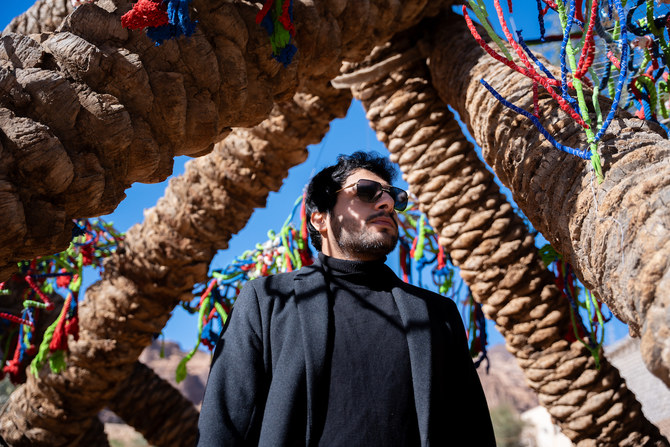

DUBAI: Saudi conceptual artist Obaid Alsafi was born in 1991 in Wadi Ad-Dawasir, which he describes as an intersection of the vast desert and green farms.
“There was a contradiction, and through that contradiction it was as if I was seeing day and night,” Alsafi, who is now based in Riyadh, tells Arab News. “I understand that this contradiction enriches a person: You can’t appreciate light without darkness, and vice versa.”
At the time Alsafi was growing up, Saudi universities did not offer art programs. So, he decided to study another field that he was interested in: Computer science. And that specialty also feeds into his practice today.
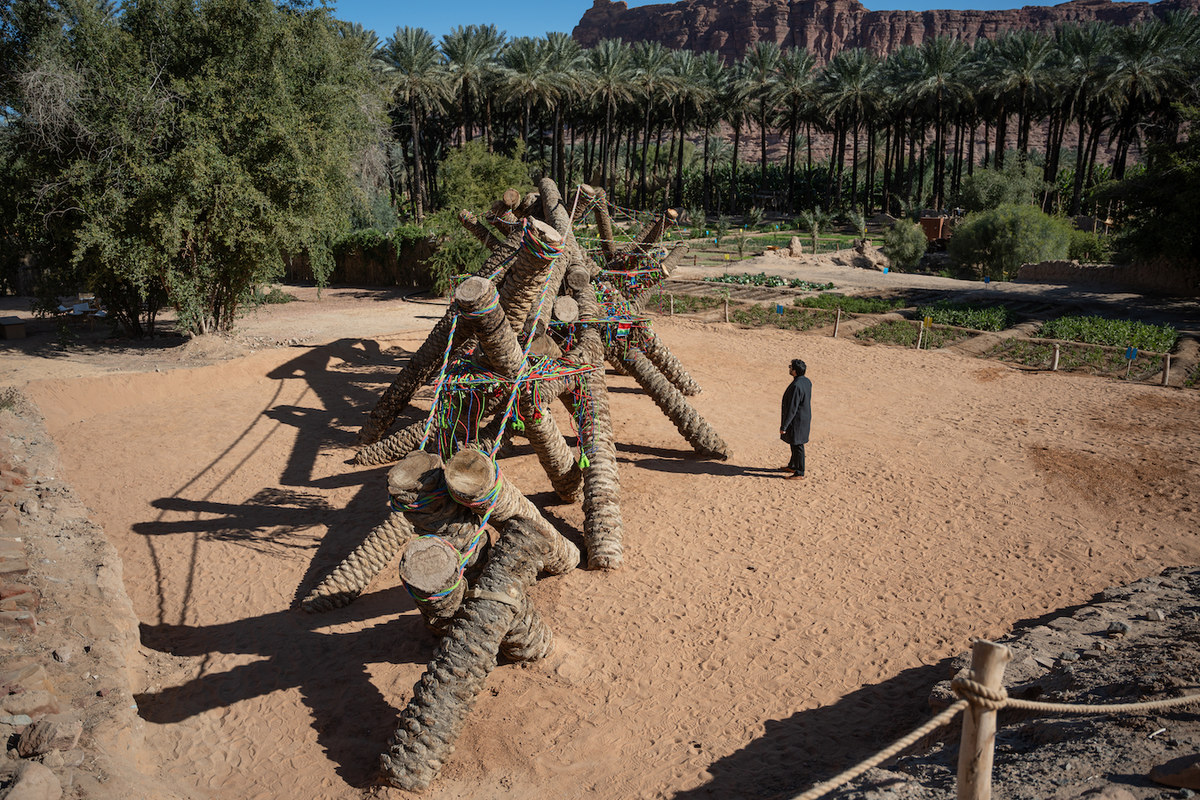
'Palms in Eternal Embrace' by Obaid Alsafi at the AlUla Arts Festival. (Supplied)
“I think artificial intelligence and technology are an extension of human beings,” says Alsafi. “It’s a natural thing. It shouldn’t incite fear or astonishment. What makes the difference is whether a person interacts with technology positively or negatively. I’m open to these ideas, and I don’t have any fear entering this world.”
Artists often have their parents to thank for nurturing their creative inclinations. But for Alsafi, even though his father was an art teacher, his artistic journey actually began with his grandmother. Alsafi calls her Al-Hanna (which, roughly translated, means ‘the affectionate one’). She came from “a bedouin environment, where there wasn’t great appreciation for art and beauty,” he says. She could not read or write but used images to express herself, and her unique character has left a mark on him.
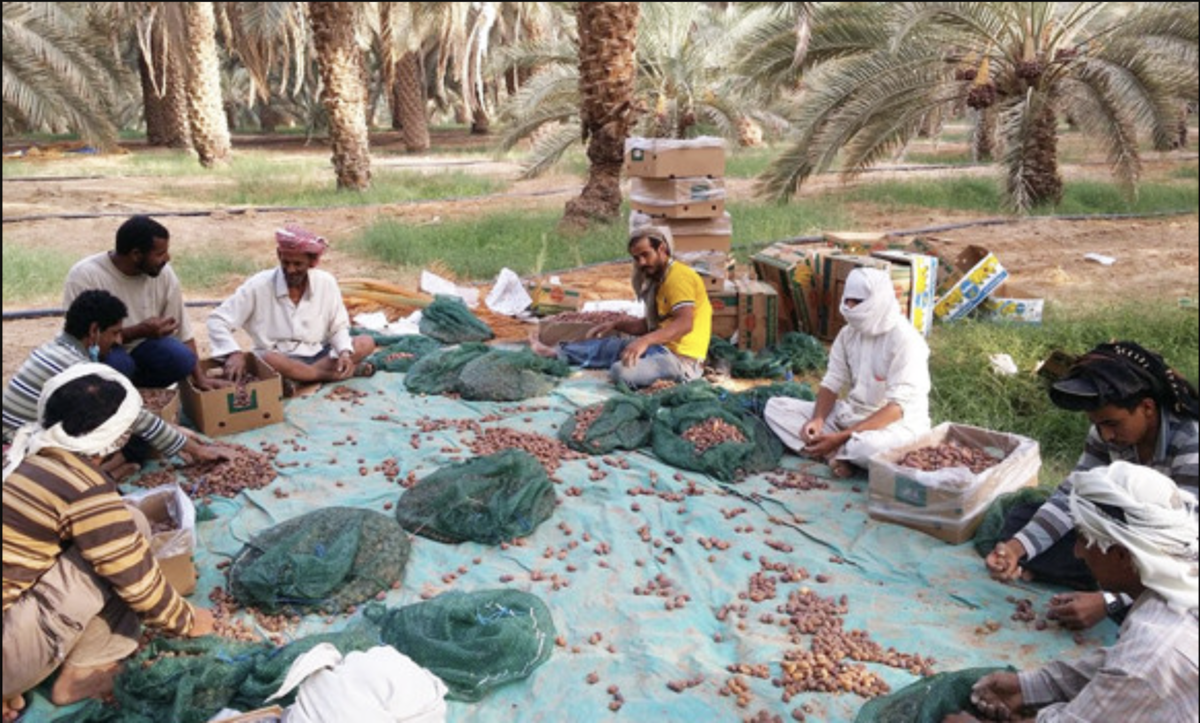
Farmers harvesting dates in Wadi Ad-Dawasir, where Obaid Alsafi was born. (SPA)
“My grandfather was away on business in Kuwait a lot, so didn’t often come to the valley,” he says. “When he did come, she would paint their bedroom walls to celebrate his return; she expressed her happiness and love through painting.” Through his anecdotes, it is clear that Alsafi has a deep respect for his elders, tradition, and heritage — especially the palm tree.
“Imagine speaking with your grandfather and he tells you, ‘The palm tree is really precious.’ He nurtures it, from morning until night, taking care of it and eating its dates,” Alsafi says. “The palm tree is the origin of our wealth.”
The palm tree remains a vital part of Saudi culture. And it is the main inspiration behind Alsafi’s latest installation “Palms in Eternal Embrace,” which was unveiled during the recent AlUla Arts Festival. The proposal for this large-scale work won Alsafi the sixth edition of the $100,000 Ithra Art Prize.
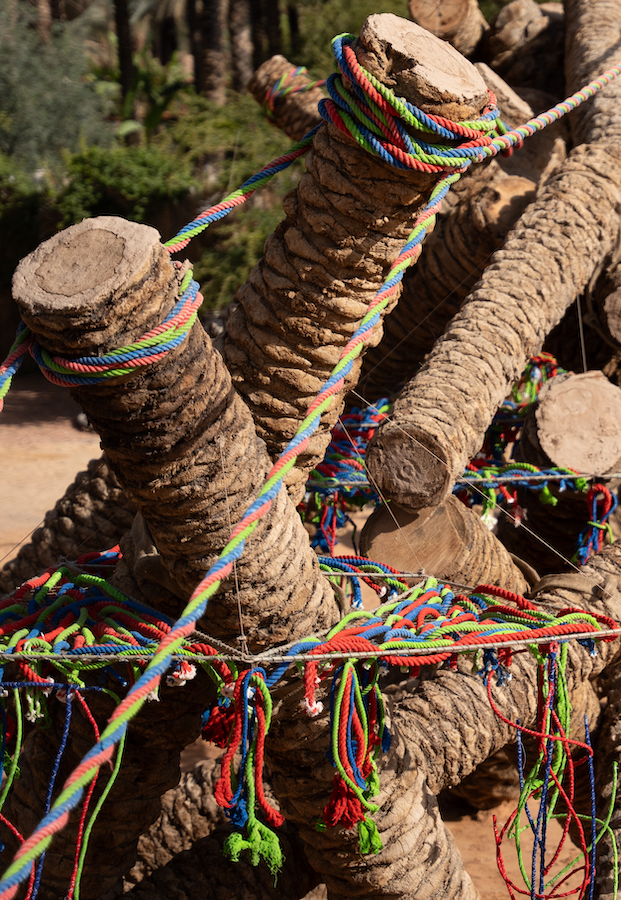
Detail from 'Palms in Eternal Embrace' by Obaid Alsafi. (Supplied)
According to the artist, the installation resembles a boat. It is made up of a complex network of 33 old palm tree trunks that are bound together using colorful ropes. The idea came to him during his residency in South Korea, where he isolated himself in a large studio, overlooking a park, for three months.
“I didn’t speak to anyone,” he recalls. “My only routine was contemplating and reading. The view from the studio reminded me of the Wadi and our farms. In this isolation, I even heard the sound of trees.” The view got him thinking: What if all of this greenery disappeared one day?
Alsafi believes that palm trees are under threat due to rising temperatures and other environmental concerns. His installation is an ode to the palm tree, punctuated with an element of urgency.
“Its hidden message is that I don’t want it to turn into a boat, with the trees moving away to another land because of climate change,” says Alsafi. “I want us to preserve our palm trees. . . As a symbol, the palm tree is important. We grew up with it. For me, the idea of the palm tree becoming extinct is a scary thought. I can’t stand it, because it gave us so much. It was the beginning for us.”
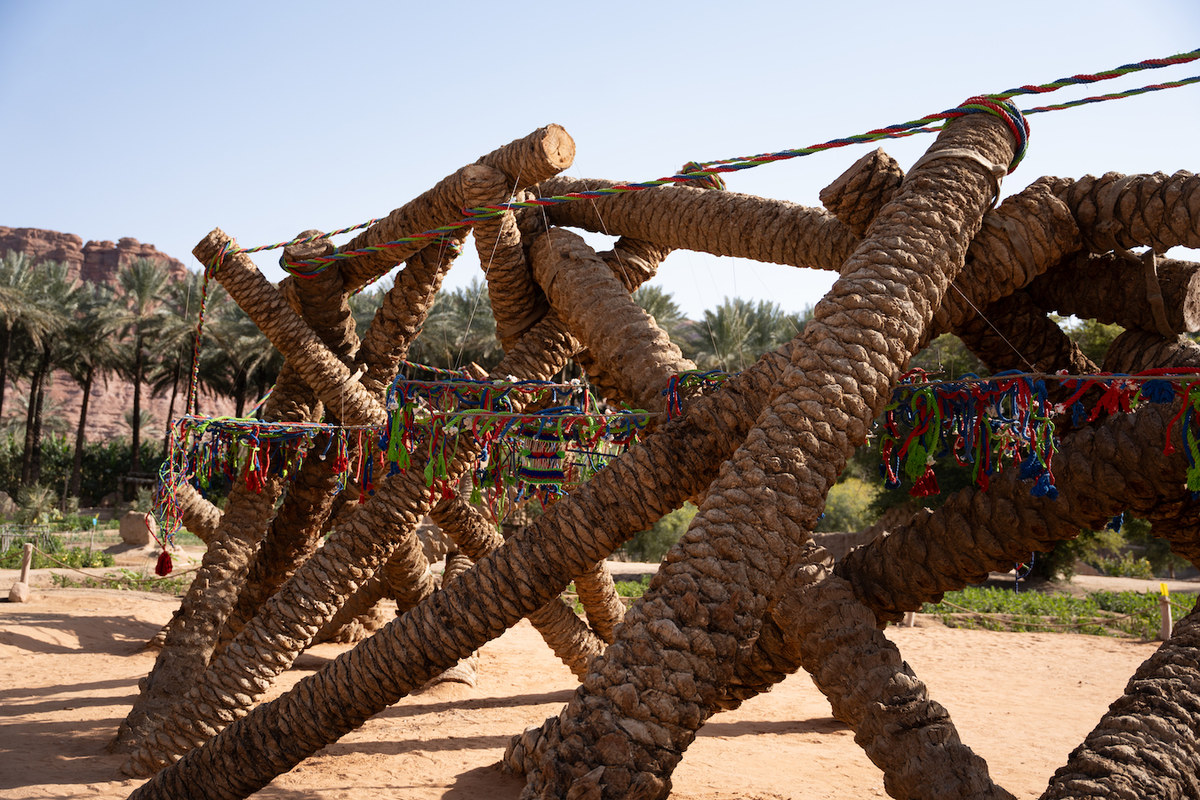
Palms in Eternal Embrace by Obaid Alsafi, winner of the 6th edition of the Ithra Art Prize in collaboration with Arts AlUla, at the AlUla Arts Festival. (Supplied)
The installation began with a simple sketch, which was meant to resemble a neural network diagram. As the project got bigger, he assembled a team of 63 individuals to help him with documenting, 3D drawing, transporting and installing. Some of the used palm trees from his grandfather’s farm had blackened and were more than 100 years old. They were later medically treated.
“The idea was that, instead of throwing them out, I returned them to their natural location, to their safe place — a farm,” he says of setting up the installation in AlUla, known for its abundance of palm trees. “From the first day I saw AlUla, with its palm trees and oases, I felt like I was in a dream. I’m still amazed and I want that dream to repeat itself every day.”
The trunks’ interiors were carved out to make handling easier. “I used 33 palm trees and I know each and every one of their stories,” Alsafi says.
When the piece — which will be moved to the Ithra Museum in Dhahran — was officially unveiled to the public, several people decided to climb it. But Alsafi’s favorite reactions came from children during the instalment process. The kids were eager to learn more about his work.
“They asked me many questions, which really affected me. And they had nothing to do with art, but they were amazed by it,” says Alsafi.
“The artist’s job is to elicit amazement,” he continues. “It’s also our duty to raise people’s awareness about the importance of the environment and preserving it.”