

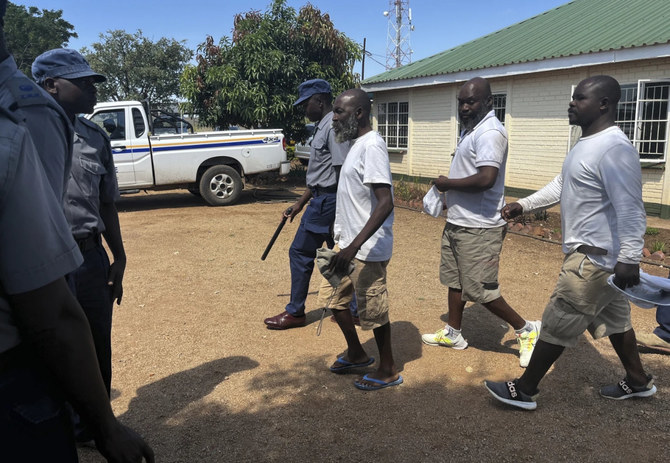

NORTON, Zimbabwe: A man calling himself a prophet was charged in a Zimbabwean court Thursday after police raided the compound where he led a religious sect and found more than 250 children being kept away from school and used as cheap labor.
Police also discovered 16 unregistered graves, including those of seven infants, at the farm about 34 kilometers (21 miles) northwest of the capital, Harare.
Ishmael Chokurongerwa and seven of his aides were charged with exploiting children and denying them access to education and health services. Police spokesman Paul Nyathi said investigations were still ongoing and authorities may press more charges.
The sect leaders are also accused of breaking laws that require deaths and burials to be registered. State media reported there were around 1,000 people living on the farm before the raid.
Chokurongerwa, 56, and his aides will remain in custody after a magistrate said at their court hearing that she would rule on their bail application next week. None of the men had legal representation at the hearing and it was unclear where they were being held.
The men pleaded with the magistrate to release them on bail, saying they were not violent people and had children to look after who would suffer if they were sent to prison.
Some of Chokurongerwa’s followers traveled to the court hearing in the nearby town of Norton to show support for him.
“Come rain, come thunder, we will follow our God,” said Tabeth Mupfana, a 34-year-old woman who said she was born into the sect when it was at another location and had not experienced any abuse. “We will never leave our religion. We are like an elephant, nothing can stop us. All those people fighting us are merchants of Satan.”
A man who lives near the farm said it was run like a factory, producing soap, cooking oil and furniture for sale, while the sect also grew crops and kept livestock.
Armed police officers with tear gas and dogs arrived on the farm Tuesday in trucks. They found 251 children who “were being used to perform various physical activities for the benefit of the sect’s leadership,” said Nyathi. He said 246 of the children had no birth certificates.
They “were subjected to abuse as cheap labor, doing manual work in the name of being taught life skills,” Nyathi said.
Police returned to the farm Wednesday with social workers and rounded up children and women, many of them with infants, and took them on buses to a shelter.
The sect is believed to be one of Zimbabwe’s many Apostolic Christian groups, whose followers are noticeable by their long white robes, with women and girls also wearing white headscarves. The Apostolic groups fuse traditional beliefs with a Pentecostal doctrine. Some are reclusive and shun modern medicine, keep children away from school and practice polygamy.
They sometimes seek healing for illnesses through prayer and the use of holy water and anointed stones.
Apostolic churches are highly popular in Zimbabwe, with the United Nations Children’s Fund estimating they are the country’s largest religious denomination with around 2.5 million followers in a country of 15 million.
At the farm on Thursday, mostly men remained, sitting in small groups and all wearing matching white T-shirts and khaki shorts. They declined to give their names.
One man said: “We are different, but we are not weird. We just have our own beliefs that come directly from God and not from scripture. Human rights are applied selectively in this country. Some of us don’t have any rights.”
Another criticized the police action.
“We are not a cult, we are here freely,” he said. “I have never seen such cruelty. Police dragged our wives and children into buses like criminals.” He said the group was made up of hard-working people who took care of themselves.
Other men carried on with their work in small buildings dotted around the farm, some of them welding steel and others milling corn.
Edmore Kwesa said he lived near the farm and learned a little about their ways by speaking with sect members who took the prophet’s cattle to graze on communal grasslands. He said the group was reclusive but “industrious.”
“It is like a mini-factory there,” he said. “They produce soap, cooking oil, furniture, crops and the livestock is so many. But no one gets paid. Instead, each member requests supplies from the prophet, who distributes according to need.”
The sect sold their products at a local business center, while people from outside could also purchase items directly from the farm, he said.
“When one of them dies, they just bury each other there without involvement from anyone outside their sect,” he said.


