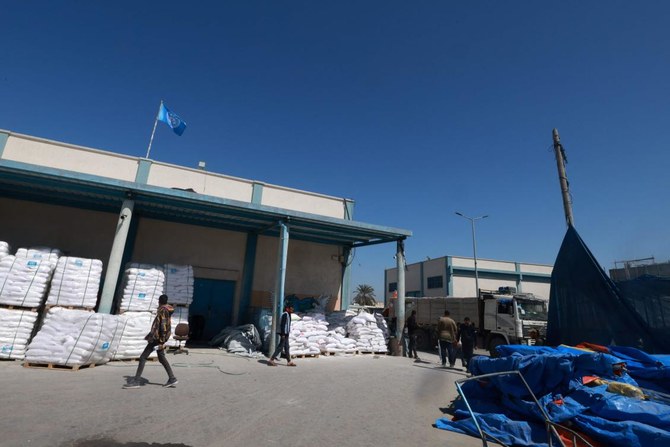
GAZA STRIP, Palestinian Territories: Efforts mounted on Thursday to get more aid into the war-devastated Gaza Strip, where the UN warns of famine and desperate residents have stormed relief convoys.
After mediators failed to reach a truce between Israel and Hamas for the Muslim holy month of Ramadan, which started Monday, fighting continued with at least 69 deaths over the previous 24 hours, the Hamas-run territory’s health ministry said.
Hamas authorities reported more than 40 air strikes across Gaza, from Beit Hanoun in the north to Rafah in the south, where most of Gaza’s population has sought refuge and Israel is threatening a ground assault.
Israeli Prime Minister Benjamin Netanyahu on Thursday doubled down on pledges to invade Rafah, saying: “There is international pressure to prevent us from entering Rafah and completing the job.
“I will continue to repel the pressures and we will enter Rafah... and bring complete victory to the people of Israel,” he said during a visit to a field intelligence base.
Around 1.5 million Palestinians have sought refuge along Gaza’s southern border with Egypt in Rafah.
Israeli military spokesman Daniel Hagari said late Wednesday that a “significant” number of them would need to be moved “to a humanitarian island that we will create with the international community.”
The Israeli military said on Thursday it was “raiding Hamas’s hideouts and military strongholds” in southern Gaza’s main city of Khan Yunis.
“During a search in the area, the forces located several weapons in a bedroom under a bed, including missiles and explosives. Following the searches in the area, the forces located a rocket launcher and missiles near a school and destroyed it.”
Gaza’s health ministry said seven people were killed when Israeli troops opened fire at an aid distribution point near Gaza City. The army had no immediate comment.
In central Israel, police said a Gaza-raised Palestinian had stabbed a soldier in a shopping center, who had shot his attacker dead before later dying from his injuries.
The war began on October 7 when Hamas militants attacked Israel, resulting in about 1,160 deaths, mostly civilians, according to an AFP tally of official figures.
Israel has carried out a relentless campaign of bombardment and ground operations in Gaza, killing at least 31,341 people, most of them civilians, according to the territory’s health ministry.
Hamas militants also seized about 250 Israeli and foreign hostages, dozens of whom were released during a week-long truce in November. Israel believes about 130 of the captives remain in Gaza and that 32 are dead.
Activists and families of Israeli hostages kept up pressure for their negotiated release, again blocking a Tel Aviv highway in protest on Thursday.
And in a sign of mounting US exasperation with the Netanyahu, US Senate leader Chuck Schumer called for a snap election in Israel, describing the veteran hawk as one of a number of “major obstacles” to a two-state solution and peace.
Palestinian president Mahmud Abbas appointed Mohammed Mustafa, a long-trusted adviser on economic affairs, as prime minister, three weeks after his predecessor resigned.
Washington and other powers have called for a reformed Palestinian Authority to take charge of all Palestinian territories after the end of the war.
US, Egyptian and Qatari mediators failed to broker a new truce in time for Ramadan, but Netanyahu said Thursday there was now “Qatari pressure on Hamas.”
“As of this moment, there has been no real response from Hamas. They are still clinging to unacceptable demands,” he told representatives of hostages’ families.
“As a result of our pressure... and also with your help, we are seeing — for the first time — Qatari pressure on Hamas.”
The war has resulted in severe shortages of medical supplies across Gaza, with only a fraction of hospitals partially functioning.
World Health Organization chief Tedros Adhanom Ghebreyesus said aid had been delivered to Al-Aqsa hospital in central Gaza, but said it was “struggling with water, sanitation, hygiene and waste management.”
“Two of the hospital’s warehouses are no longer functional and are being used to shelter 7,000 displaced people,” he added.
The Spanish aid vessel Open Arms, pulling about 200 tons of food, was nearing Israel’s coast after departing Cyprus on Tuesday, the Marinetraffic website showed on Thursday.
Cypriot Foreign Minister Constantinos Kombos said a second, bigger vessel was being readied for the aid corridor which, senior US officials have said, will be complemented by a temporary pier off Gaza to be built by American troops.
Daily aid airdrops by multiple countries have been taking place this month, and Germany said it would join the effort.
But the air and sea missions are “no alternative” to land deliveries, 25 organizations including Amnesty International and Oxfam said in a statement.
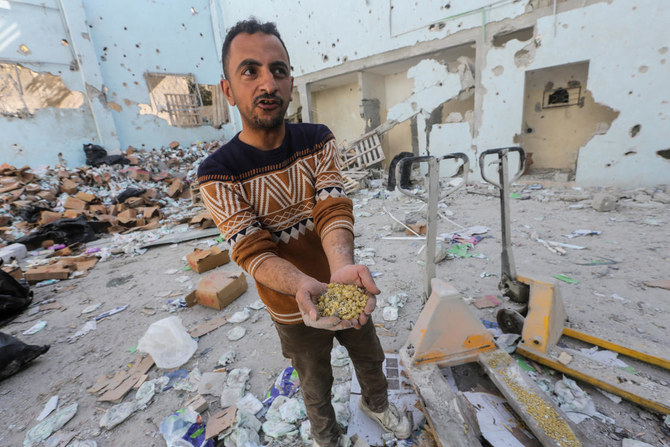
Dire shortages have left many scrambling for scraps of aid, among them Mokhles Al-Masry, 27, who was displaced from Beit Hanoun to Beit Lahia in northern Gaza.
“There is no food, nothing to feed our children. We can’t even find a bottle of baby milk. We’ve been wandering around since early morning, hoping that a plane would drop parachutes,” he said.
“As you can see, these parachutes don’t cover one percent of people’s needs.”
Amnesty’s secretary general, Agnes Callamard, said the international community seemed to have accepted that the war will drag on.
“Why are you making an investment that is going to take two months?” she asked, referring to the Pentagon’s timeline for setting up the temporary pier which, it said, could enable the provision of more than two million meals a day.

Aid efforts intensify for famine-stalked Gaza
Short Url
https://arab.news/v3nwn
Aid efforts intensify for famine-stalked Gaza
- The war has resulted in severe shortages of medical supplies across Gaza, with only a fraction of hospitals partially functioning
- WHO chief Tedros Adhanom Ghebreyesus said aid had been delivered to Al-Aqsa hospital in central Gaza
First Ramadan after truce brings flicker of joy in devastated Gaza
- Ramadan lanterns and string lights appear on streets lined with collapsed buildings and piles of rubble in Gaza City
- The first holy month since the October ceasefire brings mixed feelings for the many still living in tents
GAZA CITY: Little Ramadan lanterns and string lights appeared on streets lined with collapsed buildings and piles of rubble in Gaza City, bringing joy and respite as Islam’s holiest month began — the first since October’s ceasefire.
In the Omari mosque, dozens of worshippers performed the first Ramadan morning prayer, fajr, bare feet on the carpet but donning heavy jackets to stave off the winter cold.
“Despite the occupation, the destruction of mosques and schools, and the demolition of our homes... we came in spite of these harsh conditions,” Abu Adam, a resident of Gaza City who came to pray, told AFP.
“Even last night, when the area was targeted, we remained determined to head to the mosque to worship God,” he said.
A security source in Gaza told AFP Wednesday that artillery shelling targeted the eastern parts of Gaza City that morning.
The source added that artillery shelling also targeted a refugee camp in central Gaza.
Israel does not allow international journalists to enter the Gaza Strip, preventing AFP and other news organizations from independently verifying casualty figures.
‘Stifled joy’
In Gaza’s south, tens of thousands of people still live in tents and makeshift shelters as they wait for the territory’s reconstruction after a US-brokered ceasefire took hold in October.
Nivin Ahmed, who lives in a tent in the area known as Al-Mawasi, told AFP this first Ramadan without war brought “mixed and varied feelings.”
“The joy is stifled. We miss people who were martyred, are still missing, detained, or even traveled,” she said.
“The Ramadan table used to be full of the most delicious dishes and bring together all our loved ones,” the 50-year-old said.
“Today, I can barely prepare a main dish and a side dish. Everything is expensive. I can’t invite anyone for Iftar or suhoor,” she said, referring to the meals eaten before and after the daily fast of Ramadan.
Despite the ceasefire, shortages remain in Gaza, whose battered economy and material damage have rendered most residents at least partly dependent on humanitarian aid for their basic needs.
But with all entries into the tiny territory under Israeli control, not enough goods are able to enter to bring prices down, according to the United Nations and aid groups.
‘Still special’
Maha Fathi, 37, was displaced from Gaza City and lives in a tent west of the city.
“Despite all the destruction and suffering in Gaza, Ramadan is still special,” she told AFP.
“People have begun to empathize with each other’s suffering again after everyone was preoccupied with themselves during the war.”
She said that her family and neighbors were able to share moments of joy as they prepared food for suhoor and set up Ramadan decorations.
“Everyone longs for the atmosphere of Ramadan. Seeing the decorations and the activity in the markets fills us with hope for a return to stability,” she added.
On the beach at central Gaza’s Deir el-Balah, Palestinian artist Yazeed Abu Jarad contributed to the holiday spirit with his art.
In the sand near the Mediterranean Sea, he sculpted “Welcome Ramadan” in ornate Arabic calligraphy, under the curious eye of children from a nearby tent camp.
Nearly all of Gaza’s 2.2 million residents were displaced at least once during the more than two years of war between Israel and Hamas, sparked by the latter’s unprecedented October 7 attack on Israel.
Mohammed Al-Madhoun, 43, also lives in a tent west of Gaza City, and hoped for brighter days ahead.
“I hope this is the last Ramadan we spend in tents. I feel helpless in front of my children when they ask me to buy lanterns and dream of an Iftar table with all their favorite foods.”
“We try to find joy despite everything,” he said, describing his first Ramadan night out with the neighbors, eating the pre-fast meal and praying.
“The children were as if they were on a picnic,” he said.
In the Omari mosque, dozens of worshippers performed the first Ramadan morning prayer, fajr, bare feet on the carpet but donning heavy jackets to stave off the winter cold.
“Despite the occupation, the destruction of mosques and schools, and the demolition of our homes... we came in spite of these harsh conditions,” Abu Adam, a resident of Gaza City who came to pray, told AFP.
“Even last night, when the area was targeted, we remained determined to head to the mosque to worship God,” he said.
A security source in Gaza told AFP Wednesday that artillery shelling targeted the eastern parts of Gaza City that morning.
The source added that artillery shelling also targeted a refugee camp in central Gaza.
Israel does not allow international journalists to enter the Gaza Strip, preventing AFP and other news organizations from independently verifying casualty figures.
‘Stifled joy’
In Gaza’s south, tens of thousands of people still live in tents and makeshift shelters as they wait for the territory’s reconstruction after a US-brokered ceasefire took hold in October.
Nivin Ahmed, who lives in a tent in the area known as Al-Mawasi, told AFP this first Ramadan without war brought “mixed and varied feelings.”
“The joy is stifled. We miss people who were martyred, are still missing, detained, or even traveled,” she said.
“The Ramadan table used to be full of the most delicious dishes and bring together all our loved ones,” the 50-year-old said.
“Today, I can barely prepare a main dish and a side dish. Everything is expensive. I can’t invite anyone for Iftar or suhoor,” she said, referring to the meals eaten before and after the daily fast of Ramadan.
Despite the ceasefire, shortages remain in Gaza, whose battered economy and material damage have rendered most residents at least partly dependent on humanitarian aid for their basic needs.
But with all entries into the tiny territory under Israeli control, not enough goods are able to enter to bring prices down, according to the United Nations and aid groups.
‘Still special’
Maha Fathi, 37, was displaced from Gaza City and lives in a tent west of the city.
“Despite all the destruction and suffering in Gaza, Ramadan is still special,” she told AFP.
“People have begun to empathize with each other’s suffering again after everyone was preoccupied with themselves during the war.”
She said that her family and neighbors were able to share moments of joy as they prepared food for suhoor and set up Ramadan decorations.
“Everyone longs for the atmosphere of Ramadan. Seeing the decorations and the activity in the markets fills us with hope for a return to stability,” she added.
On the beach at central Gaza’s Deir el-Balah, Palestinian artist Yazeed Abu Jarad contributed to the holiday spirit with his art.
In the sand near the Mediterranean Sea, he sculpted “Welcome Ramadan” in ornate Arabic calligraphy, under the curious eye of children from a nearby tent camp.
Nearly all of Gaza’s 2.2 million residents were displaced at least once during the more than two years of war between Israel and Hamas, sparked by the latter’s unprecedented October 7 attack on Israel.
Mohammed Al-Madhoun, 43, also lives in a tent west of Gaza City, and hoped for brighter days ahead.
“I hope this is the last Ramadan we spend in tents. I feel helpless in front of my children when they ask me to buy lanterns and dream of an Iftar table with all their favorite foods.”
“We try to find joy despite everything,” he said, describing his first Ramadan night out with the neighbors, eating the pre-fast meal and praying.
“The children were as if they were on a picnic,” he said.
© 2026 SAUDI RESEARCH & PUBLISHING COMPANY, All Rights Reserved And subject to Terms of Use Agreement.